


The government has begun to requisition COVID-19 rapid test kits, with an aim to distribute 40 million kits each month to meet public demand, Premier Su Tseng-chang (蘇貞昌) said yesterday.
Su made the remarks at the weekly Cabinet meeting amid calls by opposition lawmakers to regulate the supply of rapid tests and keep prices down.
In addition to requisitioning kits from domestic and overseas manufacturers, the armed forces also are to help with domestic production, Su said.
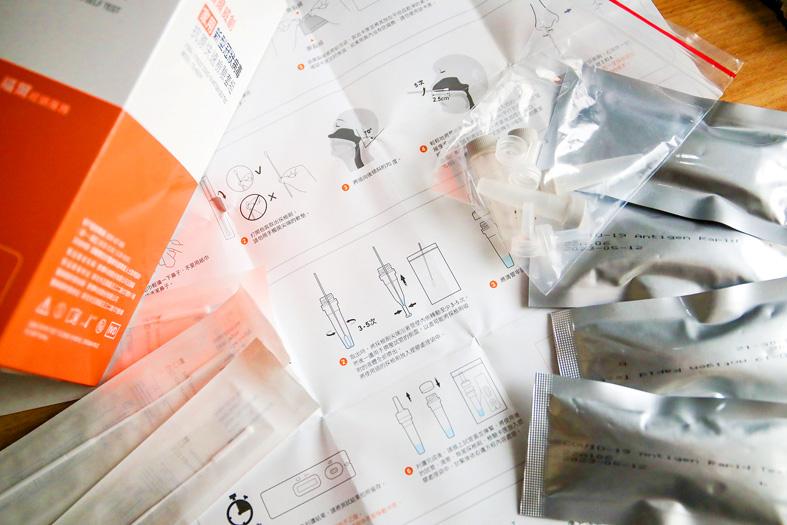
Photo: CNA
The need for the kits increased as local COVID-19 cases have increased since the Tomb Sweeping Day long weekend early this month, he said.
However, case numbers have not risen exponentially and 99.6 percent of people with the disease have mild or no symptoms, he said.
Rapid tests are being used instead of polymerase chain reaction (PCR) tests and disease prevention measures would be adjusted based on the pandemic situation, he said.
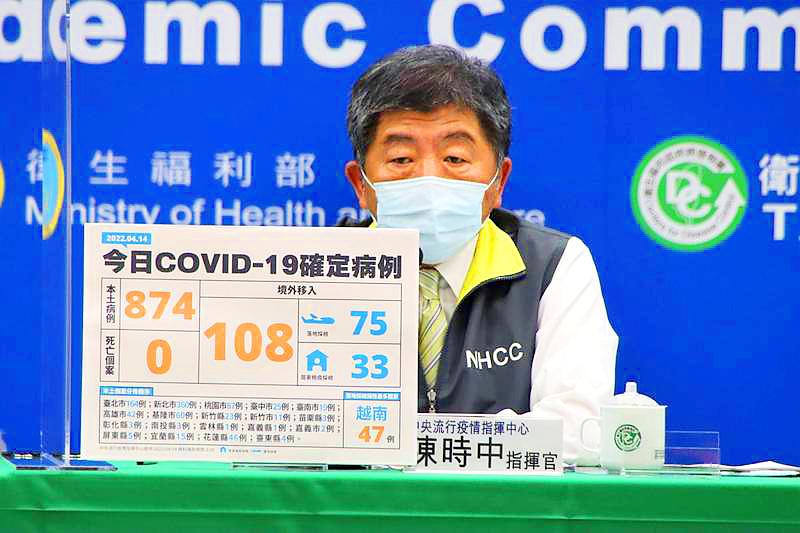
Photo courtesy of the Central Epidemic Command Center
Su encouraged people to lead a normal life while practicing disease prevention measures, adding that Taiwan should be more tenacious, and strive to balance economic development and pandemic control.
In response to complaints that rapid test kits, which cost more than NT$300 each, are too expensive in Taiwan compared with the international average, Minister of Health and Welfare Chen Shih-chung (陳時中), who heads the Central Epidemic Command Center (CECC), said the government is to propose solutions to the problem in a few days.
Rapid test kits are available at stores, and those for people in isolation or quarantine, or in high-risk communities would be provided by the government, Chen said.
The government would introduce rapid test kit rationing, which would allow people to purchase them at a cheaper rate by registering with their National Health Insurance card, Centers for Disease Control Director-General Chou Jih-haw (周志浩) said.
Taiwan yesterday reported 874 new domestic COVID-19 cases, breaking its daily record for the second consecutive day, CECC data showed.
There were 108 new imported cases reported, the data showed.
Most of the new infections are either mild or asymptomatic, the CECC said.
New Taipei City reported the most domestic cases, with 360, followed by Taipei with 164, Taoyuan with 87 and Keelung with 60, it said.
Hualien County recorded 46 cases, Kaohsiung 42, Taichung 25, Hsinchu County 23, Tainan 19, Yilan County 15 and Hsinchu City 11, it said.
Pingtung County reported five cases, Taitung County had four, and Nantou, Changhua and Miaoli counties each recorded three.
Chiayi City reported two cases, and Yunlin and Chiayi counties reported one each, the data showed.
The 874 new domestic cases yesterday was up from 744 the previous day, which broke the previous one-day high of 720 on May 22 last year, the CECC said.
Of the 5,670 domestic COVID-19 cases recorded nationwide this year through Wednesday, 17 were classified as moderate infections and two as severe, while the rest, or 99.66 percent, were either mild or asymptomatic, the CECC said.
The CECC said that one person who tested positive on April 2 had developed a moderate infection and his oxygen levels had dropped.
The patient, a Taiwanese man in his 60s, was unvaccinated, the CECC said, adding that he is now in stable condition in hospital.
In Hualien, all elementary and junior-high school classes were suspended today as a preventive measure, as several cases at a local hospital had not been counted, Hualien County Commissioner Hsu Chen-wei (徐榛蔚) said yesterday.
The county would also introduce the home isolation scheme adopted by the CECC that was trialed this week in New Taipei City.
Under the scheme, people aged 65 or younger who are not pregnant and not undergoing dialysis who have been ordered to isolate can do so at home.
Additional reporting by Wang Chun-chi

The nation’s fastest supercomputer, Nano 4 (晶創26), is scheduled to be launched in the third quarter, and would be used to train large language models in finance and national defense sectors, the National Center for High-Performance Computing (NCHC) said. The supercomputer, which would operate at about 86.05 petaflops, is being tested at a new cloud computing center in the Southern Taiwan Science Park in Tainan. The exterior of the server cabinet features chip circuitry patterns overlaid with a map of Taiwan, highlighting the nation’s central position in the semiconductor industry. The center also houses Taiwania 2, Taiwania 3, Forerunner 1 and
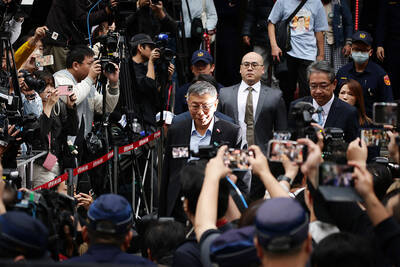
FIRST TRIAL: Ko’s lawyers sought reduced bail and other concessions, as did other defendants, but the bail judge denied their requests, citing the severity of the sentences Former Taipei mayor Ko Wen-je (柯文哲) was yesterday sentenced to 17 years in prison and had his civil rights suspended for six years over corruption, embezzlement and other charges. Taipei prosecutors in December last year asked the Taipei District Court for a combined 28-year, six-month sentence for the four cases against Ko, who founded the Taiwan People’s Party (TPP). The cases were linked to the Core Pacific City (京華城購物中心) redevelopment project and the mismanagement of political donations. Other defendants convicted on separate charges included Chinese Nationalist Party (KMT) Taipei City Councilor Angela Ying (應曉薇), who was handed a 15-year, six-month sentence; Core Pacific
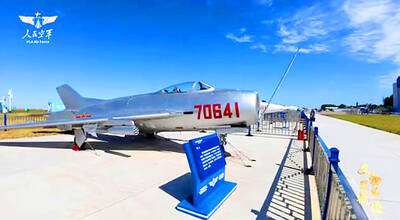
J-6 REMODEL: The converted drones are part of Beijing’s expanding mix of airpower weapons, including bombers with stand-off missiles and UAV swarms, the report said China has stationed obsolete supersonic fighters converted to attack drones at six air bases close to the Taiwan Strait, a report published this month by the Arlington, Virginia-based Mitchell Institute for Aerospace Studies said. Satellite imagery of the airfields from the institute’s “China Airpower Tracker” shows what appear to be lines of stubby, swept-winged aircraft matching the shape of J-6 fighters that first flew with the Chinese People’s Liberation Army (PLA) Air Force in the 1960s. Since their conversion to drones, the aircraft have been identified at five bases in China’s Fujian Province and one in Guangdong Province, the report said. J.

China used fake LinkedIn profiles to harvest sensitive data from NATO and EU institutions by soliciting information from staff, a European security source said on Friday. The operation, allegedly orchestrated by the Chinese Ministry of State Security, targeted dozens of employees at the military alliance or EU organizations through fictitious accounts, the source said, confirming reports in French and Belgian media. Posing as recruiters on the online professional networking platform, Chinese spies would initially request paid reports before later soliciting non-public or even classified information. One particularly active fake profile used the name “Kevin Zhang,” claiming to be the head


 RSS
RSS