


Shellfire rang out in eastern Ukraine yesterday as the country’s military and Moscow-backed separatists accused each other of provocations, and US warnings of an imminent Russian invasion stoked international tension.
An Agence France-Presse (AFP) reporter near the front line between Ukrainian government forces and rebel-held territory in the Lugansk region heard the thud of explosions and saw damaged civilian buildings.
All eyes were on Russian President Vladimir Putin’s next move, as Moscow announced he would oversee a weekend drill of “strategic forces” — ballistic and cruise missiles.
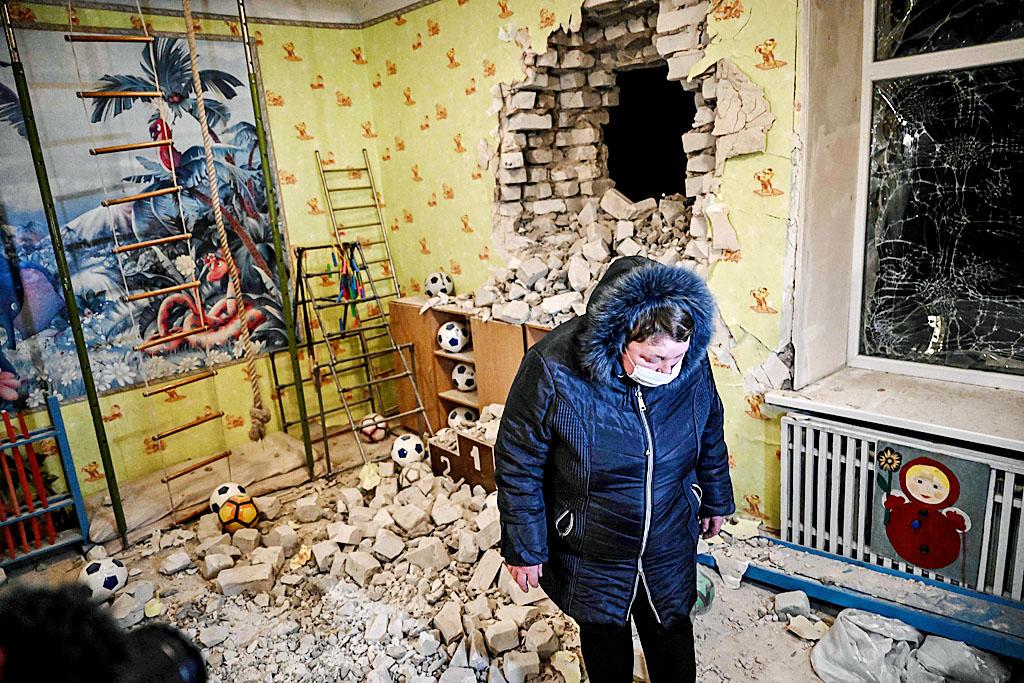
Photo: AFP
Russia has demanded that the US withdraw all forces from NATO member states in central and eastern Europe, and is turning up the pressure on Ukraine.
On Thursday, US Secretary of State Antony Blinken told the UN that Washington has intelligence showing that Moscow could order an invasion in the “coming days.”
Russia has denied it has any such plan and claims to have begun withdrawing some of the 149,000 troops that Ukraine says are on its borders.
However, Putin has done nothing to dial down tensions, ordering the missile drills even as there are reports of an increase in shelling from Russian-backed rebels in eastern Ukraine.
On Thursday, a shell punched a hole in the wall of a kindergarten in government-held territory near the front line in the village of Stanytsia Luganska.
The 20 children and 18 adults inside escaped serious injury, but the attack sparked international howls of protest.
“The children were eating breakfast when it hit,” school laundry worker Natalia Slesareva told AFP at the scene. “It hit the gym. After breakfast, the children had gym class. So another 15 minutes, and everything could have been much, much worse.”
Yesterday, part of the village remained without electricity.
Konstantin Reutsky, director of the Vostok SOS aid agency, told AFP that houses and a shop had been damaged.
The Ukrainian joint command center said the rebels had breached the ceasefire 20 times between midnight and 9am yesterday, while the Donetsk and Lugansk separatist groups said the army had fired 27 times.
The conflict in Ukraine’s east has rumbled on for eight years, claiming the lives of more than 14,000 people and forcing more than 1.5 million from their homes.
However now, after Russia surrounded its neighbor with armored battle groups, missile batteries and warships, there are fears that Ukraine would be drawn into a clash that Russia could use as a pretext for invasion.
Ukrainian Minister of Defense Oleksiy Reznikov told the country’s legislature that government forces would keep their cool.
“Ukraine is stepping up its defenses, but we have no intention of conducting military operations” against the separatists of Russian-annexed Crimea, he said. “Our mission is not to do any of the things the Russians are trying to provoke us into doing. We have to push back, but keep a cool head.”
Separately, Kremlin spokesman Dmitry Peskov said: “What is happening in the Donbas is very concerning news and potentially very dangerous,” referring to a rebel-held area.
Putin was to host his ally Belarusian President Alexander Lukashenko, who this week said that his country could host Russian nuclear weapons aimed at the West.
The Russian Ministry of Defense further upped the ante by saying that Putin would oversee an “exercise of strategic deterrence forces ... during which ballistic and cruise missiles will be launched.”
The Russian Air Force, units of the southern military district, and the Northern and Black Sea fleets would be involved, it said.
Russia’s aggressive stance has sent diplomatic shockwaves through the West, scrambling to counter an unpredictable foe during what has been described as the worst threat to European security since the Cold War.
German Minister of Foreign Affairs Annalena Baerbock said that Moscow needed to show “serious steps towards de-escalation.”
“With an unprecedented deployment of troops on the border with Ukraine and Cold War demands, Russia is challenging fundamental principles of the European peace order,” Baerbock said.

Japan has deployed long-range missiles in a southwestern region near China, the Japanese defense minister said yesterday, at a time when ties with Beijing are at their lowest in recent years. The missiles were installed in Kumamoto in the southern region of Kyushu, as Japan is attempting to shore up its military capacity as China steps up naval activity in the East China Sea. “Standoff defense capabilities enable us to counter the threat of enemy forces attempting to invade our country ... while ensuring the safety of our personnel,” Japanese Minister of Defense Shinjiro Koizumi said. “This is an extremely important initiative for
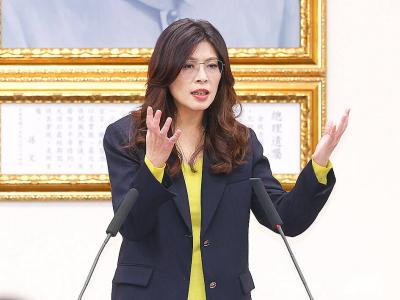
Chinese Nationalist Party (KMT) Chairwoman Cheng Li-wun (鄭麗文) today accepted an invitation from Chinese President Xi Jinping (習近平) to lead a delegation to China next month, saying she hopes to promote the peaceful development of cross-strait relations and bring stability to the Taiwan Strait. “I am grateful and happy to accept this invitation,” Cheng said in a statement from the KMT chairperson’s office. Cheng said she hopes both sides can work together to promote the peaceful development of cross-strait relations, enhance exchange and cooperation, bring stability to the Taiwan Strait and improve people’s livelihoods. At today's news conference, Cheng said any efforts to

MORE POPULAR: Taiwan Pass sales increased by 59 percent during the first quarter compared with the same period last year, the Tourism Administration said The Tourism Administration yesterday said that it has streamlined the Taiwan Pass, with two versions available for purchase beginning today. The tourism agency has made the pass available to international tourists since 2024, allowing them to access the high-speed rail, Taiwan Railway Corp services, four MRT systems and four Taiwan Tourist Shuttles. Previously, five types of Taiwan Pass were available, but some tourists have said that the offerings were too complicated. The agency said only two types of Taiwan Pass would be available, starting from a three-day pass with the high-speed rail and a three-day pass with Taiwan Railway Corp. The former costs NT$2,800

The nation’s fastest supercomputer, Nano 4 (晶創26), is scheduled to be launched in the third quarter, and would be used to train large language models in finance and national defense sectors, the National Center for High-Performance Computing (NCHC) said. The supercomputer, which would operate at about 86.05 petaflops, is being tested at a new cloud computing center in the Southern Taiwan Science Park in Tainan. The exterior of the server cabinet features chip circuitry patterns overlaid with a map of Taiwan, highlighting the nation’s central position in the semiconductor industry. The center also houses Taiwania 2, Taiwania 3, Forerunner 1 and


 RSS
RSS