

Starting today, eating and drinking in Taipei movie theaters is to be banned as the city government seeks to bolster its disease prevention measures.
Movie theaters may continue to sell food and beverages, but customers cannot consume them on the premises, Taipei Deputy Mayor Tsai Ping-kun (蔡炳坤) said.
The ban aims to ensure that people keep their masks on at all times when watching a movie, as they would be in close proximity to others inside a movie theater, he added.

Photo: Tsai Shu-yuan, Taipei Times
The new measure does not mean the COVID-19 alert level was being raised and it only aims to adjust precautions at movie theaters, Taipei Department of Information and Tourism Commissioner Liu Yi-ting (劉奕霆) said.
“Customers can still buy snacks and beverages, and eat them outside the theater hall while waiting for the movie to start,” he said.
There have been recent cases with unknown infection sources, so the city has been looking at measures to improve public safety, he added.
Offenders would not be fined for now, Tsai said, calling on the public and theaters to cooperate.
Tsai said the city would later this week reopen its online vaccine appointment Web site to finish off a stock of 80,000 doses of the Pfizer-BioNTech COVID-19 vaccine.
People can make appointments on the Web site on Friday and Saturday, he said, adding that vaccinations would begin on Monday.
Walk-in vaccination sites, such as the one in Taipei Railway Station, stopped work on Thursday for the Lunar New Year holiday, and would resume service on Monday next week, offering 600 doses of the Pfizer-BioNTech and the AstraZeneca vaccine each every day.
Meanwhile, the Central Epidemic Command Center (CECC) yesterday reported 17 domestic and 38 imported COVID-19 cases.
As 10 of the domestic cases tested positive during quarantine after being listed as close contacts of other confirmed cases, the spread of COVID-19 in Taiwan remains under control, said Centers for Disease Control Deputy Director-General Chuang Jen-hsiang (莊人祥), the CECC’s spokesman.
Sixteen of the new local cases were linked to previously reported clusters in Taoyuan, Kaohsiung, the greater Taipei area and Yilan County, while the source of one case, who was confirmed in Kaohsiung, but had recently been to New Taipei City, is being investigated, the CECC said.
Eleven of the new cases were classified as breakthrough infections.
One had received one dose of the Pfizer-BioNTech vaccine, while three, including one under the age of 10, have not been vaccinated.
The vaccination status of two cases is still being investigated, the CECC said.
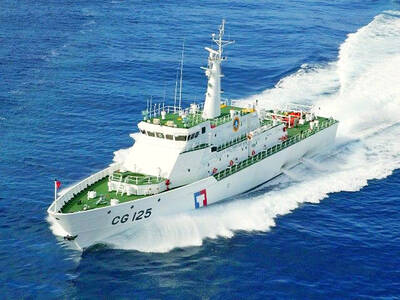
GEOPOLITICAL SIGNIFICANCE: The CGA’s nonmilitary role makes it a tool to avert diplomatic issues, an official said, while confirming the donation of a ship to Manila Coast Guard Administration (CGA) ships are scheduled to sail to the Philippines bearing the words “Taiwan Coast Guard” in a high-profile visit in October next year, the first such visit by a Taiwanese maritime law enforcement vessel to the Southeast Asian nation, the agency said yesterday. The CGA also confirmed that it had donated one of its decommissioned patrol vessels to the Philippines in a rare transfer of a retired ship to a nondiplomatic ally. The Republic of China (ROC) Navy last made such a visit in 1974, shortly before the Philippines switched diplomatic recognition to the People’s Republic of China in

CALL FOR CHANGE: They urged the UN to facilitate Taiwan’s involvement in the body, recognize its peace efforts and to work with members in preventing military conflict Representatives to the UN from five of Taiwan’s diplomatic allies sent a joint letter to UN Secretary-General Antonio Guterres on Friday, calling for the country’s inclusion in the body. Allies in the letter sent ahead of the 81st session of the UN General Assembly General Debate made three demands in support of Taiwan: inclusion, recognition and camaraderie. They implored the UN to seek an appropriate way to facilitate Taiwan’s meaningful involvement in the world governing body, saying that UN Resolution 2758, which accepted the People’s Republic of China (PRC) as a member of the UN, does not exclude Taiwan. Beijing claims that the

‘GLOBAL WARNING’: The infiltration is not just a local problem, as Beijing has been deploying the same tactics worldwide against Western democracies, a report said Between 50,000 and 100,000 Chinese spies are operating in Taiwan, far more than the National Security Bureau’s previous estimate of 5,000, German journalist and author Jurgen Kremb said on Monday. Kremb presented his research, titled “The War of Spies: How China’s Intelligence Services Are Infiltrating Taiwan — and What Europe Must Learn from It,” at a joint event held by the Taiwan offices of the Friedrich Naumann Foundation and the European Values Center for Security Policy. The report was published in June in the Ministry of Justice Investigation Bureau’s Prospect & Exploration Monthly (展望與探索月刊). By spies, he said he was referring to informants,
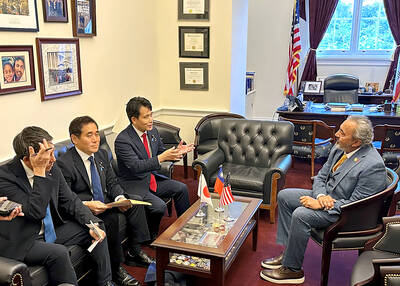
WASHINGTON MEETING: Japan’s Hirofumi Takinami said participants rejected the idea that the US should limit its defensive perimeter to the Second Island Chain US and Japanese lawmakers agree that the US must defend the First Island Chain, including Taiwan, and should not fall back to the Second Island Chain, while “a Taiwan contingency is a Japan contingency and therefore a US-Japan alliance contingency,” media reported after a meeting between officials of the two nations in Washington on Tuesday. A delegation of Japanese lawmakers from the Liberal Democratic Party met with US Senator Thom Tillis, co-chair of the Senate Taiwan Caucus, and US Representative Ami Bera, co-chair of the US Congressional Taiwan caucus, to discuss issues concerning East Asia and the Taiwan Strait. The Japanese and


 RSS
RSS