


The US and China are engaged in an arms race to develop the most lethal hypersonic weapons, US Secretary of the Air Force Frank Kendall said on Tuesday, as Beijing and Washington build and test an increasing number of the high-speed next-generation arms.
“There is an arms race, not necessarily for increased numbers, but for increased quality,” Kendall said in an interview at his Pentagon offices. “It’s an arms race that has been going on for quite some time. The Chinese have been at it very aggressively.”
In October, Chairman of the US Joint Chiefs of Staff General Mark Milley, the top US military officer, confirmed a Chinese hypersonic weapons test that military experts say appears to show Beijing’s pursuit of an Earth-orbiting system designed to evade US missile defenses.
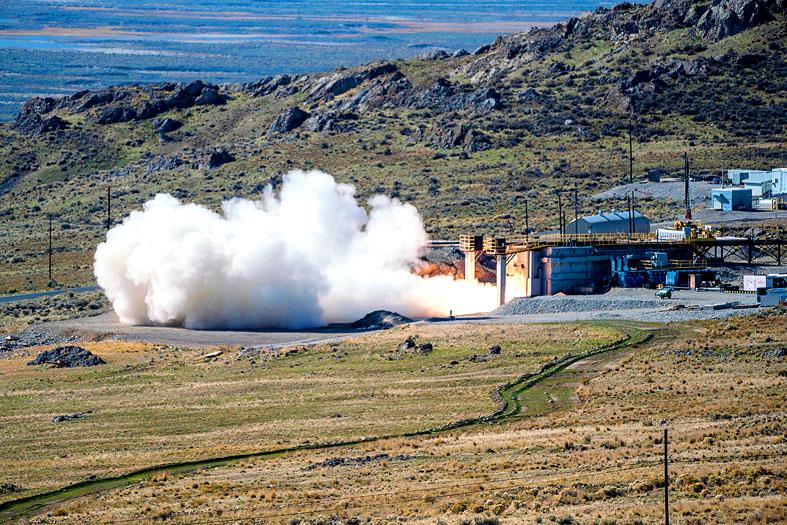
Photo: Courtesy of Northrop Grumman vis Reuters
This year, the Pentagon has held several hypersonic weapons tests with mixed success. In October, the US Navy successfully tested a booster rocket motor that would be used to power a launch vehicle carrying a hypersonic weapon aloft.
Hypersonic weapons travel in the upper atmosphere at more than five times the speed of sound, or about 6,200kph.
Kendall said that while the US military has focused funds on Iraq and Afghanistan, it has taken its eye off the ball in terms of hypersonic weapons.
“This isn’t saying we’ve done nothing, but we haven’t done enough,” he said.
As the Pentagon enters the 2023 annual budget cycle, Kendall hopes to raise funds with the retirement of older and expensive-to-maintain systems in favor of new systems, including hypersonic development programs.
“I love the A-10 [combat aircraft]. The C-130 [cargo plane] is a great aircraft that’s been very capable and very effective for a lot of missions. The MQ-9s [drones] have been very effective for counterterrorism and so on. They’re still useful, but none of these things scare China,” he said.
Defense contractors hope to capitalize on the shift to hypersonic weapons not only by building them, but also by developing new detection and defeat mechanisms.
Arms makers Lockheed Martin Corp, Northrop Grumman Corp and Raytheon Technologies Corp have all touted their hypersonic weapons programs to investors as the world’s focus shifts to the new arms race for an emerging class of weapons.
Still, the Pentagon wants defense contractors to cut the ultimate cost of hypersonic weapons, the head of research and development has said, as the next generation of super-fast missiles being developed currently costs tens of millions of US dollars per unit.

Japan has deployed long-range missiles in a southwestern region near China, the Japanese defense minister said yesterday, at a time when ties with Beijing are at their lowest in recent years. The missiles were installed in Kumamoto in the southern region of Kyushu, as Japan is attempting to shore up its military capacity as China steps up naval activity in the East China Sea. “Standoff defense capabilities enable us to counter the threat of enemy forces attempting to invade our country ... while ensuring the safety of our personnel,” Japanese Minister of Defense Shinjiro Koizumi said. “This is an extremely important initiative for

Chinese Nationalist Party (KMT) Chairwoman Cheng Li-wun (鄭麗文) today accepted an invitation from Chinese President Xi Jinping (習近平) to lead a delegation to China next month, saying she hopes to promote the peaceful development of cross-strait relations and bring stability to the Taiwan Strait. “I am grateful and happy to accept this invitation,” Cheng said in a statement from the KMT chairperson’s office. Cheng said she hopes both sides can work together to promote the peaceful development of cross-strait relations, enhance exchange and cooperation, bring stability to the Taiwan Strait and improve people’s livelihoods. At today's news conference, Cheng said any efforts to

MORE POPULAR: Taiwan Pass sales increased by 59 percent during the first quarter compared with the same period last year, the Tourism Administration said The Tourism Administration yesterday said that it has streamlined the Taiwan Pass, with two versions available for purchase beginning today. The tourism agency has made the pass available to international tourists since 2024, allowing them to access the high-speed rail, Taiwan Railway Corp services, four MRT systems and four Taiwan Tourist Shuttles. Previously, five types of Taiwan Pass were available, but some tourists have said that the offerings were too complicated. The agency said only two types of Taiwan Pass would be available, starting from a three-day pass with the high-speed rail and a three-day pass with Taiwan Railway Corp. The former costs NT$2,800
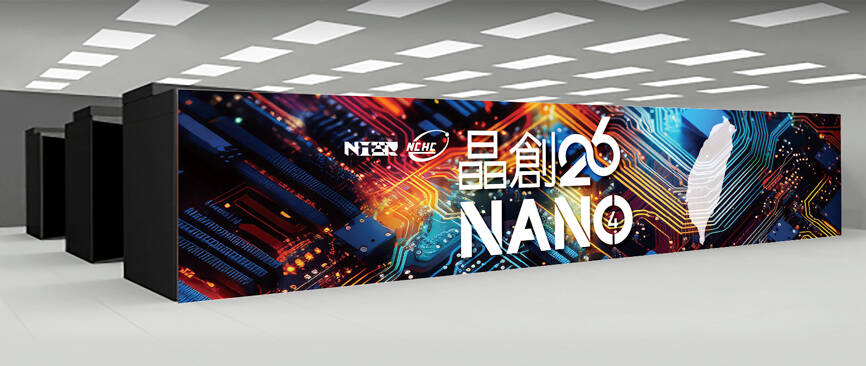
The nation’s fastest supercomputer, Nano 4 (晶創26), is scheduled to be launched in the third quarter, and would be used to train large language models in finance and national defense sectors, the National Center for High-Performance Computing (NCHC) said. The supercomputer, which would operate at about 86.05 petaflops, is being tested at a new cloud computing center in the Southern Taiwan Science Park in Tainan. The exterior of the server cabinet features chip circuitry patterns overlaid with a map of Taiwan, highlighting the nation’s central position in the semiconductor industry. The center also houses Taiwania 2, Taiwania 3, Forerunner 1 and


 RSS
RSS