


Taiwanese who have been removed from household registration records due to the COVID-19 pandemic can re-enroll into the National Health Insurance (NHI) scheme upon returning to Taiwan without the normal six-month wait, the Central Epidemic Command Center (CECC) said yesterday.
Minister of Health and Welfare Chen Shih-chung (陳時中), who heads the center, said that the pandemic has made international travel more difficult, so the rights and interests of some overseas Taiwanese might have been harmed, as they could not return home.
Government agencies have made adjustments to regulations to reduce possible damage to the rights and interests of overseas Taiwanese, Chen said.
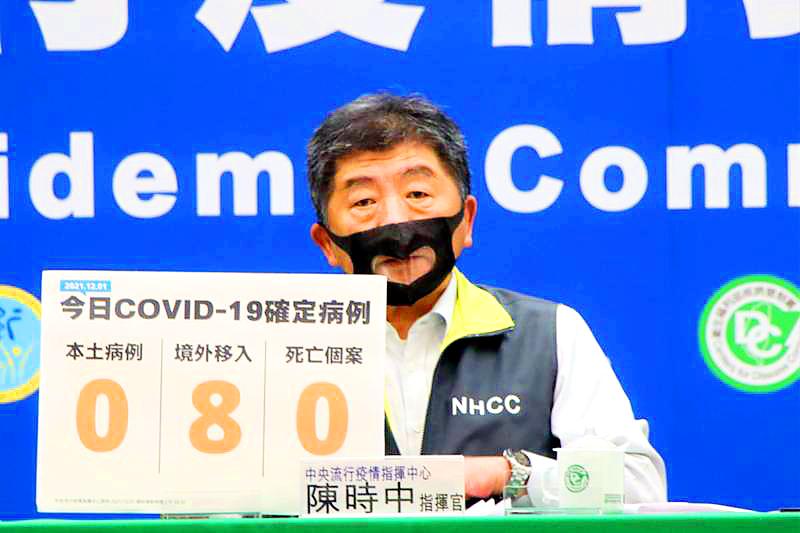
Photo courtesy of the Central Epidemic Command Center
Department of Social Insurance Director Shang Tung-fu (商東福) said that those who have been away from Taiwan for more than two years are removed from household registration and withdrawn from the NHI scheme, but measures have been put in place to protect their right to enroll with the NHI and the national pension scheme.
People who were enrolled with the NHI on Jan. 1 last year can apply to the NHI Administration to continue their enrollment from the day they were removed, Shang said.
People who have been delisted from the household registration and NHI since Jan. 1, 2018, but return to Taiwan between Jan. 1 last year and Dec. 31 next year, can re-enroll with the NHI immediately without having to wait six months, he said.
The eased rules are similar for the national pension, he said, adding that people who were enrolled on Jan. 1 last year should apply with the Labor Insurance Bureau to continue their enrollment.
People who lose their household registration between Jan. 1 last year and Dec. 31 next year, and were not able to stay in Taiwan for more than 183 days per year for the past three years can apply with the bureau to have their claims recognized, he said.
The Ministry of Finance’s Taxation Administration also announced eased rules for recognizing residency for people who were removed from their household registration due to travel difficulties caused by the pandemic, as residency affects individual income tax and land value tax.
Meanwhile, Chen said that as of yesterday, the nation’s first-dose vaccination rate had reached 77.93 percent, while the full vaccination rate reached 56.8 percent.
Centers for Disease Control Deputy Director-General Chuang Jen-hsiang (莊人祥), the CECC’s spokesman, said that there are still about 9.37 million COVID-19 vaccine doses in four brands available in Taiwan.
As there is now sufficient supply of vaccines in the nation, the CECC urges unvaccinated or partially vaccinated people to get fully vaccinated as soon as possible to reduce the risk of serious complications or death, Chen said.
Taiwan yesterday reported eight imported cases, with six among them vaccine breakthrough infections, the CECC said.

CROSS-STRAIT COLLABORATION: The new KMT chairwoman expressed interest in meeting the Chinese president from the start, but she’ll have to pay to get in Beijing allegedly agreed to let Chinese Nationalist Party (KMT) Chairwoman Cheng Li-wun (鄭麗文) meet with Chinese President Xi Jinping (習近平) around the Lunar New Year holiday next year on three conditions, including that the KMT block Taiwan’s arms purchases, a source said yesterday. Cheng has expressed interest in meeting Xi since she won the KMT’s chairmanship election in October. A source, speaking on condition of anonymity, said a consensus on a meeting was allegedly reached after two KMT vice chairmen visited China’s Taiwan Affairs Office Director Song Tao (宋濤) in China last month. Beijing allegedly gave the KMT three conditions it had to

STAYING ALERT: China this week deployed its largest maritime show of force to date in the region, prompting concern in Taipei and Tokyo, which Beijing has brushed off Deterring conflict over Taiwan is a priority, the White House said in its National Security Strategy published yesterday, which also called on Japan and South Korea to increase their defense spending to help protect the first island chain. Taiwan is strategically positioned between Northeast and Southeast Asia, and provides direct access to the second island chain, with one-third of global shipping passing through the South China Sea, the report said. Given the implications for the US economy, along with Taiwan’s dominance in semiconductors, “deterring a conflict over Taiwan, ideally by preserving military overmatch, is a priority,” it said. However, the strategy also reiterated

‘BALANCE OF POWER’: Hegseth said that the US did not want to ‘strangle’ China, but to ensure that none of Washington’s allies would be vulnerable to military aggression Washington has no intention of changing the “status quo” in the Taiwan Strait, US Secretary of Defense Pete Hegseth said on Saturday, adding that one of the US military’s main priorities is to deter China “through strength, not through confrontation.” Speaking at the annual Reagan National Defense Forum in Simi Valley, California, Hegseth outlined the US Department of Defense’s priorities under US President Donald Trump. “First, defending the US homeland and our hemisphere. Second, deterring China through strength, not confrontation. Third, increased burden sharing for us, allies and partners. And fourth, supercharging the US defense industrial base,” he said. US-China relations under

The Chien Feng IV (勁蜂, Mighty Hornet) loitering munition is on track to enter flight tests next month in connection with potential adoption by Taiwanese and US armed forces, a government source said yesterday. The kamikaze drone, which boasts a range of 1,000km, debuted at the Taipei Aerospace and Defense Technology Exhibition in September, the official said on condition of anonymity. The Chungshan Institute of Science and Technology and US-based Kratos Defense jointly developed the platform by leveraging the engine and airframe of the latter’s MQM-178 Firejet target drone, they said. The uncrewed aerial vehicle is designed to utilize an artificial intelligence computer


 RSS
RSS