

China’s armed forces are capable of blockading Taiwan’s key harbors and airports, the Ministry of National Defense said yesterday, offering its latest assessment of what it described as a “grave” military threat posed by its giant neighbor.
China has been ramping up military activity around Taiwan, including by repeatedly flying warplanes into Taiwan’s air defense identification zone (ADIZ).
In a report it issues every two years, the ministry said China had launched what it called “gray zone” warfare, citing 554 “intrusions” by Chinese warplanes into its southwest ADIZ between September last year and the end of August.
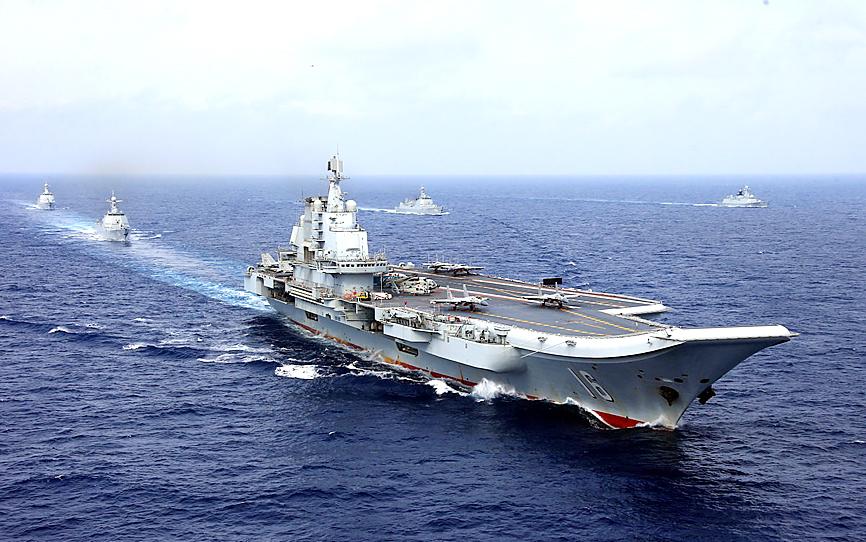
Photo: Reuters
The Chinese People’s Liberation Army (PLA) also aims to complete the modernization of its forces by 2035 to “obtain superiority in possible operations against Taiwan and viable capabilities to deny foreign forces, posing a grave challenge to our national security,” the ministry said.
“At present, the PLA is capable of performing [a] local joint blockade against our critical harbors, airports, and outbound flight routes, to cut off our air and sea lines of communication and impact the flow of our military supplies and logistic resources,” the ministry said.
The Chinese Ministry of National Defense did not immediately respond to a request for comment.
President Tsai Ing-wen (蔡英文) has vowed to defend Taiwan’s freedom and democracy.
She has made bolstering Taiwan’s defenses a priority, pledging to produce more domestically developed weapons, including submarines, and buying more equipment from the US, the nation’s most important arms supplier and international backer.
Last month, Taiwan reported 148 Chinese air force planes in its south and southwest ADIZ over a four-day period, marking a dramatic escalation in tensions between Taipei and Beijing.
“Its intimidating behavior does not only consume our combat power and shake our faith and morale, but also attempts to alter or challenge the status quo in the Taiwan Strait to ultimately achieve its goal of ‘seizing Taiwan without a fight,’” the ministry said.
To counter China’s attempt to “seize Taiwan swiftly whilst denying foreign interventions,” the ministry vowed to improve its “asymmetric warfare” capabilities to make any attack as painful and as difficult for China as possible.
That includes precision strikes by long-range missiles on targets in China, deployment of coastal minefields as well as boosting reserve training.
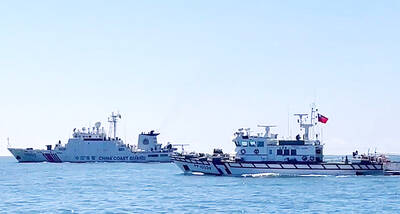
China deployed a record number of coast guard, scientific research and other ships near Taiwan’s waters last month, the Coast Guard Administration (CGA) said, as Beijing dials up pressure on Taipei. The coast guard warned of an increasingly severe situation, as analysts say the increased activity is part of China’s bid to map the region for submarine warfare. The number of Chinese ships detected around Taiwan proper soared to a record 244 last month — an average of nearly eight every day, official data showed. That compares with 55 ships detected in June and 30 in May, and 58 in July last year. In
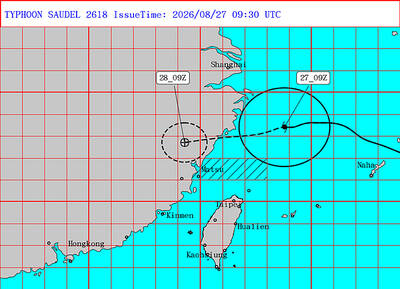
Taiwan is bracing for heavy rain in the south and rough seas around outlying Lienchiang County (Matsu), as Typhoon Saudel passes north toward eastern China, with forecasters yesterday warning of localized flooding over the next two days. Saudel is expected to pass closest to Taiwan today, when its outer rain bands are forecast to brush past Matsu, before making landfall at about noon in China’s Zhejiang Province and weakening significantly, the Central Weather Administration said. The storm’s outer bands, combined with strengthening southwesterly winds, are expected to bring heavy rain to southern and southeastern Taiwan today, it said. As the storm approaches Matsu,

LIMITED: The bill’s NT$40bn annual spending cap would prevent Taiwan from effectively building up its drone combat capabilities, National Defense Minister Wellington Koo said The legislature yesterday rejected the Executive Yuan’s NT$210 billion (US$6.62 billion) special budget proposal to buy military drones and instead passed its own plan, which earmarks NT$40 billion per year over six consecutive years. The Executive Yuan said its plan to buy about 210,000 drones by 2031 could not wait, as the wars in Ukraine and Iran showed the importance of uncrewed systems in modern warfare amid a rising threat from China. However, the Chinese Nationalist Party (KMT) and Taiwan People’s Party (TPP) used their opposition majority to pass a bill providing NT$240 billion through annual budgets over six years, with annual

INCREASING IMBALANCE: The percentage of working-age people is expected to shrink to 42.3% of the population, while older people would comprise 52.9%, the agency said Taiwan’s population is projected to shrink by almost half over the next five decades, intensifying labor shortages and placing a growing drag on economic growth as the technology-intensive economy confronts a rapidly aging workforce. The population is expected to fall to 12.15 million by 2075, a 48 percent decline from this year, National Development Council projections released yesterday showed. The decline would fundamentally alter Taiwan’s workforce. From 2037, more than half of the working-age population is projected to be aged between 45 and 64, signaling the end of an era when the economy could rely on a relatively large labor force. The shift


 RSS
RSS