


Minister of National Defense Chiu Kuo-cheng (邱國正) yesterday denied a report published by the Wall Street Journal on Monday that suggested that Taiwan’s military would be no match for China’s People’s Liberation Army (PLA).
“I don’t understand what foreign media is basing its evaluation on, but I’m very confident in our military. There is no need to feel dispirited,” Chiu told reporters.
In its report, the Journal said that US military and government officials were concerned about China’s ambitions toward Taiwan and that very few among them believed that Taiwan could resist an attack by the PLA.
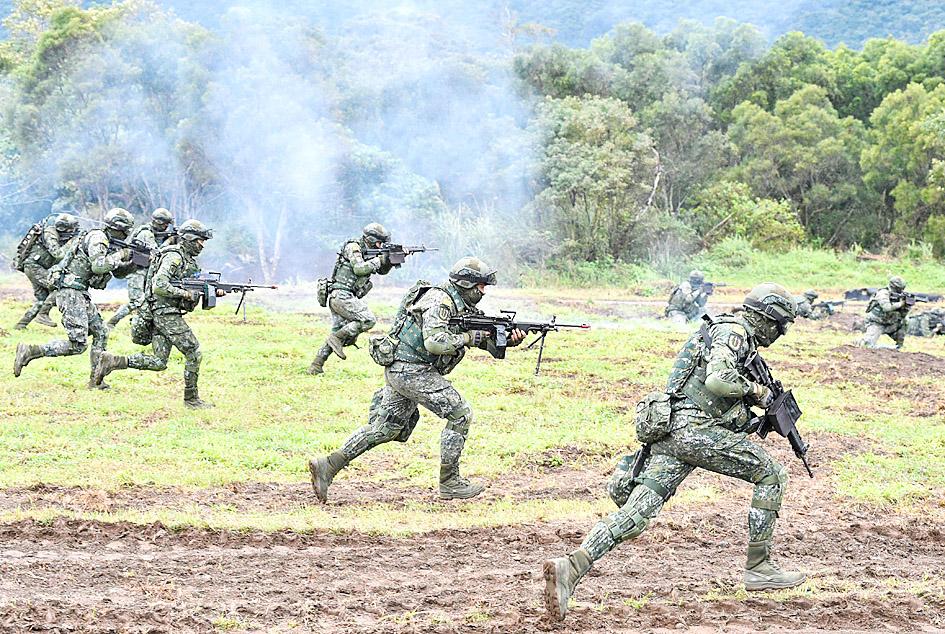
Photo: Mandy Cheng, AFP
The report cited the officials as saying they believed morale was low in Taiwan’s military and that its preparations for a Chinese attack were inadequate.
The report blamed Taiwan’s shift from a mandatory two-year conscription for all young men to a four-month term that mostly had conscripts “sweeping leaves and pulling weeds.”
The report said practice at a firing range was the only beneficial part of the training.
Chiu said that he had previously heard criticism that the military was worsening with each generation, but he had also denied that assertion.
Separately, Ministry of National Defense spokesman Major General Shih Shun-wen (史順文) at a routine news conference yesterday called for public support in efforts to strengthen national defenses in the face of Chinese threats to regional security.
The military would continuously aim to strengthen its combat abilities, he said, adding that military preparedness was an ongoing task.
The specifics of training would always keep pace with the times and the military is always working hard to make improvements, Shih said.
Meanwhile, Democratic Progressive Party Legislator Wang Ting-yu (王定宇) yesterday said that Taiwan had already transitioned to a professional military and that the four months of general training was not the same as that for professional military personnel.
“It’s true there is room for improvement in our military, but this idea often raised by opposition lawmakers and foreign academics that our military gets only four months of training is just a blatant attempt at disparagement,” Wang said.
The quality of Taiwan’s professional military training, the integration of branches of the military and its use of technology far exceed that of the PLA, he said.
However, in terms of the quality of equipment Taiwan still lags behind the PLA, he added.
“If you want to talk about morale, the family members of Taiwan’s military personnel live here in Taiwan. Of course their determination to protect this nation is greater than the will of the enemy to invade it,” Wang said.
Additional reporting by CNA

RESILIENCE: Taiwan plays a key role in semiconductors, energy, information infrastructure and advanced manufacturing, AIT Director Raymond Greene said Taiwan’s continued investment in deterrence and resilience remains vital, especially in uncrewed systems and other emerging technologies, American Institute in Taiwan (AIT) Director Raymond Greene said yesterday. Greene made the remarks at the annual National Strategic Summit on Supply Chain Resilience held by the Research Institute for Democracy, Society and Emerging Technology (DSET), a government-backed think tank. As Taiwan last year became the US’ fourth-largest trading partner and supply chain security is becoming more important, cooperation in emerging technologies continues to deepen between the two countries, he said. The US is committed to accelerating innovation, building key infrastructure, strengthening cooperation

The National Chungshan Institute of Science and Technology yesterday showcased its locally developed variants of the Vision 60 robotic patrol dog, which it plans to deploy on the nation’s outlying territories in the South China Sea. The variants were produced under the Joint Lab project — created by the institute and domestic companies — and assembled with domestically produced motors, lenses and artificial intelligence (AI) systems alongside licensed tech from the US, Missile and Rocket Systems Research Division deputy director Jen Kuo-kang (任國光) told the media event at a military base in Taipei’s Dazhi (大直) area. Taiwan has built up its strengths

RIGHT DIRECTION: Taiwan’s efforts to prevent forced labor include a proposal to ‘fully prohibit’ employers from withholding workers’ documents, an official said Taiwan is to establish a mechanism to restrict imports of goods linked to forced labor, the Executive Yuan said yesterday, after the US proposed imposing additional tariffs on Taiwanese goods over labor concerns. “The Ministry of Labor and the Ministry of Economic Affairs are to establish an interministerial review procedure,” Executive Yuan spokesperson Michelle Lee (李慧芝) said at a news briefing in Taipei. “The government is to use the Foreign Trade Act [貿易法] as the legal basis to restrict imports of goods produced with forced labor” and bring its supply chain governance more in line with international standards on human rights, resilience

NOT IMMEDIATE: Taiwan has a chance to appeal the proposed 10 percent tariff before it starts, while other countries face a 12.5 percent tariff from the trade office Taiwan is among 60 economies determined by the US to have failed to impose or enforce a ban on the importation of goods produced with forced labor, according to a notice released on Tuesday by the Office of the US Trade Representative (USTR), which proposed imposing an additional 10 percent or more tariff on them. The USTR in a statement said that following an investigation, it had determined under Section 301 of the Trade Act of 1974 that the failure of the 60 economies to impose and effectively enforce a prohibition on the importation of goods produced with forced labor is


 RSS
RSS