


Taiwan-Vatican diplomatic ties remain stable, the Ministry of Foreign Affairs said yesterday after a report published on Sunday by Italian newspaper Corriere della Sera claimed that Beijing had been pressuring the Vatican City into severing ties with Taiwan and establishing formal relations with China.
The report said that a Vatican foreign affairs official had approached Beijing about a framework for establishing diplomatic relations and that Beijing had told the official that the Vatican would first have to sever ties with Taiwan.
The Vatican had hoped to first establish an embassy in Beijing and then slowly reassess its relationship with Taiwan, but China had not agreed to such a proposition, leaving the negotiations deadlocked, the report said.
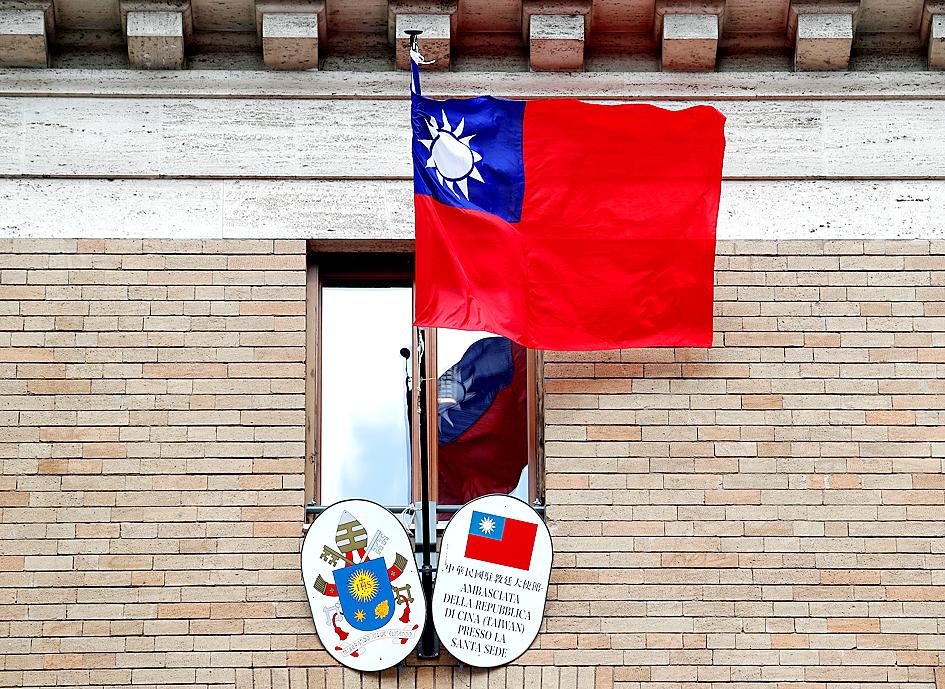
Photo: Reuters
Ministry of Foreign Affairs spokeswoman Joanne Ou (歐江安) yesterday in Taipei said that all communication channels with the Vatican were open and diplomatic ties remained strong.
The ministry would not further comment on conjecture or information from unnamed sources, Ou said.
Giving an example of the healthy state of Taiwan-Vatican relations, Ou said that the government, the Catholic Church in Taiwan and civic organizations had been providing assistance to Vatican City officials throughout the COVID-19 pandemic.
The Vatican had also placed President Tsai Ing-wen (蔡英文) at the top of a list of people it thanked for providing well-wishes to Pope Francis following his surgery in July, she said.
The Pope also offered his best wishes to Tsai on Double Ten National Day, she added.
The ministry would continue to seek opportunities to cooperate with the Vatican and strengthen the relationship, Ou said.
In related news, Minister of Foreign Affairs Joseph Wu (吳釗燮) departed Taiwan late on Sunday to visit Slovakia and the Czech Republic, a rare trip to nations with which Taiwan has no official diplomatic relations.
Wu today is due to deliver the keynote address at a conference hosted by Bratislava-based think tank GLOBSEC, before receiving a medal from Czech Senate President Milos Vystrcil and meeting Prague Mayor Zdenek Hrib, the ministry said.
During his visit, Wu is to speak at an online conference organized by the Inter-Parliamentary Alliance on China in Rome on Friday, it said.
Wu’s visit coincides with that of a Taiwanese trade delegation led by National Development Council Minister Kung Ming-hsin (龔明鑫).
The 66-person delegation departed Taiwan on Wednesday last week and is visiting the Czech Republic, Slovakia and Lithuania as part of the government’s strategy to boost trade and economic ties with central and east European nations.
The three nations’ relations with Taiwan have improved over the past few years, despite pressure from Beijing. They have donated more than 850,000 COVID-19 vaccine doses to Taiwan to reciprocate mask donations made by Taipei last year.
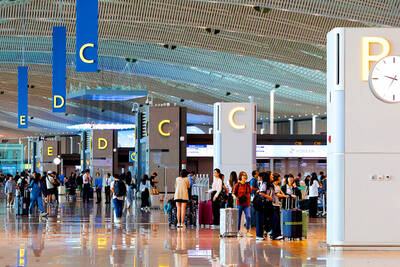
South Korea has adjusted its electronic arrival card system to no longer list Taiwan as a part of China, a move that the Ministry of Foreign Affairs said would help facilitate exchanges between the two sides. South Korea previously listed “Taiwan” as “Taiwan (China)” in the drop-down menus of its online arrival card system, where people had to fill out where they came from and their next destination. The ministry had requested South Korea make a revision and said it would change South Korea’s name on Taiwan’s online immigration system from “Republic of Korea” to “Korea (South),” should the issue not be

Tainan, Taipei and New Taipei City recorded the highest fines nationwide for illegal accommodations in the first quarter of this year, with fines issued in the three cities each exceeding NT$7 million (US$220,639), Tourism Administration data showed. Among them, Taipei had the highest number of illegal short-term rental units, with 410. There were 3,280 legally registered hotels nationwide in the first quarter, down by 14 properties, or 0.43 percent, from a year earlier, likely indicating operators exiting the market, the agency said. However, the number of unregistered properties rose to 1,174, including 314 illegal hotels and 860 illegal short-term rental
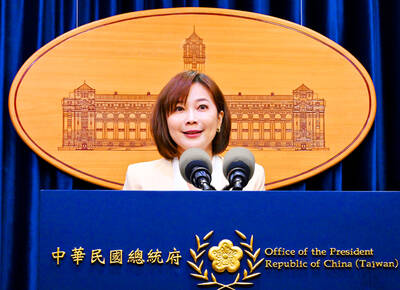
ECONOMIC COERCION: Such actions are often inconsistently applied, sometimes resumed, and sometimes just halted, the Presidential Office spokeswoman said The government backs healthy and orderly cross-strait exchanges, but such arrangements should not be made with political conditions attached and never be used as leverage for political maneuvering or partisan agendas, Presidential Office spokeswoman Karen Kuo (郭雅慧) said yesterday. Kuo made the remarks after China earlier in the day announced 10 new “incentive measures” for Taiwan, following a landmark meeting between Chinese President Xi Jinping (習近平) and Chinese Nationalist Party (KMT) Chairwoman Cheng Li-wun (鄭麗文) in Beijing on Friday. The measures, unveiled by China’s Xinhua news agency, include plans to resume individual travel by residents of Shanghai and China’s Fujian
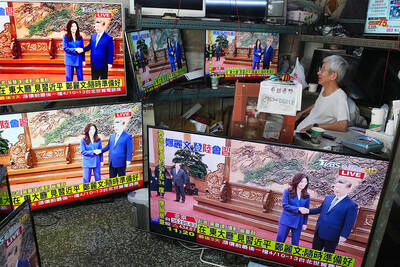
Chinese President Xi Jinping (習近平) and Chinese Nationalist Party (KMT) Chairwoman Cheng Li-wun (鄭麗文) met in Beijing yesterday, where they vowed to bring people on both sides of the Taiwan Strait closer to facilitate the “great rejuvenation of the Chinese nation.” The meeting was held in the East Hall of the Great Hall of the People, a venue typically reserved for meetings between Xi and foreign heads of state. In public remarks prior to a closed-door meeting, Xi, in his role as head of the Chinese Communist Party (CCP), said that Taiwan is historically part of China, and remains an “inalienable” and


 RSS
RSS