


As supporters of former US president Donald Trump stormed the US Capitol on Jan. 6, battling police and forcing lawmakers into hiding, an insurrection of a different kind was taking place inside the world’s largest social media company.
Thousands of kilometers away, in California, Facebook engineers were racing to tweak internal controls to slow the spread of misinformation and inciting content.
Emergency actions — some of which were rolled back after last year’s election — included banning Trump, freezing comments in groups with a record for hate speech, filtering out the “Stop the Steal” rallying cry and empowering content moderators to act more assertively by labeling the US a “Temporary High Risk Location” for political violence.
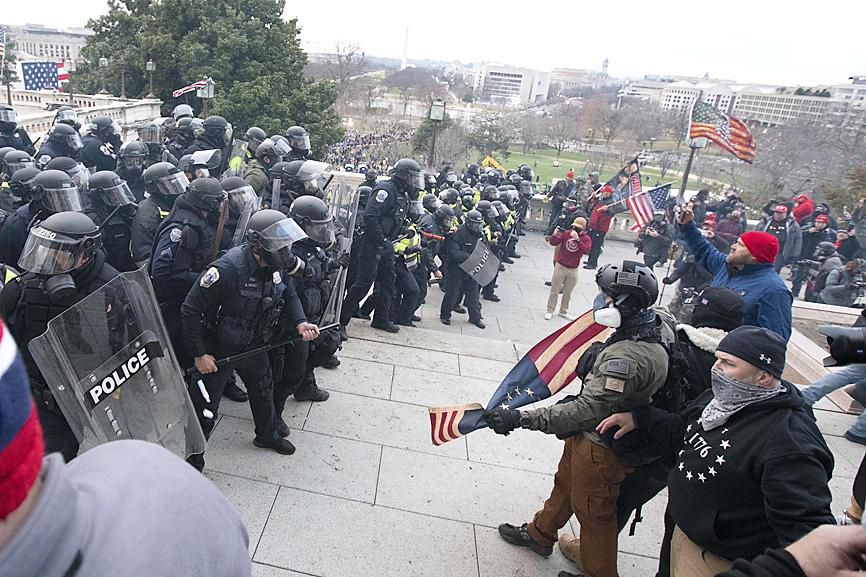
Photo: AP
At the same time, frustration inside Facebook erupted over what some saw as the company’s halting and inconsistent response to rising extremism in the US.
“Haven’t we had enough time to figure out how to manage discourse without enabling violence?” one employee wrote on an internal message board at the height of the Jan. 6 turmoil. “We’ve been fueling this fire for a long time and we shouldn’t be surprised it’s now out of control.”
It is a question that hangs over the company as the US Congress and regulators investigate its role part in the Jan. 6 riots.
New internal documents provided by former Facebook employee Frances Haugen provide a rare glimpse into how the company appears to have simply stumbled into the riot.
It quickly became clear that even after years under the microscope for insufficiently policing its platform, the social network had missed how riot participants spent weeks vowing — on Facebook itself — to stop Congress from certifying US President Joe Biden’s election victory.
An internal report found that 10 percent of political content viewed by US Facebook users in the days after the election perpetuated the falsehood that the vote had been rigged.
A 2019 internal study, entitled “Carol’s Journey to QAnon,” described the results of an experiment conducted with a test account established to reflect the views of a prototypical “strong conservative” — but not extremist — 41-year North Carolina woman.
Within days, page recommendations for this account generated by Facebook featured “a barrage of extreme, conspiratorial and graphic content.”
The results led the researcher to recommend safety measures, such as removing content with known conspiracy references and disabling “top contributor” badges for misinformation commenters.
Facebook says the situation is more nuanced and that it carefully calibrates its controls, adding that it is not responsible for the actions of the Jan. 6 rioters and that having stricter controls prior to that day would not have helped.
Some employees were unhappy with Facebook’s managing of problematic content even before the riots.
One employee who departed the company last year left a long note charging that promising new tools, backed by strong research, were being constrained by Facebook for “fears of public and policy stakeholder responses.”
Additional reporting by AFP

SILENCING CRITICS: In addition to blocking Taiwan, China aimed to prevent rights activists from speaking out against authoritarian states, a Cabinet department said The Ministry of Foreign Affairs (MOFA) yesterday condemned transnational repression by Beijing after RightsCon, a major digital human rights conference scheduled to be held in Zambia this week, was abruptly canceled due to Chinese pressure over Taiwanese participation. This year’s RightsCon, the world’s largest conference discussing issues “at the intersection of human rights and technology,” was scheduled to take place from tomorrow to Friday in Lusaka, and expected to draw 2,600 in-person attendees from 150 countries, along with 1,100 online participants. However, organizers were forced to cancel the event due to behind-the-scenes pressure from China, the ministry said, expressing its “strongest condemnation”
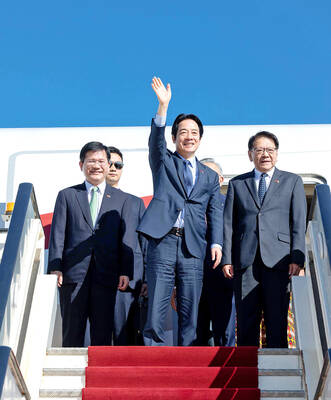
DELAYED BUT DETERMINED: The president’s visit highlights Taiwan’s right to international engagement amid regional pressure from China President Willaim Lai (賴清德) yesterday arrived in Eswatini, more than a week after his planned visit to Taiwan’s sole African ally was suspended because of revoked overflight permits. “The visit, originally scheduled for April 22, was postponed due to unforeseen external factors,” Lai wrote on social media. “After several days of careful arrangements by our diplomatic and national security teams, we successfully arrived today.” Lai said he looked forward to further deepening Taiwan-Eswatini relations through closer cooperation in the economy, agriculture, culture and education, as well as advancing the nation’s international partnerships. The president was initially scheduled to arrive in time to celebrate
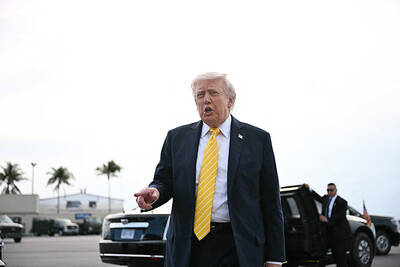
Iran’s Islamic Revolutionary Guard Corp (IRGC) yesterday said the US faced a choice between an “impossible” military operation or a “bad deal” with Tehran, after US President Donald Trump disparaged Iran’s latest peace proposal. Negotiations between the two countries have been deadlocked since a ceasefire came into effect on April 8, with only one round of direct peace talks held so far. Iran’s Tasnim and Fars news agencies reported that Tehran had submitted a 14-point proposal to mediator Pakistan, but Trump was quick to cast doubt on it. “I will soon be reviewing the plan that Iran has just sent to us, but

A group affiliated with indicted Chinese immigrant Xu Chunying (徐春鶯) is to be dissolved for monitoring Chinese immigrants in Taiwan, a source said yesterday. Xu, the secretary-general of the Cross-Strait Marriage and Family Service Alliance, was indicted on March 24 on charges of violating the Anti-Infiltration Act (反滲透法). The alliance “illegally monitored" Chinese immigrants living in Taiwan on behalf of the Chinese Communist Party (CCP) and the Ministry of the Interior is expected to dissolve the organization in the coming days under provisions of the Civil Associations Act (人民團體法), the source said. Xu, who married a Taiwanese in 1993 and became a Republic


 RSS
RSS