


A nationwide level 2 COVID-19 alert is to be extended for two weeks until Nov. 1, the Central Epidemic Command Center (CECC) said yesterday, adding that agencies are still discussing whether to allow foreign spouses and children of foreigners in Taiwan with a residence permit to enter the nation.
“In principle we agree to relaxing the entry regulations for the group, but relevant agencies are still reviewing and discussing the matter,” said Minister of Health and Welfare Chen Shih-chung (陳時中), who heads the center.
The center on Sept. 13 eased border restrictions for foreign dependents of Taiwanese nationals. They can apply for visas at representative offices overseas and, if granted, enter the nation.
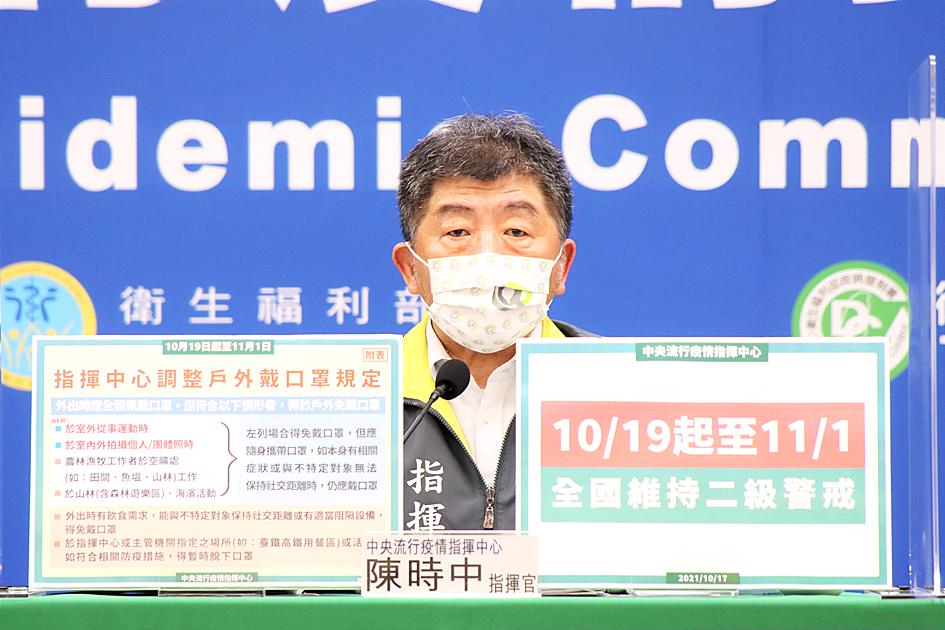
Photo courtesy of the CECC
“The local COVID-19 situation is increasingly under control, with only three locally transmitted infections reported this month, all of which are considered earlier infections,” Chen said. “However, as we are still working hard to administer more COVID-19 vaccines, we have decided to keep the level 2 alert in place from tomorrow to Nov. 1.”
Regarding requirements for fully vaccinated travelers, Chen said that there are no plans for shortened quarantines.
“Several countries have achieved a high COVID-19 vaccination coverage, but are still facing local outbreaks, so getting vaccinated is not the only weapon we need for fighting the [COVID-19] pandemic,” he said. “We need multiple layers of protection.”
“We need to achieve the first step — at least a certain percentage of vaccination coverage — before we can start considering reopening national borders,” he added.
Asked whether the CECC is considering introducing vaccine passports that would exempt travelers who tested negative for COVID-19 from quarantine requirements, Chen said that the CECC’s main concern is the vaccination rate, rather than Taiwan’s COVID-19 situation.
“The fewer local COVID-19 cases we have, the weaker our general immunity against COVID-19 is, and our vaccination coverage is at this point lower than that of several other countries, so Taiwan has a relatively weak immunity,” Chen said.
Taiwan welcomes international exchanges in business, trade, sports, diplomacy, humanitarian aid and other official global events, and it might also allow visitors to enter for such purposes under “vaccine travel bubble” arrangements, Chen said.
However, private or tourist visits would continue to be postponed until the local vaccination coverage increases to about the same level as in many other countries, Chen said, adding that other countries only began vaccine passport projects once they had reached high vaccination rates.
As of Saturday, Taiwan’s first-dose vaccination coverage had reached 62.11 percent, while 22.01 percent of the population are double-vaccinated, he said.
Meanwhile, the CECC modified mask wearing rules so that people would be allowed to take off their mask when “exercising outdoors” or “taking individual or group photographs indoors or outdoors.”
The rule only applies to those who do not have COVID-19 symptoms and in situations where people can keep a safe distance from other people or groups, the center added.
The relaxation follows eased mask wearing rules for people working in the agriculture, forestry, fishing or animal husbandry sectors, as well as for people visiting mountainous areas, forests or the beach.
“These are the circumstances in which people are not required to wear a mask, but they should still bring a mask with them, and wear the mask when they cannot practice social distancing with strangers,” Chen said.
When people need to eat or drink while outside, they can also remove their mask, under the condition that they practice social distancing or there are physical barriers set up to separate people, he said.
The CECC reported no new local infections or deaths yesterday, but there was one imported case — a traveler arriving from Indonesia.
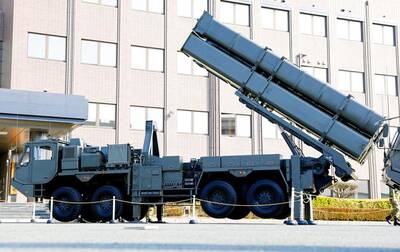
Japan has deployed long-range missiles in a southwestern region near China, the Japanese defense minister said yesterday, at a time when ties with Beijing are at their lowest in recent years. The missiles were installed in Kumamoto in the southern region of Kyushu, as Japan is attempting to shore up its military capacity as China steps up naval activity in the East China Sea. “Standoff defense capabilities enable us to counter the threat of enemy forces attempting to invade our country ... while ensuring the safety of our personnel,” Japanese Minister of Defense Shinjiro Koizumi said. “This is an extremely important initiative for
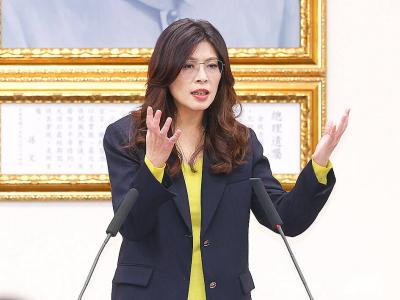
Chinese Nationalist Party (KMT) Chairwoman Cheng Li-wun (鄭麗文) today accepted an invitation from Chinese President Xi Jinping (習近平) to lead a delegation to China next month, saying she hopes to promote the peaceful development of cross-strait relations and bring stability to the Taiwan Strait. “I am grateful and happy to accept this invitation,” Cheng said in a statement from the KMT chairperson’s office. Cheng said she hopes both sides can work together to promote the peaceful development of cross-strait relations, enhance exchange and cooperation, bring stability to the Taiwan Strait and improve people’s livelihoods. At today's news conference, Cheng said any efforts to
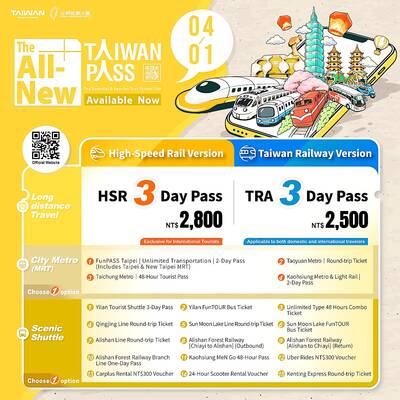
MORE POPULAR: Taiwan Pass sales increased by 59 percent during the first quarter compared with the same period last year, the Tourism Administration said The Tourism Administration yesterday said that it has streamlined the Taiwan Pass, with two versions available for purchase beginning today. The tourism agency has made the pass available to international tourists since 2024, allowing them to access the high-speed rail, Taiwan Railway Corp services, four MRT systems and four Taiwan Tourist Shuttles. Previously, five types of Taiwan Pass were available, but some tourists have said that the offerings were too complicated. The agency said only two types of Taiwan Pass would be available, starting from a three-day pass with the high-speed rail and a three-day pass with Taiwan Railway Corp. The former costs NT$2,800

The nation’s fastest supercomputer, Nano 4 (晶創26), is scheduled to be launched in the third quarter, and would be used to train large language models in finance and national defense sectors, the National Center for High-Performance Computing (NCHC) said. The supercomputer, which would operate at about 86.05 petaflops, is being tested at a new cloud computing center in the Southern Taiwan Science Park in Tainan. The exterior of the server cabinet features chip circuitry patterns overlaid with a map of Taiwan, highlighting the nation’s central position in the semiconductor industry. The center also houses Taiwania 2, Taiwania 3, Forerunner 1 and


 RSS
RSS