


The Central Epidemic Command Center (CECC) yesterday announced that those eligible for the 11th round of COVID-19 vaccinations would begin to book appointments on two separate days.
Those eligible for their first dose of Pfizer Inc and BioNTech SE’s COVID-19 vaccine can book a vaccination appointment from 10am on Monday next week, while those eligible for a second dose of AstraZeneca PLC’s vaccine can book an appointment from 10am on Tuesday next week, said Centers for Disease Control Deputy Director-General Chuang Jen-hsiang (莊人祥), who is the CECC’s spokesperson.
A reminder text message is to be sent to those eligible from 2pm on the day before they can book an appointment, he said.
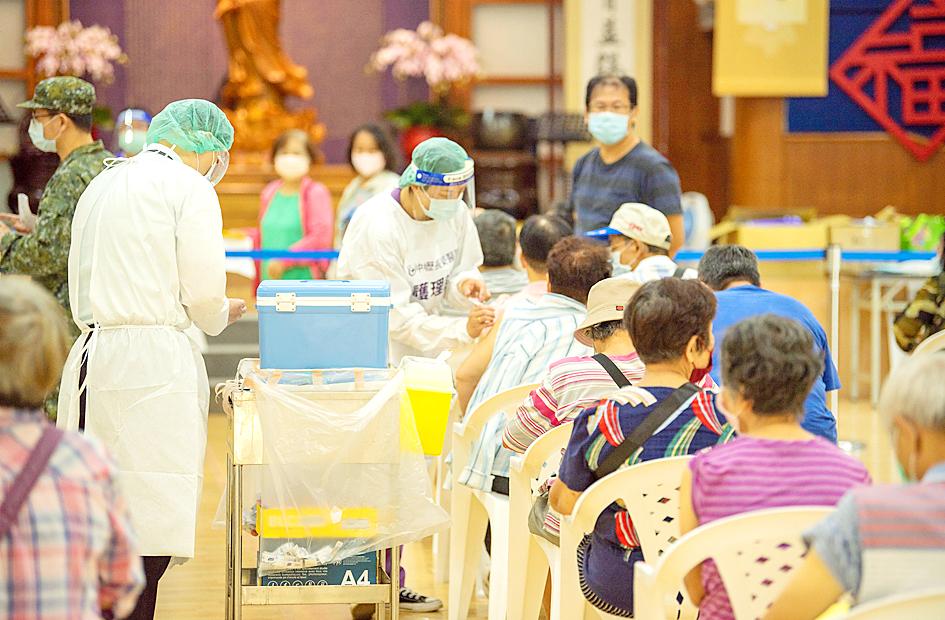
Photo: Lee Jung-ping, Taipei Times
Regarding Medigen Vaccine Biologics Corp’s (高端疫苗) vaccine, Chuang said that anyone aged 20 or older who has not yet received their first dose of a COVID-19 vaccine is eligible to book a vaccination appointment directly with a contracted healthcare facility or a hospital affiliated with the Ministry of Health and Welfare.
Those who received their first dose of the Medigen vaccine more than 28 days ago can book an appointment for the second directly with a healthcare facility, without going through the national online COVID-19 vaccination booking system, he added.
As more of the Pfizer-BioNTech vaccine has been arriving in Taiwan than other vaccine brands, the center has been asked whether it would consider allowing the mix-and-match approach.
Eligibility for Pfizer-BioNTech has been expanded to those aged 47 or older, as well as young people aged 12 to 22, so if more shipments of the brand arrive soon, eligibility is likely to be extended to those aged 12 or older who have yet to receive their first dose, Chuang said.
Yesterday, the center reported no new local COVID-19 infections or deaths, but there were five imported cases, including one breakthrough case: a Taiwan-based airline pilot who became infected.
Minister of Health and Welfare Chen Shih-chung (陳時中), who heads the center, said that the pilot lives in Taipei.
She quarantined for five days at a hotel after returning to Taiwan and tested negative in a polymerase chain reaction test before going home for enhanced self-health management, but tested positive on Tuesday, with a cycle threshold (CT) value of 33, he said in response to media queries.
The case is temporarily listed as an imported case, Chen said.
Chuang said that a second test yesterday morning showed that her CT value had dropped to 22, indicating a higher viral load, while an antibody test indicated that she had contracted the virus recently.
CDC Deputy Director-General Philip Lo (羅一鈞), deputy head of the CECC’s medical response division, said that AstraZeneca was the vaccine used in the three previous cases of breakthrough infections involving Taiwan-based airline pilots, while this pilot had received Moderna Inc’s COVID-19 vaccine.
The pilot had contact with her two children at home, so their two classes at two elementary schools were suspended as a precaution.
Taipei Deputy Mayor Vivian Huang (黃珊珊) said that 114 students and teachers at two elementary schools — in Daan District (大安) and Wenshan District (文山) — as well as a cram school at which the two children studied in on Mondays and Tuesdays, have been ordered to practice enhanced self-health management.
The two classes are to be suspended for five days — until Sunday — and the students and teachers were instructed to get tested for COVID-19 from yesterday, she said.
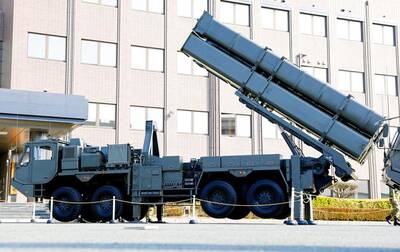
Japan has deployed long-range missiles in a southwestern region near China, the Japanese defense minister said yesterday, at a time when ties with Beijing are at their lowest in recent years. The missiles were installed in Kumamoto in the southern region of Kyushu, as Japan is attempting to shore up its military capacity as China steps up naval activity in the East China Sea. “Standoff defense capabilities enable us to counter the threat of enemy forces attempting to invade our country ... while ensuring the safety of our personnel,” Japanese Minister of Defense Shinjiro Koizumi said. “This is an extremely important initiative for

MORE POPULAR: Taiwan Pass sales increased by 59 percent during the first quarter compared with the same period last year, the Tourism Administration said The Tourism Administration yesterday said that it has streamlined the Taiwan Pass, with two versions available for purchase beginning today. The tourism agency has made the pass available to international tourists since 2024, allowing them to access the high-speed rail, Taiwan Railway Corp services, four MRT systems and four Taiwan Tourist Shuttles. Previously, five types of Taiwan Pass were available, but some tourists have said that the offerings were too complicated. The agency said only two types of Taiwan Pass would be available, starting from a three-day pass with the high-speed rail and a three-day pass with Taiwan Railway Corp. The former costs NT$2,800

POLLS CONCERNS: There are concerns within the KMT that a Cheng Li-wun-Xi Jinping meeting could trigger a voter backlash in elections in November Chinese Nationalist Party (KMT) Chairwoman Cheng Li-wun (鄭麗文) accepted an invitation from Chinese President Xi Jinping (習近平) to visit next month, her party and Chinese state media reported yesterday. Cheng, who took up her role in November last year, “gladly accepted” the invitation to lead a delegation to China, the KMT said in a statement, confirming a Xinhua news agency report. Cheng “looks forward to joint efforts by both parties to advance the peaceful development of cross-strait relations, promote cross-strait exchanges and cooperation, and work for peace in the Taiwan Strait and greater well-being for people on both sides,” the statement said. Chinese

SIGNIFICANT TO THE WORLD: The delegation’s visit aims to send a clear message that bipartisan support for Taiwan is consistent, US Senator Jeanne Shaheen said The US Senate’s bipartisan support for Taiwan remains strong and Taiwan-US ties would continue for decades to come, a US Senate delegation said in Taipei yesterday, while calling on the legislature to swiftly pass a special defense budget bill. A US delegation led by Democratic US Senator Jeanne Shaheen and Republican US Senator John Curtis — both members of the US Senate Committee on Foreign Relations — arrived in Taiwan yesterday for a two-day visit. The other senators of the delegation included Senate Taiwan Caucus cochair Thom Tillis and Senate Committee on Armed Services senior member Jacky Rosen. Shaheen told a news


 RSS
RSS