


Washington has confirmed to Taipei that its policy toward Taiwan remains unchanged, the Presidential Office said yesterday.
The US is to maintain its commitments to Taiwan in accordance with the Taiwan Relations Act and the “six assurances,” Presidential Office spokesman Xavier Chang (張惇涵) said in a statement.
The Presidential Office issued the remarks after US President Joe Biden — who for the first time since taking office was responding to Chinese military sorties near Taiwan — told Chinese President Xi Jinping (習近平) that the two nations should stick to the “Taiwan agreement.”
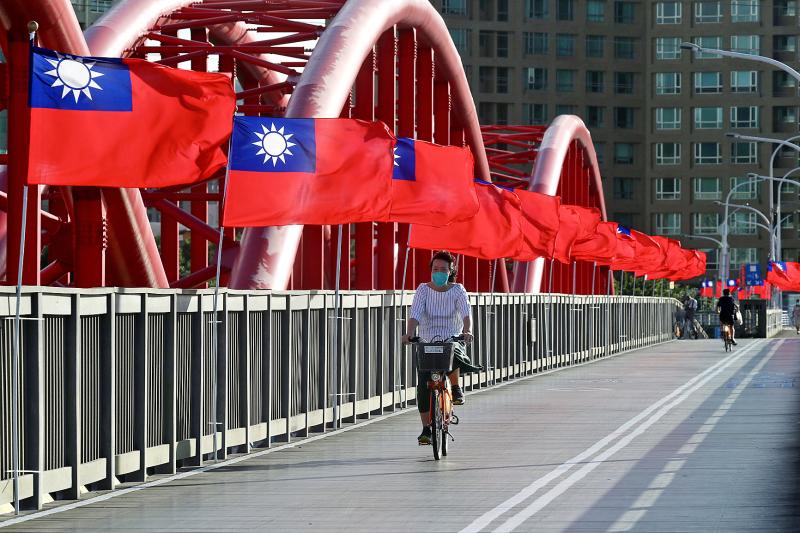
Photo: Ritchie B. Tongo, EPA-EFE
“I’ve spoken with Xi about Taiwan. We agree ... we will abide by the Taiwan agreement,” Biden told reporters at the White House after returning from a trip to Michigan when asked about China’s military maneuvers in the South China Sea.
“That’s where we are and we made it clear that I don’t think he should be doing anything other than abiding by the agreement,” he said, without specifying what agreement he was referring to.
NO CHANGE
Following Biden’s remarks about the “Taiwan agreement,” the Ministry of Foreign Affairs immediately checked with US officials in Taipei and Washington, who reassured ministry officials that US has not changed its policy toward Taiwan, ministry spokeswoman Joanne Ou (歐江安) said in a statement.
As the US Department of State’s statement on Sunday shows, the US’ policy toward Taiwan is predicated on its Taiwan Relations Act and the “six assurances,” Ou said.
The US has reiterated that its commitment to Taiwan is rock solid, and that it would continue to assist Taiwan in maintaining adequate self-defense capabilities, she added.
COMMITTED
Asked to clarify the “Taiwan agreement,” the American Institute in Taiwan (AIT) also referred to the US state department’s statement, without commenting further.
The ministry thanked the Biden administration for reiterating its commitment to Taiwan, Ou said.
In the face of Chinese military, diplomatic and economic pressure, Taiwan and the US have been maintaining close and smooth communication, she said.
The government would continue to bolster its self-defense capabilities, in a bid to defend Taiwan’s freedoms and democratic institutions, while continuing to work with the US and other like-minded partners in defending a rules-based international order, Ou added.
This month, the Chinese People’s Liberation Army (PLA) has deployed a record number of aircraft in military exercises near Taiwan, a move criticized by Taipei as a provocation and an attempt to intimidate.
Over the past five days, 150 PLA warplanes have entered the southwestern part of Taiwan’s air defense identification zone, according to the Ministry of National Defense, which has made the data available on its Web site since September last year.
BACKUP
The dispute over Taiwan was expected to be on the agenda when US National Security Adviser Jake Sullivan and top Chinese diplomat Yang Jiechi (楊潔篪) met in Zurich, Switzerland, later yesterday.
The talks are the highest-level meeting between the two nations since an acrimonious exchange in Anchorage, Alaska, in March and are the latest sign of a potential diplomatic thaw between them.
Additional reporting by Lin Chia-nan and Bloomberg

‘NO SECURITY RISK’: The Railway Bureau reassured the public that the technicians’ activities were limited to technical guidance and did not involve sensitive systems The Railway Bureau yesterday said it had invited eight Chinese technicians to assist with an airport MRT construction project. The bureau issued the confirmation after an Internet user said Chinese nationals had entered the construction zone of Taiwan Taoyuan International Airport’s Terminal 3 project. They asked why “individuals from an enemy state” were allowed access to such a major national infrastructure project, which raised serious concerns over Taiwan’s industrial safety, sensitive systems and information security. The bureau’s Northern Region Engineering Branch Office said subcontractor Taiwan Handle Industrial Co (台灣手把工業) of the Taoyuan airport MRT’s “Contract No. CU05 Project A14 Station Civil, MEP &

A US uncrewed surface vessel (USV) encountered multiple Chinese warships during an autonomous transit of the Taiwan Strait, US defense company Seasats said in a statement on Wednesday. Seasats announced that a Lightfish USV had completed the first autonomous transit of the Taiwan Strait. Over five days, the USV traversed the entire length of the Strait while constantly monitoring surface vessel traffic, the company said. The Lightfish encountered multiple Chinese warships, one of which was a Chinese People’s Liberation Army Navy (PLAN) Type 056 corvette, it said. The Chinese vessels were operating “well within Taiwan’s exclusive economic zone without transmitting their identity via the
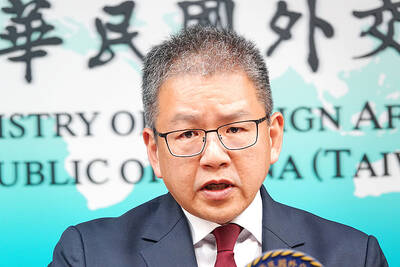
Taiwan is still in the process of assessing the possibility of recruiting workers from Eswatini, the Ministry of Foreign Affairs said yesterday, adding that its goal is to help Eswatini upgrade its vocational training centers. If there are plans to recruit workers from Eswatini, safeguarding national security, protecting public health and ensuring the employment rights of Taiwanese would be prerequisites, Department of West Asian and African Affairs Director-General Yen Chia-liang (顏嘉良) told a news conference. Key considerations would also include filling labor shortages in specific industries, and fostering bilateral professional and technical exchanges, he said. Yen was asked about the progress of labor
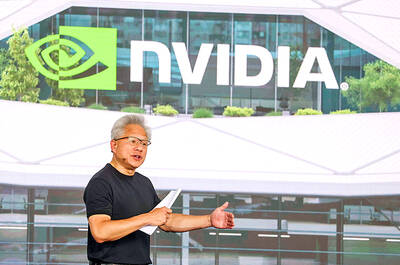
‘BOOMING’: ’ The number of partners we have here is incredible. You can see from their stock prices. They’re doing so well, they’re so happy,’ Jensen Huang said Nvidia Corp’s spending in Taiwan has ballooned to about US$150 billion a year, 10 times the US$10 billion to US$15 billion the company spent five years ago, Nvidia chief executive officer Jensen Huang (黃仁勳) said yesterday, suggesting Taiwan’s strategic importance in the global artificial intelligence (AI) supply chain. “Taiwan is the epicenter of the AI revolution. This is where the chips come, packaging comes. This is where the systems are made. This is where AI supercomputers were created,” Huang said at a meeting for the company’s employees in Beitou-Shilin Technology Park (北投士林科技園區) in Taipei, the planned site of Nvidia’s Taipei headquarters. “Taiwan


 RSS
RSS