


Nearly 2.07 million people yesterday applied for the digital version of the Quintuple Stimulus Vouchers, which the government is to issue to stimulate consumer spending, the Ministry of Economic Affairs (MOEA) said.
At 9am, a government Web site began to accept applications from people who intend to link the vouchers, valued at NT$5,000 (US$180), to a credit card or mobile payment service. The stimulus vouchers can be used from Oct. 8.
The Web site recorded heavy traffic during the first three hours, as more than 3.51 million people visited the site, the ministry said, adding that by 9pm, the Web site had recorded 10.28 million visits.

Photo: CNA
Of the applications, 1.61 million were for personal use, while 463,508 were for pooled used with friends or relatives, ministry data showed.
People can link the vouchers to credit cards or mobile payment services, such as Apple Pay or Line Pay, or add the value of the vouchers to stored value cards, such as EasyCard and iPass.
With Taiwan’s recent COVID-19 outbreak having eased, President Tsai Ing-wen (蔡英文) wrote on Facebook: “Now, we need to begin stimulating the economy.”
She reminded those who would prefer the physical version of the vouchers to register through the Web site from Saturday and to spend them before April 30 next year.
This is the second time that the government has issued spending vouchers to boost consumption after COVID-19 restrictions affected many retail businesses.
In July last year, the government issued the first round of spending vouchers of NT$3,000, for which people needed to pay NT$1,000 and which expired on Dec. 31 that year. This time, no upfront payment is required.
According to the ministry, 23.32 million people, or 98.35 percent of those eligible, collected the vouchers in the first round, leading to spending of nearly NT$64.48 billion.
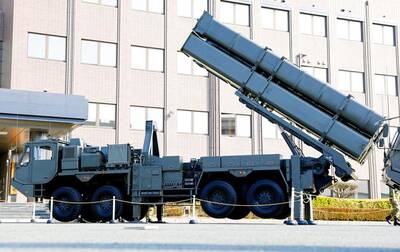
Japan has deployed long-range missiles in a southwestern region near China, the Japanese defense minister said yesterday, at a time when ties with Beijing are at their lowest in recent years. The missiles were installed in Kumamoto in the southern region of Kyushu, as Japan is attempting to shore up its military capacity as China steps up naval activity in the East China Sea. “Standoff defense capabilities enable us to counter the threat of enemy forces attempting to invade our country ... while ensuring the safety of our personnel,” Japanese Minister of Defense Shinjiro Koizumi said. “This is an extremely important initiative for

The nation’s fastest supercomputer, Nano 4 (晶創26), is scheduled to be launched in the third quarter, and would be used to train large language models in finance and national defense sectors, the National Center for High-Performance Computing (NCHC) said. The supercomputer, which would operate at about 86.05 petaflops, is being tested at a new cloud computing center in the Southern Taiwan Science Park in Tainan. The exterior of the server cabinet features chip circuitry patterns overlaid with a map of Taiwan, highlighting the nation’s central position in the semiconductor industry. The center also houses Taiwania 2, Taiwania 3, Forerunner 1 and
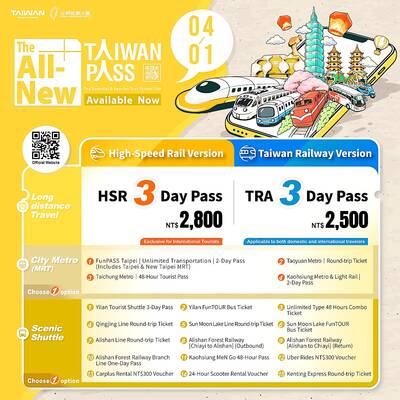
MORE POPULAR: Taiwan Pass sales increased by 59 percent during the first quarter compared with the same period last year, the Tourism Administration said The Tourism Administration yesterday said that it has streamlined the Taiwan Pass, with two versions available for purchase beginning today. The tourism agency has made the pass available to international tourists since 2024, allowing them to access the high-speed rail, Taiwan Railway Corp services, four MRT systems and four Taiwan Tourist Shuttles. Previously, five types of Taiwan Pass were available, but some tourists have said that the offerings were too complicated. The agency said only two types of Taiwan Pass would be available, starting from a three-day pass with the high-speed rail and a three-day pass with Taiwan Railway Corp. The former costs NT$2,800

FIRST TRIAL: Ko’s lawyers sought reduced bail and other concessions, as did other defendants, but the bail judge denied their requests, citing the severity of the sentences Former Taipei mayor Ko Wen-je (柯文哲) was yesterday sentenced to 17 years in prison and had his civil rights suspended for six years over corruption, embezzlement and other charges. Taipei prosecutors in December last year asked the Taipei District Court for a combined 28-year, six-month sentence for the four cases against Ko, who founded the Taiwan People’s Party (TPP). The cases were linked to the Core Pacific City (京華城購物中心) redevelopment project and the mismanagement of political donations. Other defendants convicted on separate charges included Chinese Nationalist Party (KMT) Taipei City Councilor Angela Ying (應曉薇), who was handed a 15-year, six-month sentence; Core Pacific


 RSS
RSS