


Typhoon Chanthu yesterday unleashed powerful winds and heavy rain on eastern Taiwan, disrupting travel and cutting electricity to thousands of homes, but sparing the island a direct hit.
Downgraded from a super typhoon since its rapid formation last week, the outer edges of Chanthu pounded the eastern coastline, while its eye remained offshore as it moved north, the Central Weather Bureau said.
The greater Taipei area witnessed the heaviest rain, with Pinglin District (坪林) in New Taipei City recording about 180mm of rainfall from midnight on Saturday to 5pm yesterday.
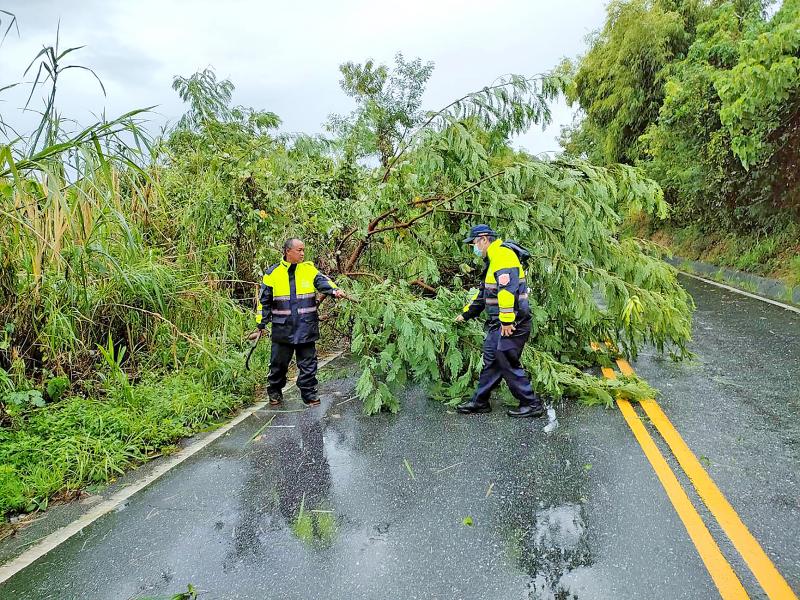
Photo courtesy of Fengbin Township Office via CNA
As of 5pm, Chanthu was about 120km northeast of Taipei, moving north at 26kph, the bureau said.
The typhoon was packing sustained winds of up to 162kph, with gusts of up to 198kph, it said.
A land warning issued for Chanthu was to expire at 8:30pm yesterday, it added.
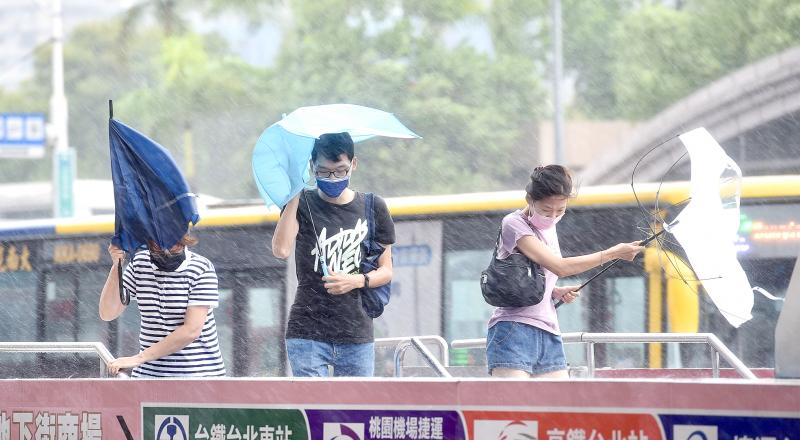
Photo: Peter Lo, Taipei Times
A total of 159 domestic and international flights were canceled due to the typhoon, and all ferry services to outlying islands were also suspended, along with some train services, the Central Emergency Operations Center (CEOC) said.
About 2,600 people in landslide-prone areas in Hualien were evacuated, while about 31,000 troops were on standby for relief work, it said.
The storm knocked out power to 28,659 households, the Ministry of Economic Affairs said, adding that as of 1pm yesterday, power had been restored to all except 2,942 households in Yilan, Hualien and Taitung counties in the east, and Taichung and Changhua County in the west.
No major injuries had been reported as of press time last night.
The storm caused the most damage in Taipei and New Taipei City, where it toppled trees, the CEOC said, citing reports it received from across the nation.
Taiwan is regularly hit by tropical storms in the summer months.
In a rare exception to the rule, not a single typhoon made landfall last year, the first time in 56 years. That helped fuel the worst water shortage in Taiwan in decades until heavy rains brought much-needed relief in early summer.

‘NO SECURITY RISK’: The Railway Bureau reassured the public that the technicians’ activities were limited to technical guidance and did not involve sensitive systems The Railway Bureau yesterday said it had invited eight Chinese technicians to assist with an airport MRT construction project. The bureau issued the confirmation after an Internet user said Chinese nationals had entered the construction zone of Taiwan Taoyuan International Airport’s Terminal 3 project. They asked why “individuals from an enemy state” were allowed access to such a major national infrastructure project, which raised serious concerns over Taiwan’s industrial safety, sensitive systems and information security. The bureau’s Northern Region Engineering Branch Office said subcontractor Taiwan Handle Industrial Co (台灣手把工業) of the Taoyuan airport MRT’s “Contract No. CU05 Project A14 Station Civil, MEP &

The National Chungshan Institute of Science and Technology yesterday showcased its locally developed variants of the Vision 60 robotic patrol dog, which it plans to deploy on the nation’s outlying territories in the South China Sea. The variants were produced under the Joint Lab project — created by the institute and domestic companies — and assembled with domestically produced motors, lenses and artificial intelligence (AI) systems alongside licensed tech from the US, Missile and Rocket Systems Research Division deputy director Jen Kuo-kang (任國光) told the media event at a military base in Taipei’s Dazhi (大直) area. Taiwan has built up its strengths

TIT-FOR-TAT: The US allegedly revoked the visa of a Chinese national working at Xinhua News Agency in the US in response to Beijing’s expulsion of Vivian Wang The Presidential Office yesterday condemned China for expelling a New York Times correspondent from Beijing following the newspaper’s interview with President William Lai (賴清德), saying the move highlighted Beijing’s suppression of press freedom and its threat to international news media. Taiwan has noted a series of recent incidents in which Beijing used similar tactics to “threaten and pressure international media outlets and journalists,” Presidential Office spokeswoman Karen Kuo (郭雅慧) said in a statement. “This concerns not only press freedom and freedom of expression, but also the safety of journalists, and Taiwan and relevant partners are paying close attention to the situation,” she

NOT IMMEDIATE: Taiwan has a chance to appeal the proposed 10 percent tariff before it starts, while other countries face a 12.5 percent tariff from the trade office Taiwan is among 60 economies determined by the US to have failed to impose or enforce a ban on the importation of goods produced with forced labor, according to a notice released on Tuesday by the Office of the US Trade Representative (USTR), which proposed imposing an additional 10 percent or more tariff on them. The USTR in a statement said that following an investigation, it had determined under Section 301 of the Trade Act of 1974 that the failure of the 60 economies to impose and effectively enforce a prohibition on the importation of goods produced with forced labor is


 RSS
RSS