


US President Joe Biden on Thursday spoke with Chinese President Xi Jinping (習近平) amid growing frustration in Washington that high-level engagement between the leaders’ top advisers has been largely unfruitful in the early months of the Biden presidency.
Biden initiated the call with Xi, the second between them since the US president took office. It comes at a time when there is no shortage of thorny issues between the nations, including cybersecurity breaches originating from China, Beijing’s handling of the COVID-19 pandemic, and what the White House has called “coercive and unfair” trade practices.
However, Biden’s aim with the 90-minute call was less focused on any of the hot-button issues and instead centered on discussing the way ahead for the US-China relationship after it got off to a decidedly rocky start in his tenure.
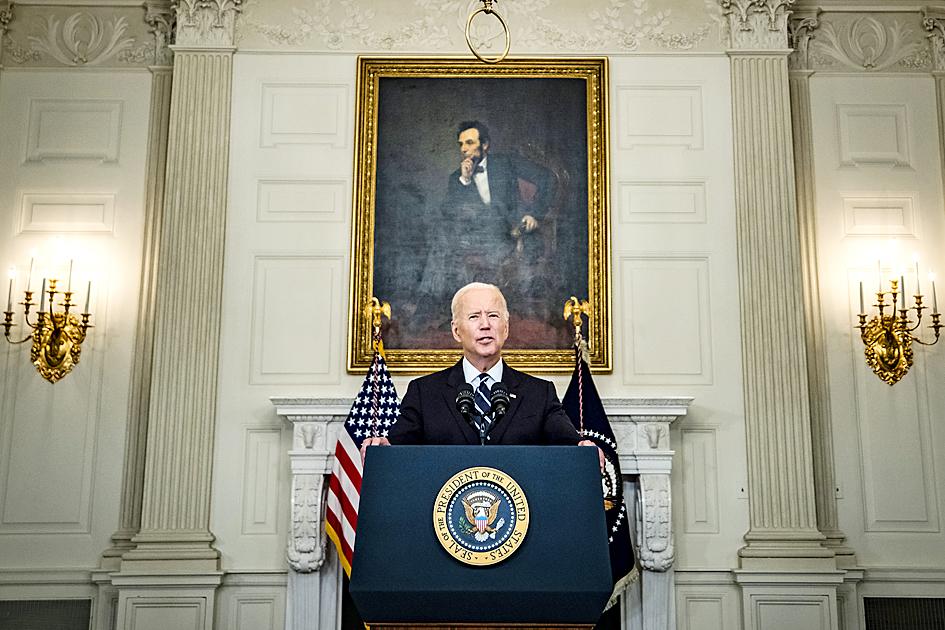
Photo: Bloomberg
The White House said in a statement that the “two leaders had a broad, strategic discussion in which they discussed areas where our interests converge, and areas where our interests, values, and perspectives diverge.”
The White House is hopeful that the two sides can work together on issues of mutual concern — including climate change and preventing a nuclear crisis on the Korean Peninsula — despite growing differences.
However, Beijing has pushed back against US pressure and has increasingly suggested that it could remain broadly uncooperative until Biden dials down criticism on what it deems Chinese internal matters.
Xi in the call appeared to echo some of the complaints, telling Biden that US government policy toward China caused “serious difficulties” in the relations, Xinhua news agency reported.
“This is not in the basic interests of the two peoples,” Xinhua cited Xi as saying.
“Chinese-US confrontation will bring disaster to both countries and the world,” Xi added.
He told Biden that the two sides should cooperate on climate change, epidemic prevention, economic recovery and other issues, Xinhua reported.
Ahead of the call, a senior US official said that the White House has been unsatisfied with early engagements with Beijing.
The official, who spoke on condition of anonymity, said that White House officials were hopeful that Xi hearing directly from Biden could prove beneficial.
The White House official said that Biden made clear to Xi that he had no intention of moving away from his administration’s policy of pressing China on human rights, trade and other areas where it believes China is acting outside international norms.
High-level engagement has in the past few months been most notable for each side blasting the other with recriminations.
In Taipei, Ministry of Foreign Affairs spokeswoman Joanne Ou (歐江安) said in a statement that the ministry closely monitors the interactions between high-ranking US and Chinese officials.
Taiwan and the US maintain close communications, and the Taipei Economic and Cultural Representative Office in the US would ask to be briefed on the matter and whether it would affect Washington’s ties with the nation, Ou said.
One of the key states in the Indo-Pacific region, Taiwan is in a pivotal position in the first island chain, and has been making salient contributions to the region’s prosperity and stability, she added.
Taiwan would continue to deepen relations with the US and other like-minded countries to defend their shared values of democracy, freedom, human rights and a rules-based international order, as well as peace, stability and prosperity across the Taiwan Strait, and in the Indo-Pacific region, she said.
Additional reporting by Lin Chia-nan

Japan has deployed long-range missiles in a southwestern region near China, the Japanese defense minister said yesterday, at a time when ties with Beijing are at their lowest in recent years. The missiles were installed in Kumamoto in the southern region of Kyushu, as Japan is attempting to shore up its military capacity as China steps up naval activity in the East China Sea. “Standoff defense capabilities enable us to counter the threat of enemy forces attempting to invade our country ... while ensuring the safety of our personnel,” Japanese Minister of Defense Shinjiro Koizumi said. “This is an extremely important initiative for

MORE POPULAR: Taiwan Pass sales increased by 59 percent during the first quarter compared with the same period last year, the Tourism Administration said The Tourism Administration yesterday said that it has streamlined the Taiwan Pass, with two versions available for purchase beginning today. The tourism agency has made the pass available to international tourists since 2024, allowing them to access the high-speed rail, Taiwan Railway Corp services, four MRT systems and four Taiwan Tourist Shuttles. Previously, five types of Taiwan Pass were available, but some tourists have said that the offerings were too complicated. The agency said only two types of Taiwan Pass would be available, starting from a three-day pass with the high-speed rail and a three-day pass with Taiwan Railway Corp. The former costs NT$2,800

POLLS CONCERNS: There are concerns within the KMT that a Cheng Li-wun-Xi Jinping meeting could trigger a voter backlash in elections in November Chinese Nationalist Party (KMT) Chairwoman Cheng Li-wun (鄭麗文) accepted an invitation from Chinese President Xi Jinping (習近平) to visit next month, her party and Chinese state media reported yesterday. Cheng, who took up her role in November last year, “gladly accepted” the invitation to lead a delegation to China, the KMT said in a statement, confirming a Xinhua news agency report. Cheng “looks forward to joint efforts by both parties to advance the peaceful development of cross-strait relations, promote cross-strait exchanges and cooperation, and work for peace in the Taiwan Strait and greater well-being for people on both sides,” the statement said. Chinese
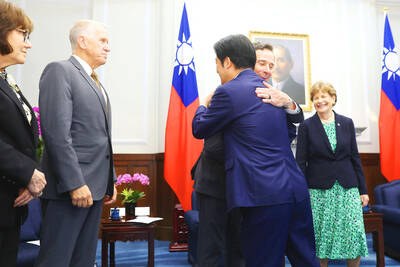
SIGNIFICANT TO THE WORLD: The delegation’s visit aims to send a clear message that bipartisan support for Taiwan is consistent, US Senator Jeanne Shaheen said The US Senate’s bipartisan support for Taiwan remains strong and Taiwan-US ties would continue for decades to come, a US Senate delegation said in Taipei yesterday, while calling on the legislature to swiftly pass a special defense budget bill. A US delegation led by Democratic US Senator Jeanne Shaheen and Republican US Senator John Curtis — both members of the US Senate Committee on Foreign Relations — arrived in Taiwan yesterday for a two-day visit. The other senators of the delegation included Senate Taiwan Caucus cochair Thom Tillis and Senate Committee on Armed Services senior member Jacky Rosen. Shaheen told a news


 RSS
RSS