


The Central Epidemic Command Center (CECC) yesterday extended a nationwide level 2 COVID-19 alert for two more weeks, as it reported nine locally transmitted infections, seven imported cases and no new COVID-19 deaths.
The two-week extension, which starts today and ends on Sept. 20, would include updates to some current restrictions, Minister of Health and Welfare Chen Shih-chung (陳時中), who heads the center, told a news conference in Taipei.
The main changes include increasing passenger capacity on trains and tour buses, increasing the number of people permitted at certain tourist sites, and conditionally reopening showering facilities, spa areas and children’s pools at sports venues, Chen said.
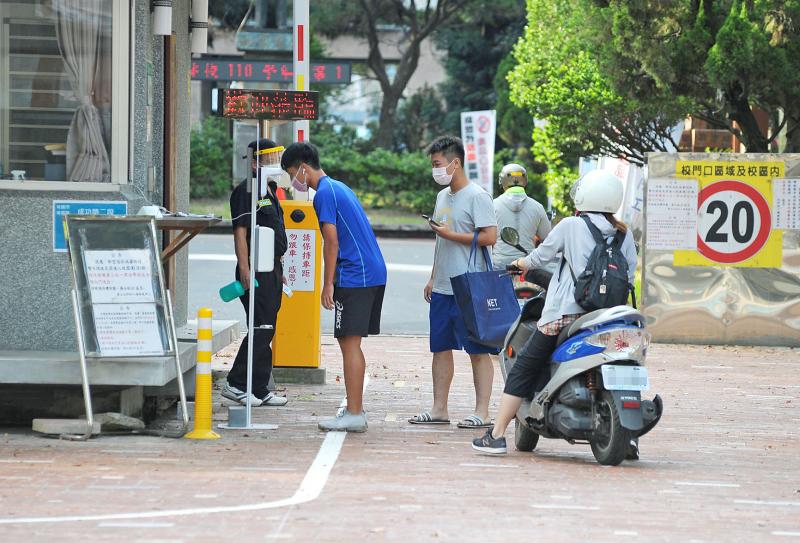
Photo: CNA
Capacity on tour buses is to increase to 80 percent of seating, he said, adding that passengers must wear masks at all times and would not be allowed to eat or drink.
National scenic areas and amusement parks would be permitted to increase capacity to 80 percent of their maximum, he said.
Sales of tickets for reserved seating on all Taiwan Railways Administration and Taiwan High Speed Rail Corp trains would be allowed, while standing tickets would not be permitted, he added.
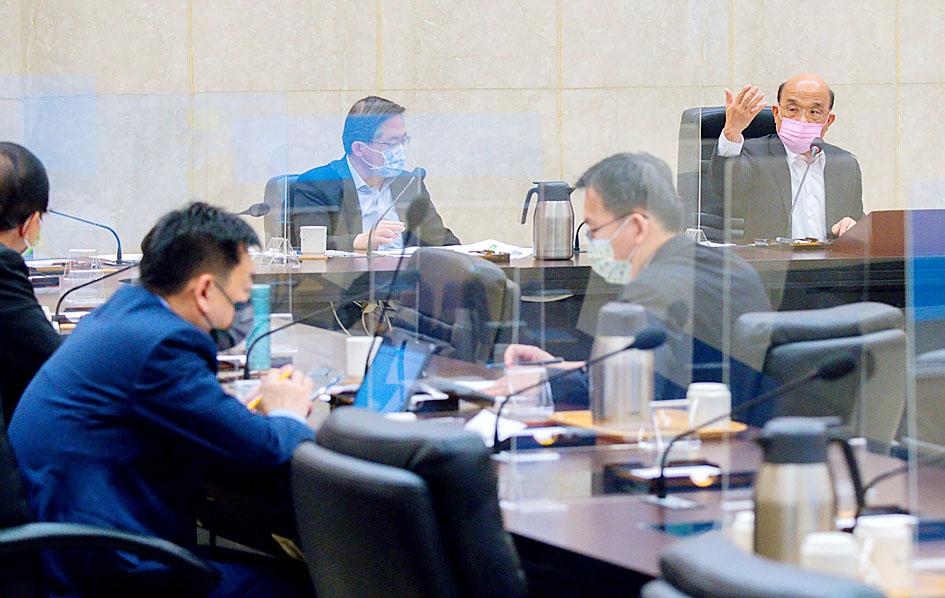
Photo courtesy of the Executive Yuan via CNA
All recent local infections were in New Taipei City and linked to a previous case reported on Sunday — a preschool teacher who tested positive for COVID-19 along with her husband, Chen said.
Eight of the cases are preschool students and one is a parent, he said.
“We expect there might be more cases not yet found in the cluster,” he said. “We have asked the New Taipei City Government to use strict standards in identifying people at risk of infection. Some have been placed under home isolation as a precaution.”
As the preschool has an after-school tutoring service used by a different group of teachers and students, the CECC asked the city government to test them and place them under home isolation, he said.
“We are quite concerned about the cluster, as the positive testing rate so far has been high,” he said, adding that among 75 close contacts who were identified for testing, 49 have been tested and nine have tested positive.
Six people in the group have tested negative, while 34 were waiting for the results of their tests and 26 have yet to be tested.
Among 109 close contacts of the preschool teacher and her husband, 60 people have been placed under home isolation and 49 have been asked to perform self-health management, the center said.
Regarding the imported cases, five of them are crew of a cargo ship that docked at Kaohsiung, Chen said, adding that the remaining crew members were being isolated in separate compartments on the ship.
The genomic sequencing of a virus sample taken from an aircrew cluster reported last week — which included two fully vaccinated Eva Airways Corp (長榮航空) cargo pilots and a son of one of them — showed that they were infected with the Delta variant of SARS-CoV-2, Chen said.
The viral sequence of the three cases was not the same as a previous vaccine breakthrough infection case — an EVA Airways pilot reported on Aug. 28 — although they were all infected with the Delta variant, he said.
Even though everyone at the school attended by the pilot’s son tested negative, the center has sent a letter to the parents and students, urging them to avoid unnecessary outings and to practice social distancing at home, he said.

PROVOCATIVE: Chinese Deputy Ambassador to the UN Sun Lei accused Japan of sending military vessels to deliberately provoke tensions in the Taiwan Strait China denounced remarks by Japan and the EU about the South China Sea at a UN Security Council meeting on Monday, and accused Tokyo of provocative behavior in the Taiwan Strait and planning military expansion. Ayano Kunimitsu, a Japanese vice foreign minister, told the Council meeting on maritime security that Tokyo was seriously concerned about the situation in the East China and South China seas, and reiterated Japan’s opposition to any attempt to change the “status quo” by force, and obstruction of freedom of navigation and overflight. Stavros Lambrinidis, head of the EU delegation to the UN, also highlighted South China Sea

The final batch of 28 M1A2T Abrams tanks purchased from the US arrived at Taipei Port last night and were transported to the Armor Training Command in Hsinchu County’s Hukou Township (湖口), completing the military’s multi-year procurement of 108 of the tanks. Starting at 12:10am today, reporters observed more than a dozen civilian flatbed trailers departing from Taipei Port, each carrying an M1A2T tank covered with black waterproof tarps. Escorted by military vehicles, the convoy traveled via the West Coast Expressway to the Armor Training Command, with police implementing traffic control. The army operates about 1,000 tanks, including CM-11 Brave Tiger
Taiwan Semiconductor Manufacturing Co (TSMC, 台積電), the world’s largest contract chipmaker, said it expects its 2-nanometer (2nm) chip capacity to grow at a compound annual rate of 70 percent from this year to 2028. The projection comes as five fabs begin volume production of 2-nanometer chips this year — two in Hsinchu and three in Kaohsiung — TSMC senior vice president and deputy cochief operating officer Cliff Hou (侯永清) said at the company’s annual technology symposium in Silicon Valley, California, last week. Output in the first year of 2-nanometer production, which began in the fourth quarter of last year, is expected to

Taiwan’s drone exports surged past US$100 million in the first quarter, exceeding last year’s full-year total, with the Czech Republic emerging as the largest buyer, the Ministry of Economic Affairs said. Exports of complete drones reached US$115.85 million in the period, about 1.2 times the total recorded for all of last year, the ministry said in a report. Exports to the Czech Republic accounted for about US$100 million, far outpacing other markets. Poland, last year’s top destination, recorded about US$11.75 million in the first quarter. Taiwan’s drone exports have expanded rapidly in the past few years, with last year’s total


 RSS
RSS