


The Ministry of Foreign Affairs yesterday thanked US Secretary of State Antony Blinken for expressing “ironclad” solidarity with Lithuania and support for it expanding ties with Taiwan in a call with Lithuanian Minister of Foreign Affairs Gabrielius Landsbergis on Saturday.
In the call, Blinken reaffirmed the “strength and breadth” of US ties with its NATO ally and solidarity “in the face of the People’s Republic of China’s coercive behavior,” the US Department of State said in a statement.
The two also discussed US support for the Belarusian democracy movement and condemnation of Belarusian President Alexander Lukashenko’s repressive regime, the statement said.
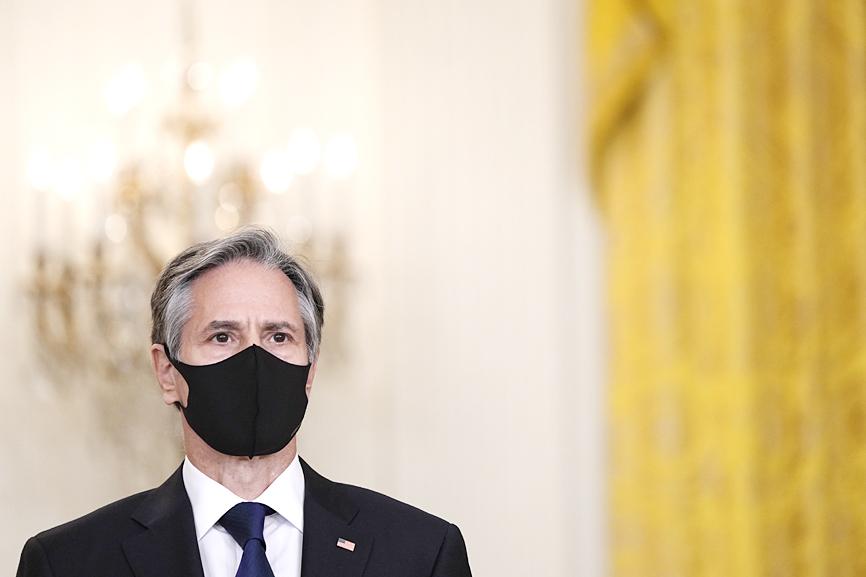
Photo: EPA-EFE
Blinken publicized the conversation on Twitter, saying he spoke with Landsbergis about “our support for Lithuania on its regional challenges, decision to expand ties with Taiwan, and support for the pro-democracy movement in Belarus.”
Minister of Foreign Affairs Joseph Wu (吳釗燮) yesterday replied to the tweet, expressing the ministry’s gratitude for US and Lithuanian support.
“The #US’s #IndoPacific partner & #NATO ally are forging closer ties for the good of the free world. Your backing toughens our resolve to fight off authoritarianism,” he wrote.
The ministry in a separate statement yesterday thanked the US for demonstrating leadership among global democracies, especially by expressing support for nations facing Chinese pressure.
Since taking office in January, the administration of US President Joe Biden has continually supported Taiwan and its improvement of ties with Lithuania, it said.
Washington has also expressed concern for Lithuania as it faces “unreasonable threats” from China, the ministry added.
“Taiwan is a force for good in the world and will continue to defend democracy, the rule of law and the protection of human rights without retreating under the threat of external pressures,” it said.
The ministry would continue to promote the development of concrete relations with like-minded nations, it added.
Blinken’s statement also signifies a higher level of support from the US government, after US Deputy Secretary of State Wendy Sherman expressed a similar sentiment earlier this month, the ministry said.
On Aug. 13, Sherman in a call with Landsbergis reiterated US solidarity with Lithuania, “including standing with them in the face of the People’s Republic of China’s recent coercive behavior in response to Lithuania’s decision to develop mutually beneficial ties with Taiwan,” the department said at the time.
Blinken’s conversation with Landsbergis comes on the heels of a rapid expansion of Taiwan-Lithuania ties over the past few months.
In June, Vilnius announced a donation of 20,000 doses of the AstraZeneca COVID-19 vaccine to Taiwan, which arrived last month.
The two nations also plan to set up respective representative offices, with Taiwan’s to be its first in Europe bearing the name “Taiwan.”
Beijing in response recalled its ambassador from Vilnius and plans to halt direct cargo train services to Lithuania conducted by state-owned China Railway Container Transport Co (中鐵集裝箱運輸公司) by the end of this month.

‘NO SECURITY RISK’: The Railway Bureau reassured the public that the technicians’ activities were limited to technical guidance and did not involve sensitive systems The Railway Bureau yesterday said it had invited eight Chinese technicians to assist with an airport MRT construction project. The bureau issued the confirmation after an Internet user said Chinese nationals had entered the construction zone of Taiwan Taoyuan International Airport’s Terminal 3 project. They asked why “individuals from an enemy state” were allowed access to such a major national infrastructure project, which raised serious concerns over Taiwan’s industrial safety, sensitive systems and information security. The bureau’s Northern Region Engineering Branch Office said subcontractor Taiwan Handle Industrial Co (台灣手把工業) of the Taoyuan airport MRT’s “Contract No. CU05 Project A14 Station Civil, MEP &

A signaling system malfunction disrupted high-speed rail (HSR) services beginning at 8am today, with trains temporarily reduced to three northbound and three southbound trains per hour as authorities conduct inspections. The malfunction occurred on a section of track in Miaoli County during pre-operation checks early this morning, forcing northbound and southbound trains to use a single track, the HSR operator said. The regular schedule has been replaced with three hourly trains offering only nonreserved seating in each direction, stopping at every station, it said, adding that business class cars would still have reserved seating. Departures from terminal stations are scheduled at the top

Taiwan is still in the process of assessing the possibility of recruiting workers from Eswatini, the Ministry of Foreign Affairs said yesterday, adding that its goal is to help Eswatini upgrade its vocational training centers. If there are plans to recruit workers from Eswatini, safeguarding national security, protecting public health and ensuring the employment rights of Taiwanese would be prerequisites, Department of West Asian and African Affairs Director-General Yen Chia-liang (顏嘉良) told a news conference. Key considerations would also include filling labor shortages in specific industries, and fostering bilateral professional and technical exchanges, he said. Yen was asked about the progress of labor

A US uncrewed surface vessel (USV) encountered multiple Chinese warships during an autonomous transit of the Taiwan Strait, US defense company Seasats said in a statement on Wednesday. Seasats announced that a Lightfish USV had completed the first autonomous transit of the Taiwan Strait. Over five days, the USV traversed the entire length of the Strait while constantly monitoring surface vessel traffic, the company said. The Lightfish encountered multiple Chinese warships, one of which was a Chinese People’s Liberation Army Navy (PLAN) Type 056 corvette, it said. The Chinese vessels were operating “well within Taiwan’s exclusive economic zone without transmitting their identity via the


 RSS
RSS