


A COVID-19 outbreak that started in May was unrelated to the relaxation of quarantine rules for aircrew members in April, Minister of Health and Welfare Chen Shih-chung (陳時中) said yesterday.
The Central Epidemic Command Center (CECC), which is headed by Chen, on April 15 allowed crew members on long-haul flights to isolate for just three days after their return. After testing negative for COVID-19, they were required to monitor their health for 11 days.
The relaxed rules, dubbed “three-plus-11,” have been criticized as many believe they led to the COVID-19 outbreak, prompting the CECC to imposed a nationwide level 3 pandemic alert from May 19 until July 27.
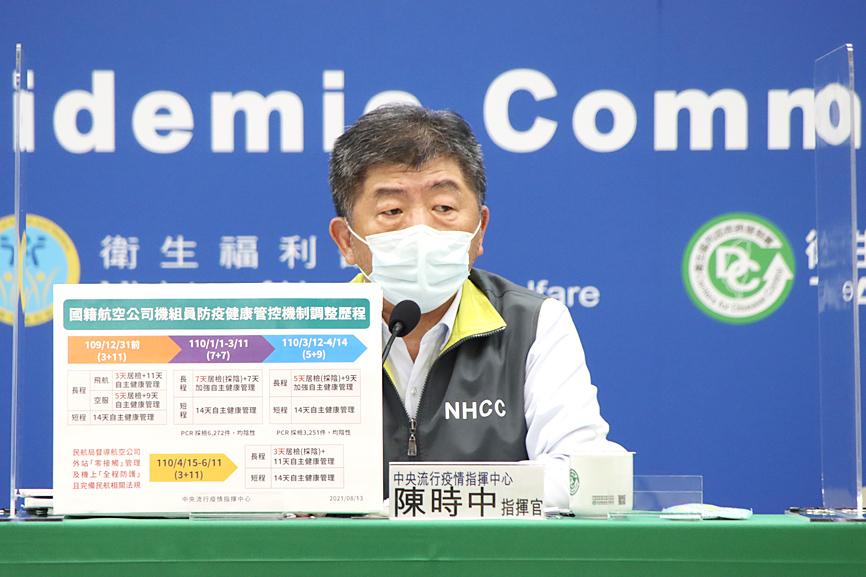
Photo courtesy of the Central Epidemic Command Center
Asked whether a planned resumption of quarantine-free travel between Taiwan and Palau might lead to another surge in infections, Chen on Thursday denied that the outbreak was related to the relaxed aircrew rules.
“There was no three-plus-11 loophole,” Chen said.
Cluster infections among China Airlines Ltd (中華航空) crew members and Novotel Taipei Taoyuan International Airport hotel employees did not spread to local communities, Chen said, adding that the cluster started with the infection of a China Airlines pilot who tested positive in Australia.
A version of the three-plus-11 policy without mandatory testing was in place last year, before being updated to a “seven-plus-seven” policy on Jan. 1, Chen said yesterday.
From March 12 to April 14, the center imposed a “five-plus-nine” policy, which was on April 15 updated to the three-plus-11 policy with additional measures to curb the spread of COVID-19 on planes, he said.
Since June 14, aircrew members returning from high-risk countries are required to quarantine for 14 days.
Chen said the adjustments were made according to the COVID-19 situations at the time.
A three-month investigation led by the CECC did not find a connection between the air crew cluster and the outbreak in May, he said.
Chen’s remarks were met with criticism online, with commenters urging him to take responsibility for Taiwan’s about 800 deaths due to COVID-19 since May.
In May, Chinese-language weekly magazine Mirror Media leaked a voice recording of an April 1 meeting about the the nation’s disease prevention measures in which Democratic Progressive Party Legislator Fan Yun (范雲) allegedly recommended the adoption of the three-plus-11 rule for aircrew members.
Yesterday, Fan said that she would cooperate should there be an investigation into the process that led to the relaxed rules.
Separately yesterday, Chinese Nationalist Party (KMT) caucus convener Alex Fai (費鴻泰), caucus secretary-general Jessica Chen (陳玉珍) and caucus deputy secretary-general Wan Mei-ling (萬美玲) said that Chen’s refusal to acknowledge that the rule change led to the May outbreak was “beyond shameless.”
The KMT caucus said that it would take Chen to court and report him to the Control Yuan.
Additional reporting by Chen Yun and CNA
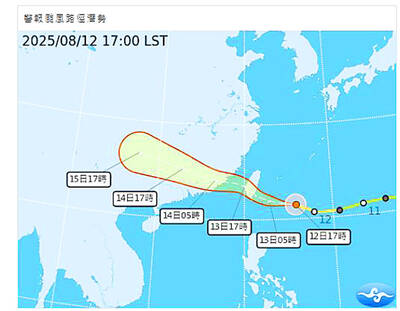
GET TO SAFETY: Authorities were scrambling to evacuate nearly 700 people in Hualien County to prepare for overflow from a natural dam formed by a previous typhoon Typhoon Podul yesterday intensified and accelerated as it neared Taiwan, with the impact expected to be felt overnight, the Central Weather Administration (CWA) said, while the Directorate-General of Personnel Administration announced that schools and government offices in most areas of southern and eastern Taiwan would be closed today. The affected regions are Tainan, Kaohsiung and Chiayi City, and Yunlin, Chiayi, Pingtung, Hualien and Taitung counties, as well as the outlying Penghu County. As of 10pm last night, the storm was about 370km east-southeast of Taitung County, moving west-northwest at 27kph, CWA data showed. With a radius of 120km, Podul is carrying maximum sustained
Tropical Storm Podul strengthened into a typhoon at 8pm yesterday, the Central Weather Administration (CWA) said, with a sea warning to be issued late last night or early this morning. As of 8pm, the typhoon was 1,020km east of Oluanpi (鵝鑾鼻), Taiwan’s southernmost tip, moving west at 23kph. The storm carried maximum sustained winds of 119kph and gusts reaching 155kph, the CWA said. Based on the tropical storm’s trajectory, a land warning could be issued any time from midday today, it added. CWA forecaster Chang Chun-yao (張竣堯) said Podul is a fast-moving storm that is forecast to bring its heaviest rainfall and strongest
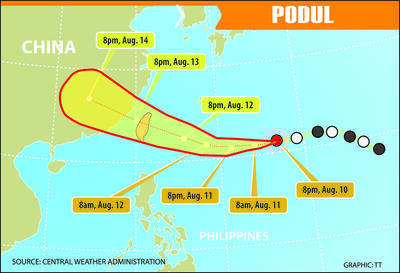
TRAJECTORY: The severe tropical storm is predicted to be closest to Taiwan on Wednesday and Thursday, and would influence the nation to varying degrees, a forecaster said The Central Weather Administration (CWA) yesterday said it would likely issue a sea warning for Tropical Storm Podul tomorrow morning and a land warning that evening at the earliest. CWA forecaster Lin Ting-yi (林定宜) said the severe tropical storm is predicted to be closest to Taiwan on Wednesday and Thursday. As of 2pm yesterday, the storm was moving west at 21kph and packing sustained winds of 108kph and gusts of up to 136.8kph, the CWA said. Lin said that the tropical storm was about 1,710km east of Oluanpi (鵝鑾鼻), Taiwan’s southernmost tip, with two possible trajectories over the next one

President William Lai (賴清德) yesterday criticized the nuclear energy referendum scheduled for Saturday next week, saying that holding the plebiscite before the government can conduct safety evaluations is a denial of the public’s right to make informed decisions. Lai, who is also the chairman of the Democratic Progressive Party (DPP), made the comments at the party’s Central Standing Committee meeting at its headquarters in Taipei. ‘NO’ “I will go to the ballot box on Saturday next week to cast a ‘no’ vote, as we all should do,” he said as he called on the public to reject the proposition to reactivate the decommissioned


 RSS
RSS