


The Central Epidemic Command Center (CECC) yesterday expanded registration for the national online COVID-19 vaccination booking system to include people aged 18 to 49.
From 9am yesterday, the booking system, 1922.gov.tw, started allowing people born in or before 2003 to register for vaccination, said Deputy Minister of the Interior Chen Tsung-yen (陳宗彥), the CECC deputy head.
However, due to heavy online traffic after the announcement, the server crashed yesterday morning, before stabilizing at about midday.
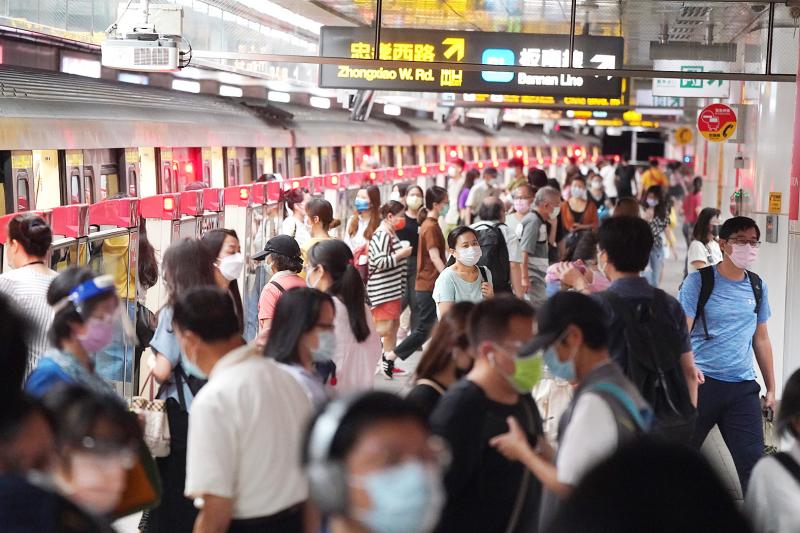
Photo: CNA
The eligibility was expanded from people in the ninth priority group — those aged 18 to 64 who have a high-risk disease, a rare disease or catastrophic illness — and the 10th priority group of people aged 50 to 64 when the system was launched last week.
The deadline for people in those two priority groups to register for inoculation was 5pm on Monday.
Minister Without Portfolio Audrey Tang (唐鳳), who designed the system, said that approximately 1.1 million doses of AstraZeneca vaccine are available, and about 1.1 million people in the ninth and 10th priority groups had selected it as their choice of vaccine by the deadline.
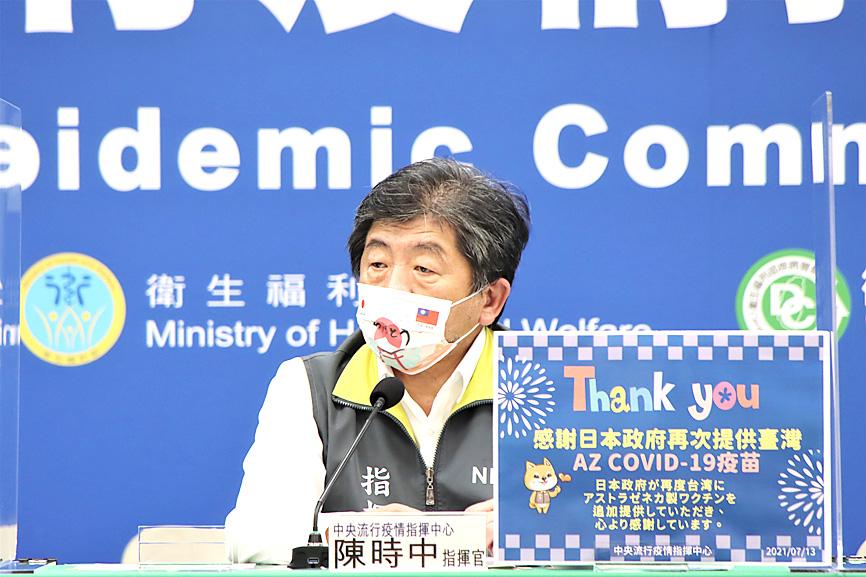
Photo courtesy of the CECC
All of those registered users received a text message yesterday morning informing them to book a vaccination appointment, which is to take place between Friday and Thursday next week, she said.
As of 1pm yesterday, more than 50,000 people had booked an appointment.
The deadline for registration for the next round of vaccination — again the AstraZeneca vaccine only — is at 5pm tomorrow, and all people aged 18 or older are eligible to register, Tang said.
As of 1pm yesterday, more than 1.67 million people aged 18 to 49 had registered for vaccination, she said.
If the number of people who selected the AstraZeneca vaccine exceeds the total number of doses available for the next round, eligible recipients would receive a text message for booking an appointment based on their age in descending order, she said.
The CECC said that as of 5pm yesterday, a total of 4,852,553 people had registered for the next round of vaccination.
It added that 63,310 people (1.3 percent) chose only the AstraZeneca vaccine, while 3,098,106 people (63.84 percent) chose only the Moderna vaccine, and 1,691,137 people (34.85 percent) selected both vaccines.
Meanwhile, Japanese Minister of Foreign Affairs Toshimitsu Motegi yesterday said Tokyo would donate a third batch of vaccines — 1 million doses of the AstraZeneca vaccine — to Taiwan tomorrow.
Minister of Health and Welfare Chen Shih-chung (陳時中), who heads the center, yesterday confirmed that the vaccines are expected to arrive in Taiwan tomorrow, thanking the Japanese government for donating three batches of vaccines.
CECC data showed that 3,821,539 doses of vaccine had been administered as of 10am yesterday, with 15.93 percent of the population having received at least one dose.
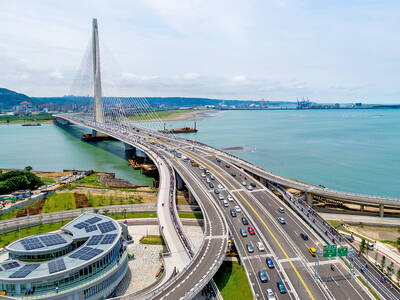
The Ministry of Transportation and Communications yesterday inaugurated the Danjiang Bridge across the Tamsui River in New Taipei City, saying that the structure would be an architectural icon and traffic artery for Taiwan. Feted as a major engineering achievement, the Danjiang Bridge is 920m long, 211m tall at the top of its pylon, and is the longest single-pylon asymmetric cable-stayed bridge in the world, the government’s Web site for the structure said. It was designed by late Iraqi-British architect Zaha Hadid. The structure, with a maximum deck of 70m, accommodates road and light rail traffic, and affords a 200m navigation channel for boats,
Taiwan Semiconductor Manufacturing Co (TSMC, 台積電), the world’s largest foundry service provider, yesterday said that global semiconductor revenue is projected to hit US$1.5 trillion in 2030, after the figure exceeds US$1 trillion this year, as artificial intelligence (AI) demand boosts consumption of token and compute power. “We are still at the beginning of the AI revolution, but we already see a significant impact across the whole semiconductor ecosystem,” TSMC deputy cochief operating officer Kevin Zhang (張曉強) said at the company’s annual technology symposium in Hsinchu City. “It is fair to say that in the past decade, smartphones and other mobile devices were
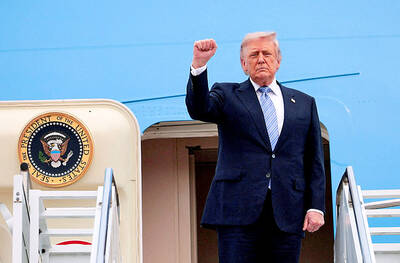
US-CHINA SUMMIT: MOFA welcomed US reassurance of no change in its Taiwan policy; Trump said he did not comment when Xi talked of opposing independence US President Donald Trump yesterday said he has not made a decision on whether to move forward with a major arms package for Taiwan after hearing concerns about it from Chinese President Xi Jinping (習近平). Trump’s comments on Taiwan came as he flew back to Washington after wrapping up critical talks in which both leaders said important progress was made in stabilizing US-China relations even as deep differences persist between the world’s two biggest powers on Iran and Taiwan. “I will make a determination,” Trump said, adding: “I’ll be making decisions. But, you know, I think the last thing we need right
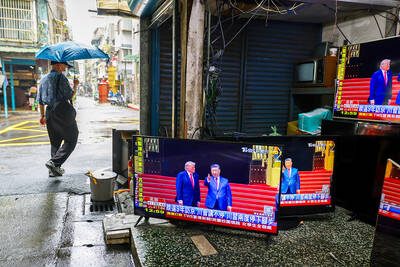
TAIWAN ISSUE: US treasury secretary Scott Bessent said on the first day of meetings that ‘it wouldn’t be a US-China summit without the Taiwan issue coming up’ There were no surprises on the first day of the summit between US President Donald Trump and Chinese President Xi Jinping (習近平), the Mainland Affairs Council (MAC) said yesterday, as the government reiterated that cross-strait stability is crucial to the Asia-Pacific region, as well as the world. As the two presidents met for a highly anticipated summit yesterday, Chinese state media reported that Xi warned Trump that missteps regarding Taiwan could push their two countries into “conflict.” Trump arrived in China with accolades for his host, calling Xi a “great leader” and “friend,” and extending an invitation to visit the White House


 RSS
RSS