


The Chinese military said it yesterday chased a US warship out of a disputed area of the South China Sea after Washington on Sunday warned that the Philippines might activate a mutual defense treaty.
Beijing affirmed its claims to portions of the sea that are also claimed by Taiwan and several Southeast Asian governments.
It rejected a declaration of support by US President Joe Biden’s administration for an international tribunal ruling in favor of the Philippines that threw out most of China’s claims.
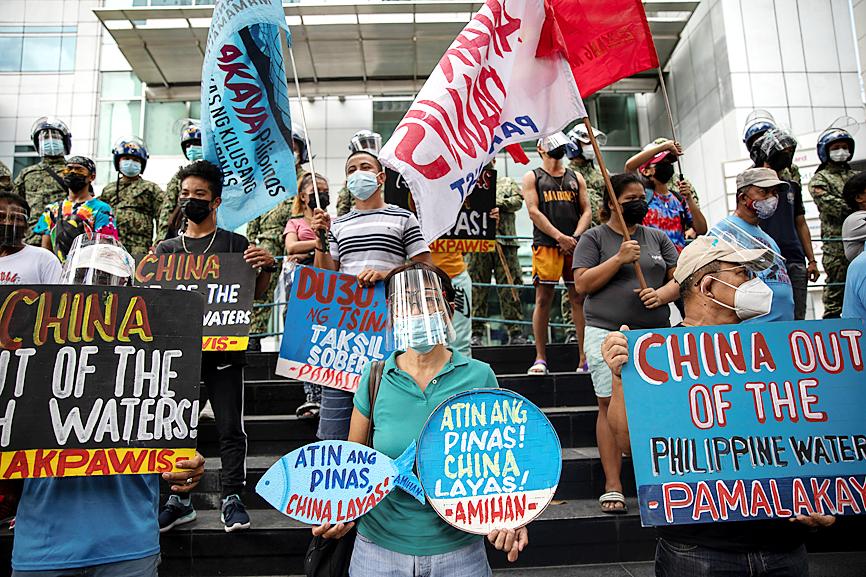
Photo: Reuters
Beijing is increasingly assertive about pressing its territorial claims, which are fueling tension with neighbors, including Taiwan, Japan, India, Vietnam and the Philippines.
The Chinese People’s Liberation Army (PLA) said it sent ships and planes after the USS Benfold entered waters claimed by Beijing around the Paracel Islands (Xisha Islands, 西沙群島).
Chinese forces “warned them and drove them away,” the military said on its social media account.
The islands are “China’s inherent territory,” the PLA said. “The actions of the US military have seriously violated China’s sovereignty and security.”
The US Navy, in a statement by the 7th Fleet Public Affairs office, rejected the Chinese statement as false, but gave no details of a possible encounter with PLA forces.
The Benfold carried out the operation “in accordance with international law and then continued on to conduct normal operations in international waters,” the statement said.
The Chinese statement was “the latest in a long string of PRC actions to misrepresent lawful US maritime operations and assert its excessive and illegitimate maritime claims,” the US Navy statement said, referring to the People’s Republic of China.
US Secretary of State Antony Blinken accused Beijing of intimidating its Southeast Asian neighbors and threatening navigation through an important global waterway.
Blinken warned that an attack on Philippine vessels or aircraft “would invoke US mutual defense commitments.”
A 1951 treaty obligates Washington and Manila to come to each other’s aid in case of an attack.
A US-based expert yesterday said that swarms of Chinese vessels anchored in a disputed area of the South China Sea have dumped human waste and wastewater for years, causing algae blooms that have damaged coral reefs and threatened fish in an unfolding catastrophe.
Satellite images over the past five years show how human waste, sewage and wastewater have accumulated and caused algae in the atoll, internationally known as Union Banks, said Liz Derr, who heads Simularity Inc, a software firm creating artificial-intelligence technologies for satellite imagery analysis.
At least 236 ships were spotted in the atoll on June 17 alone, Derr said at a Philippine online news forum on China’s actions in the South China Sea.
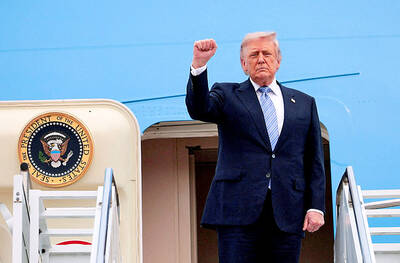
US-CHINA SUMMIT: MOFA welcomed US reassurance of no change in its Taiwan policy; Trump said he did not comment when Xi talked of opposing independence US President Donald Trump yesterday said he has not made a decision on whether to move forward with a major arms package for Taiwan after hearing concerns about it from Chinese President Xi Jinping (習近平). Trump’s comments on Taiwan came as he flew back to Washington after wrapping up critical talks in which both leaders said important progress was made in stabilizing US-China relations even as deep differences persist between the world’s two biggest powers on Iran and Taiwan. “I will make a determination,” Trump said, adding: “I’ll be making decisions. But, you know, I think the last thing we need right
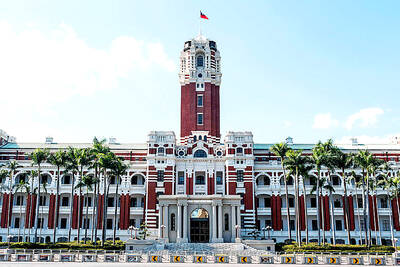
SECURITY: Taipei presses the US for arms supplies, saying the arms sales are not only a reflection of the US security commitment to Taiwan but also serve as a mutual deterrent against regional threats Taiwan is committed to preserving the cross-strait “status quo” and contributing to regional peace and stability, the Presidential Office said yesterday. “It is an undeniable fact that the Republic of China is a sovereign and independent democratic nation,” Presidential Office spokeswoman Karen Kuo (郭雅慧) reiterated, adding that Beijing has no right to claim sovereignty over Taiwan. The statements came after US President Donald Trump warned against Taiwanese independence. Trump wrapped up a state visit to Beijing on Friday, during which Chinese President Xi Jinping (習近平) had pressed him not to support Taiwan. Taiwan depends heavily on US security backing to deter China from carrying
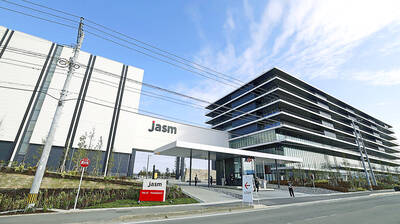
The subsidiary of Taiwan Semiconductor Manufacturing Co (TSMC, 台積電) in Kumamoto, Japan, turned a profit in the first quarter of this year, marking the first time the first fab of the unit has become profitable since mass production started at the end of 2024. According to the contract chipmaker’s financial statement released on Friday, Japan Advanced Semiconductor Manufacturing Inc (JASM), a joint venture running the fab in Kumamoto, posted NT$951 million (US$30.19 million) in profit in the January-to-March period, compared with a loss of NT$1.39 billion in the previous quarter, and a loss of NT$3.25 billion in the first quarter of
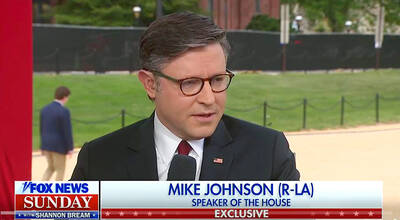
RESOLUTE BACKING: Two Republican senators are planning to introduce legislation that would impose immediate sanctions on China if it attempts to invade Taiwan US House of Representatives Speaker Mike Johnson on Sunday reaffirmed US congressional support for Taiwan, saying the US and “all freedom-loving people” have a stake in preventing China from seizing Taiwan by force. Johnson made the remarks in an interview with Fox News Sunday on US President Donald Trump’s summit with Chinese President Xi Jinping (習近平) last week. In an interview that aired on Friday on Fox News, just as Trump wrapped up a high-stakes visit to China, he said he has yet to green-light a new US$14 billion arms package to Taiwan and that it “depends on China.” “It’s a very good


 RSS
RSS