


Taiwan’s Hsieh Su-wei (謝淑薇) on Saturday won her third Wimbledon women’s doubles title when she and Belgian partner Elise Mertens defeated Russia’s Elena Vesnina and Veronika Kudermetova.
“It’s not always easy to play in the final, and the opponent will fight super hard,” Hsieh said ahead of the match. “We all know it’s the last match so we will fight until the last point definitely.”
Her determination paid off for the third-seeded pair, who were competing in their fifth tournament together. They saved two match points in the second set to win 3-6, 7-5, 9-7.

Photo: Reuters
Unseeded Kudermetova and Vesnina had two match points at 5-4 in the second set, the second one producing an incredible rally that Hsieh eventually won with a volley.
As the third set dragged on, 35-year-old Hsieh finished off a gripping contest with a backhand winner.
Hsieh and Mertens clinched a back-and-forth third set when Hsieh hit a backhand winner to break Vesnina’s serve.

Photo: AFP
“Some of her volleys, I can’t do. She’s a magician,” Mertens, the world’s No. 1 doubles player, said of Hsieh.
“That felt like seven hours,” Mertens said of the two-and-a-half-hour battle on a packed Centre Court. “There were nerves, but we managed it well in the end... We are very happy that we could close it out.”
“It was such a tough match,” Mertens added. “We just kept going... We never gave up. That’s the fighting spirit we had today that maybe made with the difference.’’
President Tsai Ing-wen (蔡英文) yesterday sent a message to congratulate Hsieh on her achievement.
She said on Twitter that Hsieh’s victory at Wimbledon would inspire the next generation of tennis players in Taiwan and around the world.
The Sports Administration also offered its congratulations and promised to continue to support tennis players as they work to achieve a higher global ranking.
Hsieh won her previous Wimbledon doubles titles with different partners. It was a first for Mertens, who has also won the Australian Open and US Open doubles.
Hsieh won the 2013 Wimbledon title with China’s Peng Shuai and the 2019 trophy alongside Barbora Strycova of the Czech Republic.
Additional reporting by Shelley Shan
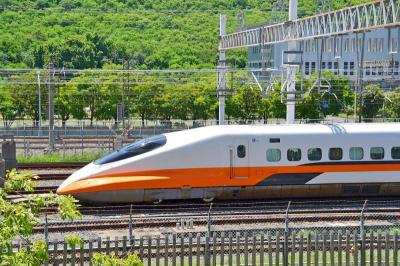
A signaling system malfunction disrupted high-speed rail (HSR) services beginning at 8am today, with trains temporarily reduced to three northbound and three southbound trains per hour as authorities conduct inspections. The malfunction occurred on a section of track in Miaoli County during pre-operation checks early this morning, forcing northbound and southbound trains to use a single track, the HSR operator said. The regular schedule has been replaced with three hourly trains offering only nonreserved seating in each direction, stopping at every station, it said, adding that business class cars would still have reserved seating. Departures from terminal stations are scheduled at the top

‘NO SECURITY RISK’: The Railway Bureau reassured the public that the technicians’ activities were limited to technical guidance and did not involve sensitive systems The Railway Bureau yesterday said it had invited eight Chinese technicians to assist with an airport MRT construction project. The bureau issued the confirmation after an Internet user said Chinese nationals had entered the construction zone of Taiwan Taoyuan International Airport’s Terminal 3 project. They asked why “individuals from an enemy state” were allowed access to such a major national infrastructure project, which raised serious concerns over Taiwan’s industrial safety, sensitive systems and information security. The bureau’s Northern Region Engineering Branch Office said subcontractor Taiwan Handle Industrial Co (台灣手把工業) of the Taoyuan airport MRT’s “Contract No. CU05 Project A14 Station Civil, MEP &

Taiwan is still in the process of assessing the possibility of recruiting workers from Eswatini, the Ministry of Foreign Affairs said yesterday, adding that its goal is to help Eswatini upgrade its vocational training centers. If there are plans to recruit workers from Eswatini, safeguarding national security, protecting public health and ensuring the employment rights of Taiwanese would be prerequisites, Department of West Asian and African Affairs Director-General Yen Chia-liang (顏嘉良) told a news conference. Key considerations would also include filling labor shortages in specific industries, and fostering bilateral professional and technical exchanges, he said. Yen was asked about the progress of labor

A US uncrewed surface vessel (USV) encountered multiple Chinese warships during an autonomous transit of the Taiwan Strait, US defense company Seasats said in a statement on Wednesday. Seasats announced that a Lightfish USV had completed the first autonomous transit of the Taiwan Strait. Over five days, the USV traversed the entire length of the Strait while constantly monitoring surface vessel traffic, the company said. The Lightfish encountered multiple Chinese warships, one of which was a Chinese People’s Liberation Army Navy (PLAN) Type 056 corvette, it said. The Chinese vessels were operating “well within Taiwan’s exclusive economic zone without transmitting their identity via the


 RSS
RSS