


The government yesterday welcomed the arrival of 150,000 doses of the Moderna COVID-19 vaccine, the first batch of its order from the US pharmaceutical firm.
The batch, carried by a China Airlines Ltd (中華航空) cargo flight of Taiwan’s national carrier, arrived at Taiwan Taoyuan International Airport at about 5pm, slightly later than the Central Epidemic Command Center’s (CECC) 3:50pm estimate given on Thursday night.
The flight departed from Luxembourg yesterday morning and stopped at Dubai before reaching Taiwan.

Photo: Chu Pei-hsiung, Taipei Times
Prior to its arrival, many aviation enthusiasts on Facebook had posted images of flight trackers showing the plane crossing the airspace above India and Vietnam, avoiding China and Hong Kong, before finally landing in Taiwan.
“The American Institute in Taiwan [AIT] welcomes the arrival of the first batch of Moderna COVID-19 vaccines, the first American vaccine to arrive in Taiwan,” the AIT wrote on Facebook yesterday morning before its arrival, adding: “We continue to communicate with Taiwan at all levels on this urgent issue.”
The US’ de facto embassy has been criticized for not assisting Taiwan with vaccine acquisition, since outgoing AIT Director Brent Christensen on Wednesday said that Washington had yet to finalize its standards for distributing its stockpile of vaccines, adding that Taiwan’s infection numbers were among the lowest in the world.
Meanwhile, a Japanese ruling party committee on Taiwan relations yesterday said it would recommend that the government supply a portion of Japan’s AstraZeneca vaccine stock to Taiwan to help it tackle a surge in infections.
“We should provide Taiwan with vaccines as soon as possible,” the head of the Liberal Democratic Party’s policy group, Masahisa Sato, told a news briefing following the meeting.
The recommendation is to be included in a set of proposals the policy group would give to Japanese Minister of Foreign Affairs Toshimitsu Motegi.
“Taiwan has many friends in Japan doing their best to help Taiwan in various ways. If there is any good news, we will announce it after it is confirmed,” Presidential Office spokesman Xavier Chang (張惇涵) said.
The Ministry of Foreign Affairs added that Taipei was seeking “like-minded countries to help obtain vaccines, and efforts have not ceased.”
In other news, in response to local government officials asking the central government to allow them to purchase vaccines independently through their own channels, the CECC yesterday released a set of requirements for applying to do so.
Local governments or businesses that intend to apply to import COVID-19 vaccines can ask pharmaceutical firms to submit vaccine rollout plans, instructions, storage and cooling logistics plans, manufacturing authorizations and documents that confirm a vaccine’s commercialization in other countries, the CECC said.
The applications would be reviewed by experts convened by the Food and Drug Administration, while use of the vaccines must abide by the CECC’s regulations, it added.
Additional reporting by Reuters
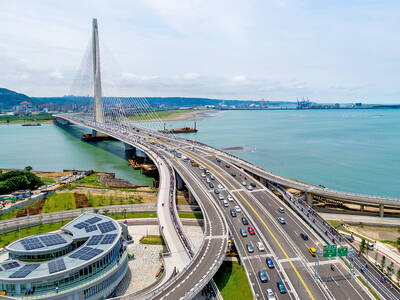
The Ministry of Transportation and Communications yesterday inaugurated the Danjiang Bridge across the Tamsui River in New Taipei City, saying that the structure would be an architectural icon and traffic artery for Taiwan. Feted as a major engineering achievement, the Danjiang Bridge is 920m long, 211m tall at the top of its pylon, and is the longest single-pylon asymmetric cable-stayed bridge in the world, the government’s Web site for the structure said. It was designed by late Iraqi-British architect Zaha Hadid. The structure, with a maximum deck of 70m, accommodates road and light rail traffic, and affords a 200m navigation channel for boats,

Taiwan Semiconductor Manufacturing Co (TSMC, 台積電), the world’s largest foundry service provider, yesterday said that global semiconductor revenue is projected to hit US$1.5 trillion in 2030, after the figure exceeds US$1 trillion this year, as artificial intelligence (AI) demand boosts consumption of token and compute power. “We are still at the beginning of the AI revolution, but we already see a significant impact across the whole semiconductor ecosystem,” TSMC deputy cochief operating officer Kevin Zhang (張曉強) said at the company’s annual technology symposium in Hsinchu City. “It is fair to say that in the past decade, smartphones and other mobile devices were
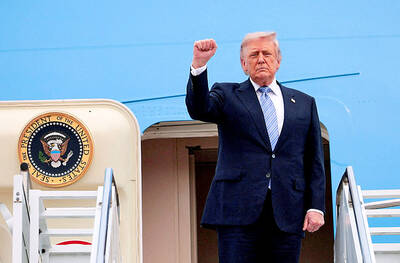
US-CHINA SUMMIT: MOFA welcomed US reassurance of no change in its Taiwan policy; Trump said he did not comment when Xi talked of opposing independence US President Donald Trump yesterday said he has not made a decision on whether to move forward with a major arms package for Taiwan after hearing concerns about it from Chinese President Xi Jinping (習近平). Trump’s comments on Taiwan came as he flew back to Washington after wrapping up critical talks in which both leaders said important progress was made in stabilizing US-China relations even as deep differences persist between the world’s two biggest powers on Iran and Taiwan. “I will make a determination,” Trump said, adding: “I’ll be making decisions. But, you know, I think the last thing we need right
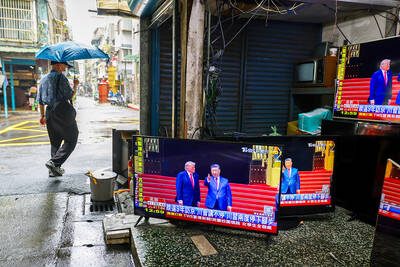
TAIWAN ISSUE: US treasury secretary Scott Bessent said on the first day of meetings that ‘it wouldn’t be a US-China summit without the Taiwan issue coming up’ There were no surprises on the first day of the summit between US President Donald Trump and Chinese President Xi Jinping (習近平), the Mainland Affairs Council (MAC) said yesterday, as the government reiterated that cross-strait stability is crucial to the Asia-Pacific region, as well as the world. As the two presidents met for a highly anticipated summit yesterday, Chinese state media reported that Xi warned Trump that missteps regarding Taiwan could push their two countries into “conflict.” Trump arrived in China with accolades for his host, calling Xi a “great leader” and “friend,” and extending an invitation to visit the White House


 RSS
RSS