


The leaders of Japan and EU institutions yesterday referred to the importance of peace and stability in the Taiwan Strait in a joint statement following a virtual summit, a move indicating their concern over China’s assertive push in regional affairs.
Japanese Prime Minister Yoshihide Suga held a videoconference with European Commission President Ursula von der Leyen and EU Council President Charles Michel, before issuing a statement saying that the leaders remained “seriously concerned about the situation in the East and South China Seas,” where Beijing has been projecting its naval might.
“We underscore the importance of peace and stability across the Taiwan Strait, and encourage the peaceful resolution of cross-strait issues,” the statement said.
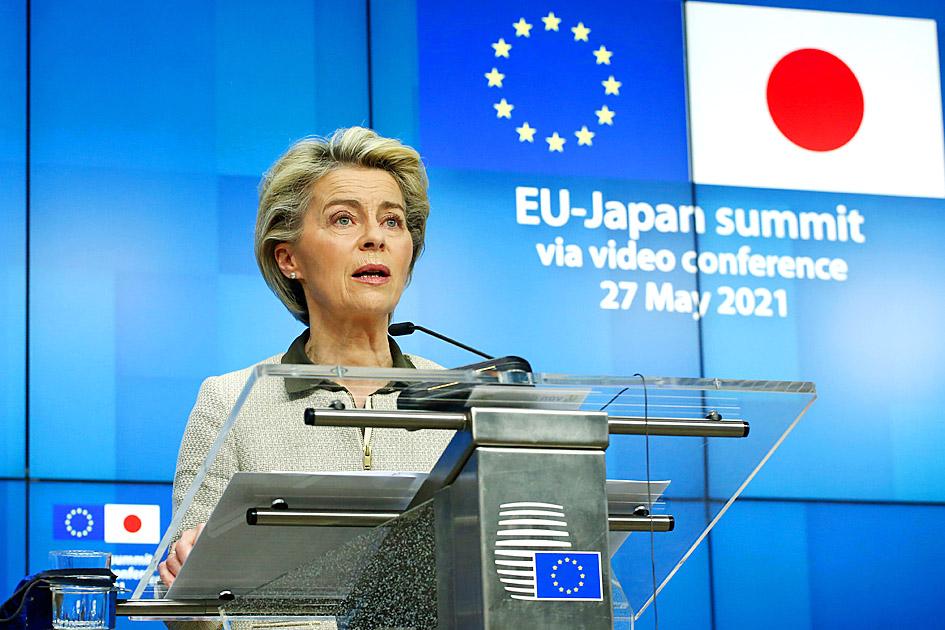
Photo: Bloomberg
The reference to Taiwan was the first in a statement from the leaders, the daily Yomiuri Shimbun reported yesterday, citing several unidentified Japanese government sources.
It follows similar wording in a joint statement issued after Suga met US President Joe Biden last month, which sparked criticism from Beijing.
The Ministry of Foreign Affairs yesterday said it welcomed the Japan-EU joint statement, despite the lack of formal ties.
The Japanese government has repeatedly said that Japan and Taiwan share similar values in freedom, democracy, human rights and the rule of law, and that Taiwan is an important partner and friend of Japan, ministry spokeswoman Joanne Ou (歐江安) said in a statement.
The government would continue to work with Japan, the EU and other like-minded partners to defend democracy and a rules-based international order and to maintain the peace, stability and prosperity across the Taiwan Strait and in the Indo-Pacific region, she said.
Tensions between Taiwan and China have worsened in the past few months, as Chinese military forces ratcheted up exercises in the area, raising the risk of a conflict that could draw in the US.
The meeting came as several European countries seek more involvement in the security of the Asia-Pacific region, a key to global economic growth.
French troops took part in an exercise with Japan and the US on Japanese soil for the first time earlier this month, while Germany is expected to deploy a frigate to Asia later in the year.
The UK is also sending its new aircraft carrier, the HMS Queen Elizabeth, on a tour including stops in Japan and South Korea, as part of its maiden voyage.
Although the Chinese Communist Party has never ruled Taiwan, it views control of the nation as essential to completing its goal of reversing China’s “century of humiliation” by colonial powers.
Chinese President Xi Jinping (習近平) has shown an increased willingness to assert sovereignty claims from the South China Sea to the Himalayan Plateau and Hong Kong.
Additional reporting by Lin Chia-nan

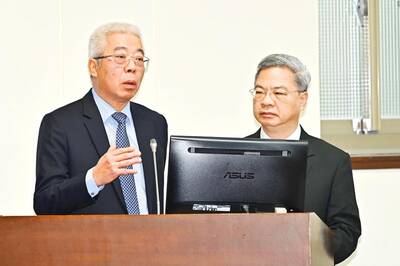
Taiwan has arranged for about 8 million barrels of crude oil, or about one-third of its monthly needs, to be shipped from the Red Sea this month to bypass the Strait of Hormuz and ease domestic supply pressures, CPC Corp, Taiwan (CPC, 台灣中油) said yesterday. The state-run oil company has worked with Middle Eastern suppliers to secure routes other than the Strait of Hormuz, through which about 20 percent of the world’s oil and liquefied natural gas typically passes, CPC chairman Fang Jeng-zen (方振仁) said at a meeting of the legislature’s Economics Committee in Taipei. Suppliers in Saudi Arabia have indicated they
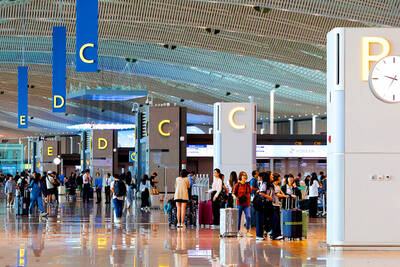
South Korea has adjusted its electronic arrival card system to no longer list Taiwan as a part of China, a move that the Ministry of Foreign Affairs said would help facilitate exchanges between the two sides. South Korea previously listed “Taiwan” as “Taiwan (China)” in the drop-down menus of its online arrival card system, where people had to fill out where they came from and their next destination. The ministry had requested South Korea make a revision and said it would change South Korea’s name on Taiwan’s online immigration system from “Republic of Korea” to “Korea (South),” should the issue not be

Tainan, Taipei and New Taipei City recorded the highest fines nationwide for illegal accommodations in the first quarter of this year, with fines issued in the three cities each exceeding NT$7 million (US$220,639), Tourism Administration data showed. Among them, Taipei had the highest number of illegal short-term rental units, with 410. There were 3,280 legally registered hotels nationwide in the first quarter, down by 14 properties, or 0.43 percent, from a year earlier, likely indicating operators exiting the market, the agency said. However, the number of unregistered properties rose to 1,174, including 314 illegal hotels and 860 illegal short-term rental
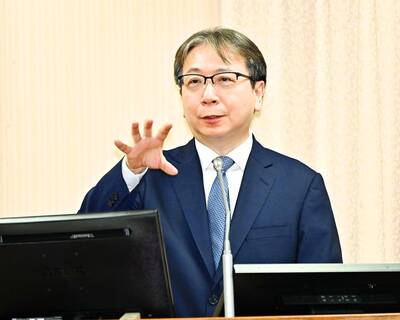
AIR ALERT: China’s reservation of airspace over the Yellow Sea and East China Sea could be an attempt to test the US’ response ahead of a Trump-Xi meeting, the NSB head said China’s attempts to infiltrate Taiwan are systematic, planned and targeted, with activity shifting from recruiting mid-level military officers to rank-and-file enlisted personnel, National Security Bureau (NSB) Director-General Tsai Ming-yen (蔡明彥) said yesterday. The Chinese Communist Party’s (CCP) integrates national security, intelligence operations and “united front” efforts into a dense network to conduct intelligence gathering and espionage in Taiwan, Tsai said at a meeting of the legislature’s Foreign Affairs and National Defense Committee. It uses specific networks to screen targets through exchange activities and recruiting local collaborators to establish intelligence-gathering organizations, he said. China is also shifting who it targets to lower-ranking military personnel,


 RSS
RSS