


Phase 2 clinical trials of locally developed COVID-19 vaccines are nearly completed and doses are expected to be available by the end of July, President Tsai Ing-wen (蔡英文) said yesterday.
Tsai made the remarks after visiting the Central Epidemic Command Center (CECC) along with Premier Su Tseng-chang (蘇貞昌) in the morning as Taipei and New Taipei City entered the fourth day under level 3 COVID-19 prevention measures.
The vaccines being developed by Medigen Vaccine Biologics Corp (高端疫苗) and United Biomedical Inc (聯亞生技) are entering the final stage of phase 2 clinical trials, Tsai said, adding that the government would fully support the firms while checking the safety and quality of the jabs.
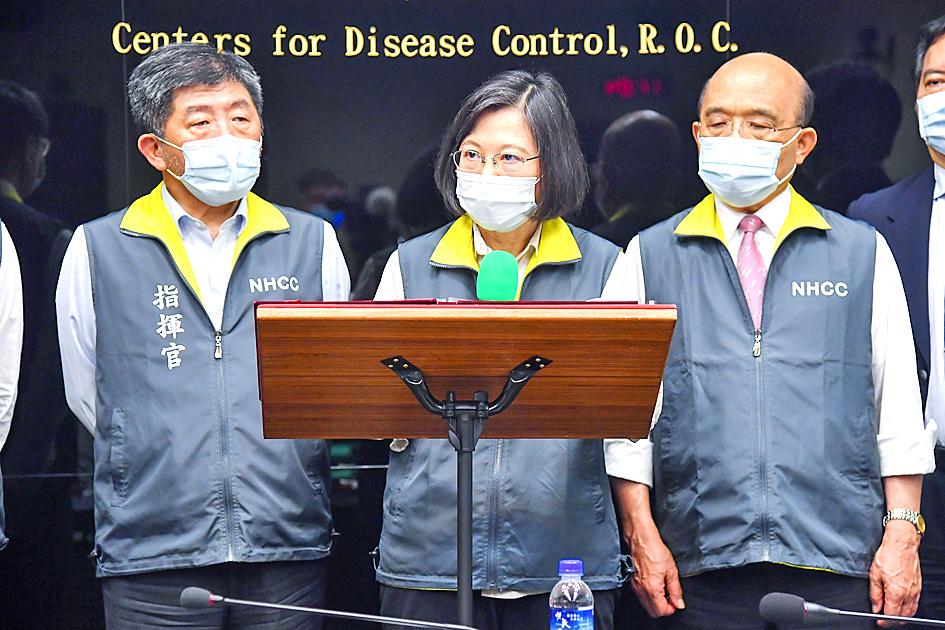
Photo: CNA
Taiwan has taken delivery of 117,000 vaccine doses purchased directly from AstraZeneca PLC and 199,200 doses of the same vaccine through the COVAX initiative.
A total of 220,352 doses had been administered as of yesterday, CECC data showed.
A surge in local COVID-19 infections over the past week has increased people’s willingness to be inoculated, as well as the pressure on the government to procure more doses.
GAVI, the Vaccine Alliance on Monday said that more AstraZeneca vaccines would be delivered to Taiwan soon.
GAVI, which is coleading the COVAX scheme set up last year to ensure fair access to vaccines among rich and poor nations, said it expects Taiwan to receive another delivery of AstraZeneca vaccines by the end of next month at the latest.
Representative to the US Hsiao Bi-khim (蕭美琴) yesterday wrote on Facebook that since the US started rolling out vaccines at the end of last year, the Ministry of Foreign Affairs and the Taipei Economic and Cultural Representative Office (TECRO) in the US have been urging Washington to help Taiwan obtain vaccines.
Hsiao’s remarks followed criticism that the government has been putting more effort into helping Latin American allies obtain vaccines than it did for Taiwan.
The US had an urgent need for vaccines at the time, so it did not respond to Taiwan’s request positively, Hsiao said, adding that the ministry and the TECRO still helped the government sign a contract with vaccine maker Moderna, which is expected to start supplying COVID-19 vaccines to Taiwan in the middle of this year.
After meeting Americans’ demand for vaccines, Washington began helping poorer countries that have been hit hard by the pandemic, and now that Taiwan is reporting more local infections, the US has understood the nation’s urgent need for more jabs, she added.
US President Joe Biden has said the US would share AstraZeneca vaccines with the rest of the world and TECRO has been asking Washington to include Taiwan among the recipients, Hsiao said.
Additional reporting by CNA

‘NO SECURITY RISK’: The Railway Bureau reassured the public that the technicians’ activities were limited to technical guidance and did not involve sensitive systems The Railway Bureau yesterday said it had invited eight Chinese technicians to assist with an airport MRT construction project. The bureau issued the confirmation after an Internet user said Chinese nationals had entered the construction zone of Taiwan Taoyuan International Airport’s Terminal 3 project. They asked why “individuals from an enemy state” were allowed access to such a major national infrastructure project, which raised serious concerns over Taiwan’s industrial safety, sensitive systems and information security. The bureau’s Northern Region Engineering Branch Office said subcontractor Taiwan Handle Industrial Co (台灣手把工業) of the Taoyuan airport MRT’s “Contract No. CU05 Project A14 Station Civil, MEP &

A signaling system malfunction disrupted high-speed rail (HSR) services beginning at 8am today, with trains temporarily reduced to three northbound and three southbound trains per hour as authorities conduct inspections. The malfunction occurred on a section of track in Miaoli County during pre-operation checks early this morning, forcing northbound and southbound trains to use a single track, the HSR operator said. The regular schedule has been replaced with three hourly trains offering only nonreserved seating in each direction, stopping at every station, it said, adding that business class cars would still have reserved seating. Departures from terminal stations are scheduled at the top

Taiwan is still in the process of assessing the possibility of recruiting workers from Eswatini, the Ministry of Foreign Affairs said yesterday, adding that its goal is to help Eswatini upgrade its vocational training centers. If there are plans to recruit workers from Eswatini, safeguarding national security, protecting public health and ensuring the employment rights of Taiwanese would be prerequisites, Department of West Asian and African Affairs Director-General Yen Chia-liang (顏嘉良) told a news conference. Key considerations would also include filling labor shortages in specific industries, and fostering bilateral professional and technical exchanges, he said. Yen was asked about the progress of labor

A US uncrewed surface vessel (USV) encountered multiple Chinese warships during an autonomous transit of the Taiwan Strait, US defense company Seasats said in a statement on Wednesday. Seasats announced that a Lightfish USV had completed the first autonomous transit of the Taiwan Strait. Over five days, the USV traversed the entire length of the Strait while constantly monitoring surface vessel traffic, the company said. The Lightfish encountered multiple Chinese warships, one of which was a Chinese People’s Liberation Army Navy (PLAN) Type 056 corvette, it said. The Chinese vessels were operating “well within Taiwan’s exclusive economic zone without transmitting their identity via the


 RSS
RSS