


The next two weeks are critical for containing the COVID-19 outbreak, which hinges on the cooperation of confirmed cases and the public, infectious-disease experts said on Saturday.
After a sharp spike in cases, the Central Epidemic Command Center on Saturday raised the pandemic alert for Taipei and New Taipei City to level 3 until May 28.
While serious, Taiwan would make it through if the outbreak is contained over the next two weeks, said Chen Yee-chun (陳宜君), director of National Taiwan University Hospital’s (NTUH) Division of Infectious Diseases.
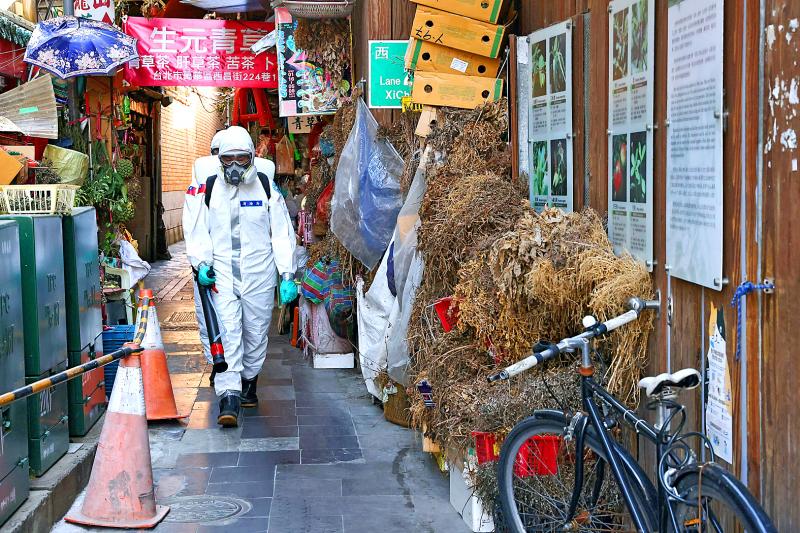
Photo: Ann Wang, Reuters
Cases have been climbing so rapidly due in part to the reluctance of confirmed cases to report their whereabouts, Chen said.
If there are any omissions, it makes it difficult to trace all of the contacts and prevent the virus from spreading further, she said.
Those who do not immediately report the places they have visited are exposing their friends and family to the greatest risk, she added.
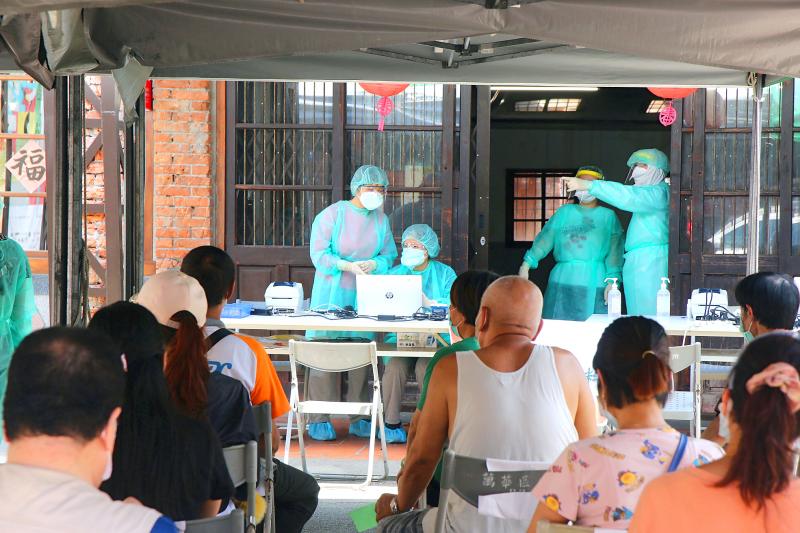
Photo: Cheng Ming-hsiang, Taipei Times
The spread of the UK variant should serve as a warning that people can no longer indulge in a sense of superiority about Taiwan’s pandemic success, Chen said.
“The medical world is most scared of the India variant, as it is more virulent and deadly,” she added.
Linkou Chang Gung Memorial Hospital deputy superintendent Chiu Cheng-hsun (邱政洵) said that he was “extremely surprised” at the 10 percent positivity rate at screening centers in Taipei’s Wanhua District (萬華).
At the height of the outbreak in New York last year, the positivity rate was also about 10 percent, Chiu said, adding that the rate in New Delhi has been higher than 30 percent.
A worst-case scenario would be if Taiwan saw more than 1,000 cases in one month, NTUH Division of Pediatric Infectious Diseases physician Lee Ping-ing (李秉穎) said.
Raising the threat level in Taipei and New Taipei City presents an opportunity to contain the outbreak, Lee said, adding that as long as residents follow guidelines, the outbreak could be contained.
There is absolutely the opportunity to stem the spread as long as people are honest, Chen said.
However, if people are not willing to work together, it is not impossible that the situation could deteriorate to the level seen in India, she added.
In addition to people wearing a mask, washing their hands and not touching their face, Lee urged everyone to avoid contact with unfamiliar people over the next two weeks to stem the outbreak’s spread.
Chiu also called on the government to restrict movement in heavily affected areas.
Residents of level 2 and level 3 cities should avoid moving between the two regions, Chiu said, adding that maintaining these measures for one to two weeks would significantly reduce the caseload.

‘NO SECURITY RISK’: The Railway Bureau reassured the public that the technicians’ activities were limited to technical guidance and did not involve sensitive systems The Railway Bureau yesterday said it had invited eight Chinese technicians to assist with an airport MRT construction project. The bureau issued the confirmation after an Internet user said Chinese nationals had entered the construction zone of Taiwan Taoyuan International Airport’s Terminal 3 project. They asked why “individuals from an enemy state” were allowed access to such a major national infrastructure project, which raised serious concerns over Taiwan’s industrial safety, sensitive systems and information security. The bureau’s Northern Region Engineering Branch Office said subcontractor Taiwan Handle Industrial Co (台灣手把工業) of the Taoyuan airport MRT’s “Contract No. CU05 Project A14 Station Civil, MEP &

A signaling system malfunction disrupted high-speed rail (HSR) services beginning at 8am today, with trains temporarily reduced to three northbound and three southbound trains per hour as authorities conduct inspections. The malfunction occurred on a section of track in Miaoli County during pre-operation checks early this morning, forcing northbound and southbound trains to use a single track, the HSR operator said. The regular schedule has been replaced with three hourly trains offering only nonreserved seating in each direction, stopping at every station, it said, adding that business class cars would still have reserved seating. Departures from terminal stations are scheduled at the top

Taiwan is still in the process of assessing the possibility of recruiting workers from Eswatini, the Ministry of Foreign Affairs said yesterday, adding that its goal is to help Eswatini upgrade its vocational training centers. If there are plans to recruit workers from Eswatini, safeguarding national security, protecting public health and ensuring the employment rights of Taiwanese would be prerequisites, Department of West Asian and African Affairs Director-General Yen Chia-liang (顏嘉良) told a news conference. Key considerations would also include filling labor shortages in specific industries, and fostering bilateral professional and technical exchanges, he said. Yen was asked about the progress of labor

A US uncrewed surface vessel (USV) encountered multiple Chinese warships during an autonomous transit of the Taiwan Strait, US defense company Seasats said in a statement on Wednesday. Seasats announced that a Lightfish USV had completed the first autonomous transit of the Taiwan Strait. Over five days, the USV traversed the entire length of the Strait while constantly monitoring surface vessel traffic, the company said. The Lightfish encountered multiple Chinese warships, one of which was a Chinese People’s Liberation Army Navy (PLAN) Type 056 corvette, it said. The Chinese vessels were operating “well within Taiwan’s exclusive economic zone without transmitting their identity via the


 RSS
RSS