


A senior BBC correspondent who had left China after facing legal threats and pressure from authorities over his reporting, has arrived in Taiwan and is in COVID-19 quarantine, Ministry of Foreign Affairs (MOFA) spokeswoman Joanne Ou (歐江安) said yesterday.
John Sudworth on Wednesday told BBC Radio 4 that he had relocated to Taiwan after nine years in Beijing, where he reported on Xinjiang rights abuses and the COVID-19 pandemic, as it was “too risky to carry on.”
Threats from Chinese authorities had “intensified” in the past few months, he added.
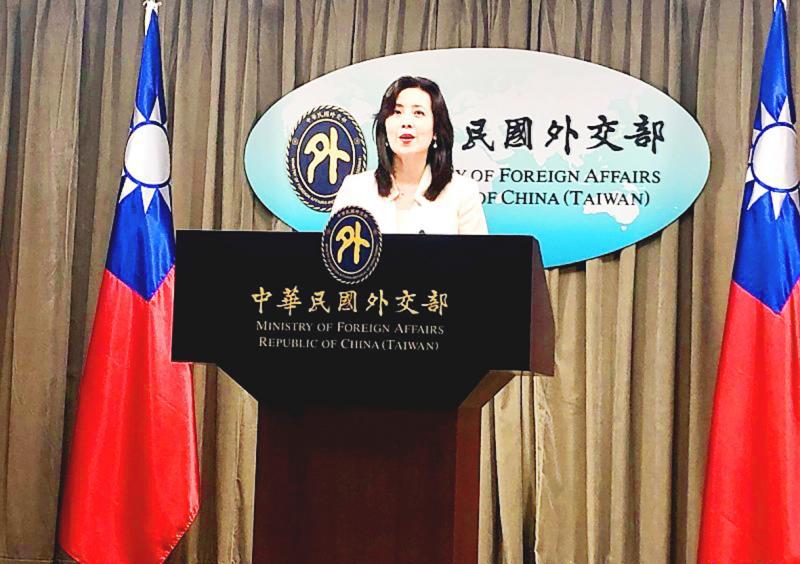
Photo: Lu Yi-hsuan, Taipei Times
At least 18 foreign correspondents were expelled by China last year, during a tit-for-tat row with the US that harmed the international press presence in the country.
Press freedom groups say that the space for foreign reporters to operate in China is increasingly tightly controlled, with journalists followed on the streets, experiencing harassment online and refused visas.
Ou said that she believes Sudworth will “feel that Taiwan is a free and democratic nation.”
From January last year to last month, 39 correspondents and 21 outlets moved to Taiwan, including the New York Times, the Washington Post, the Wall Street Journal and the BBC, she said.
Taiwan is a free and democratic nation with a diverse and open society, and news organizations are welcome to send correspondents to work without restrictions, she said.
“The BBC has faced a full-on propaganda attack not just aimed at the organization itself, but at me personally across multiple [Chinese] Communist Party-controlled platforms,” said Sudworth, who is to continue to work as a China correspondent from Taiwan.
“We face threats of legal action, as well as massive surveillance now, obstruction and intimidation, whenever and wherever we try to film,” he said, adding that he and his family had been “followed by plainclothes police” as they left to fly out of China.
Sudworth’s wife, Irish journalist Yvonne Murray, left the country with him “because of mounting pressure from the Chinese authorities,” her employer, Radio Television of Ireland (RTE), reported.
“We left in a hurry as the pressure and threats from the Chinese government, which have been going on for some time, became too much,” she told RTE.
In the past few weeks, Chinese state media and officials have repeatedly attacked Sudworth for his reporting on alleged forced labor practices targeting Uighurs in Xinjiang’s cotton industry in particular.
On Wednesday, the Chinese embassy in Ireland said that Sudworth “has been strongly criticized by a lot of Chinese for his unfair, unobjective and biased reporting on China.”
On Twitter the embassy said: “Nobody has forced or will force” Sudworth’s wife to leave China.
The BBC confirmed Sudworth’s relocation after China’s state-run Global Times reported that he was “hiding” in Taiwan.
In the middle of last month, Xinjiang authorities said that Sudworth was the target of a civil lawsuit for producing “fake news” about the region.
Additional reporting by CNA

The nation’s fastest supercomputer, Nano 4 (晶創26), is scheduled to be launched in the third quarter, and would be used to train large language models in finance and national defense sectors, the National Center for High-Performance Computing (NCHC) said. The supercomputer, which would operate at about 86.05 petaflops, is being tested at a new cloud computing center in the Southern Taiwan Science Park in Tainan. The exterior of the server cabinet features chip circuitry patterns overlaid with a map of Taiwan, highlighting the nation’s central position in the semiconductor industry. The center also houses Taiwania 2, Taiwania 3, Forerunner 1 and
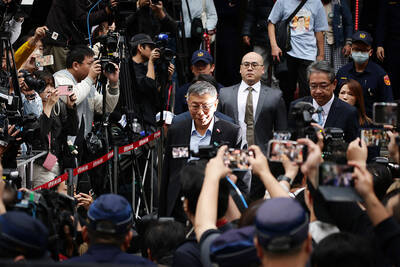
FIRST TRIAL: Ko’s lawyers sought reduced bail and other concessions, as did other defendants, but the bail judge denied their requests, citing the severity of the sentences Former Taipei mayor Ko Wen-je (柯文哲) was yesterday sentenced to 17 years in prison and had his civil rights suspended for six years over corruption, embezzlement and other charges. Taipei prosecutors in December last year asked the Taipei District Court for a combined 28-year, six-month sentence for the four cases against Ko, who founded the Taiwan People’s Party (TPP). The cases were linked to the Core Pacific City (京華城購物中心) redevelopment project and the mismanagement of political donations. Other defendants convicted on separate charges included Chinese Nationalist Party (KMT) Taipei City Councilor Angela Ying (應曉薇), who was handed a 15-year, six-month sentence; Core Pacific
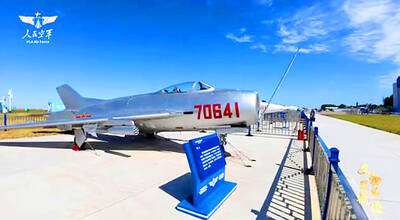
J-6 REMODEL: The converted drones are part of Beijing’s expanding mix of airpower weapons, including bombers with stand-off missiles and UAV swarms, the report said China has stationed obsolete supersonic fighters converted to attack drones at six air bases close to the Taiwan Strait, a report published this month by the Arlington, Virginia-based Mitchell Institute for Aerospace Studies said. Satellite imagery of the airfields from the institute’s “China Airpower Tracker” shows what appear to be lines of stubby, swept-winged aircraft matching the shape of J-6 fighters that first flew with the Chinese People’s Liberation Army (PLA) Air Force in the 1960s. Since their conversion to drones, the aircraft have been identified at five bases in China’s Fujian Province and one in Guangdong Province, the report said. J.

China used fake LinkedIn profiles to harvest sensitive data from NATO and EU institutions by soliciting information from staff, a European security source said on Friday. The operation, allegedly orchestrated by the Chinese Ministry of State Security, targeted dozens of employees at the military alliance or EU organizations through fictitious accounts, the source said, confirming reports in French and Belgian media. Posing as recruiters on the online professional networking platform, Chinese spies would initially request paid reports before later soliciting non-public or even classified information. One particularly active fake profile used the name “Kevin Zhang,” claiming to be the head


 RSS
RSS