


The government yesterday launched an online “pork dashboard,” which showed no pork imports since Friday, when the nation started allowing imports of pork containing residue of the leanness-enhancing additive ractopamine.
A collaboration between the Council of Agriculture and the Ministry of Health and Welfare, the dashboard — ifi.fda.gov.tw/ifi/pfp/cp/pfpcp0706q.jsp — showed that from Friday to Sunday domestically produced pork totaled 3,048 tonnes.
The nation also produced 2,811 tonnes of pork liver, kidney and other edible pig organs, it showed.
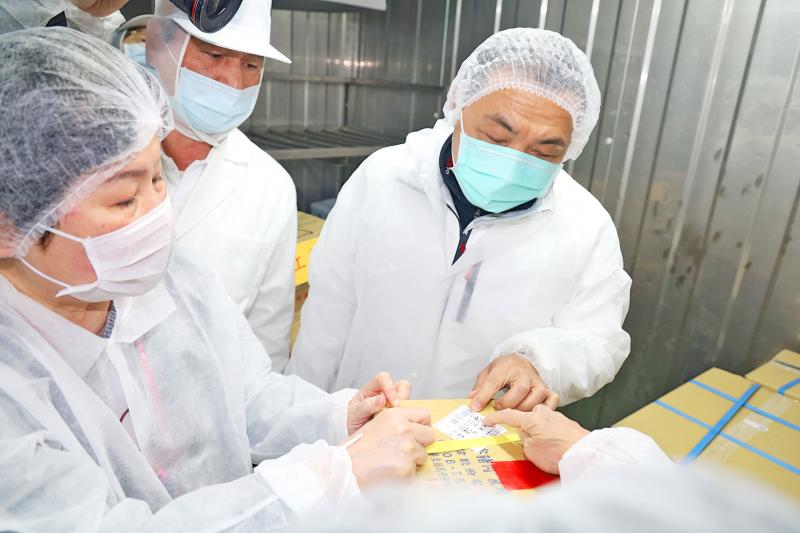
Photo courtesy of the New Taipei City Education Department
Statistics on pork products are collected and compiled by the council, the ministry and the Customs Administration, and uploaded to the dashboard before 9am on workdays.
It includes information on domestically produced pork, including the number of pigs slaughtered and weights of pork and edible pig organs. It also contains data on imports of pork and edible pig organs, including weight and the number of batches of pork and pig organs containing ractopamine residue, the council said.
Premier Su Tseng-chang (蘇貞昌) yesterday inspected how pork imports are examined batch by batch at the Port of Taipei.
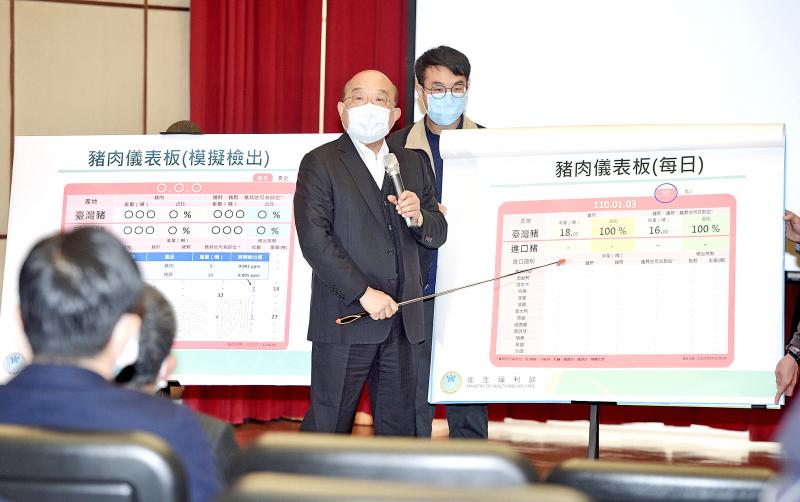
Photo: Peter Lo, Taipei Times
“Taiwan is a nation built on trade. We want to sell our products to the world, but we must also allow other countries to sell their products to us,” he said.
“The government’s responsibility is to stipulate science-based standards which conform with those stipulated by the international community. All government agencies are prepared to inspect imported pork batch by batch, clearly label imported pork and follow relevant procedures,” he added.
Poultry Sale and Development Association honorary chairman Lee Chun-lai (李春來) said that US pork arriving this month is not likely to contain ractopamine residue, as the orders were placed in August or September last year, which were backlogged because of a global shortage of refrigerated cargo containers and disruptions in shipping schedules.
Consumers should not worry, as many of the companies importing meat from other countries have pledged not to bring in pork containing ractopamine residue, Lee said, adding that no company has so far this year placed orders for US pork.
Locally produced pork dominates the domestic market with about a 90 percent share, he said.
Of the 10 percent imported from abroad, the US accounts for only about 10 percent, he said, adding that it could be easily replaced by pork from Denmark, Canada, the Netherlands and Spain.
New Taipei City Mayor Hou You-yi (侯友宜) also inspected meat processing companies in the city’s Shulin District (樹林).
Nobody can guarantee that businesses would never import pork containing ractopamine, even though they have all said they would not, Hou said.
The real test begins when there are companies that want to import pork containing ractopamine, he added.
“Consumers should have a way of knowing that imported pork containing ractopamine residue has arrived, so they can decide for themselves whether they want to purchase it or not,” Hou said.
Additional Reporting by Chiu Shu-yu
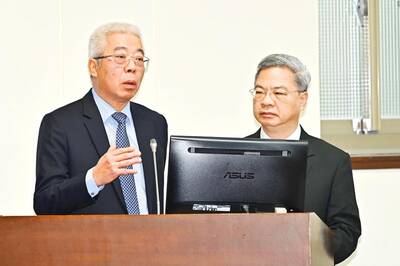
Taiwan has arranged for about 8 million barrels of crude oil, or about one-third of its monthly needs, to be shipped from the Red Sea this month to bypass the Strait of Hormuz and ease domestic supply pressures, CPC Corp, Taiwan (CPC, 台灣中油) said yesterday. The state-run oil company has worked with Middle Eastern suppliers to secure routes other than the Strait of Hormuz, through which about 20 percent of the world’s oil and liquefied natural gas typically passes, CPC chairman Fang Jeng-zen (方振仁) said at a meeting of the legislature’s Economics Committee in Taipei. Suppliers in Saudi Arabia have indicated they
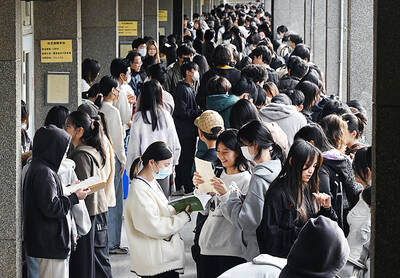
A global survey showed that 60 percent of Taiwanese had attained higher education, second only to Canada, the Ministry of the Interior said. Taiwan easily surpassed the global average of 43 percent and ranked ahead of major economies, including Japan, South Korea and the US, data from the Organisation for Economic Co-operation and Development (OECD) for 2024 showed. Taiwan has a high literacy rate, data released by the ministry showed. As of the end of last year, Taiwan had 20.617 million people aged 15 or older, accounting for 88.5 percent of the total population, with a literacy rate of 99.4 percent, the data

CCP ‘PAWN’? Beijing could use the KMT chairwoman’s visit to signal to the world that many people in Taiwan support the ‘one China’ principle, an academic said Chinese Nationalist Party (KMT) Chairwoman Cheng Li-wun (鄭麗文) yesterday arrived in China for a “peace” mission and potential meeting with Chinese President Xi Jinping (習近平), while a Taiwanese minister detailed the number of Chinese warships currently deployed around the nation. Cheng is visiting at a time of increased Chinese military pressure on Taiwan, as the opposition-dominated Legislative Yuan stalls a government plan for US$40 billion in extra defense spending. Speaking to reporters before going to the airport, Cheng said she was going on a “historic journey for peace,” but added that some people felt uneasy about her trip. “If you truly love Taiwan,

South Korea has adjusted its electronic arrival card system to no longer list Taiwan as a part of China, a move that the Ministry of Foreign Affairs said would help facilitate exchanges between the two sides. South Korea previously listed “Taiwan” as “Taiwan (China)” in the drop-down menus of its online arrival card system, where people had to fill out where they came from and their next destination. The ministry had requested South Korea make a revision and said it would change South Korea’s name on Taiwan’s online immigration system from “Republic of Korea” to “Korea (South),” should the issue not be


 RSS
RSS