


An abrupt deviation by the Taichung City Government from arrangements made with the American Institute in Taiwan (AIT) demonstrated a lack of respect and could result in global mistrust of Taiwan, Executive Yuan Secretary-General Li Meng-yen (李孟諺) said yesterday.
The Taichung City Government on Wednesday allegedly did not confer with AIT Director Brent Christensen before turning a closed-door meeting into a public briefing — especially as it included a severe critique of US pork imports.
Taichung Mayor Lu Shiow-yen (盧秀燕) of the Chinese Nationalist Party (KMT) told Christensen in plain terms that she is opposed to the importation of US pork with traces of ractopamine.
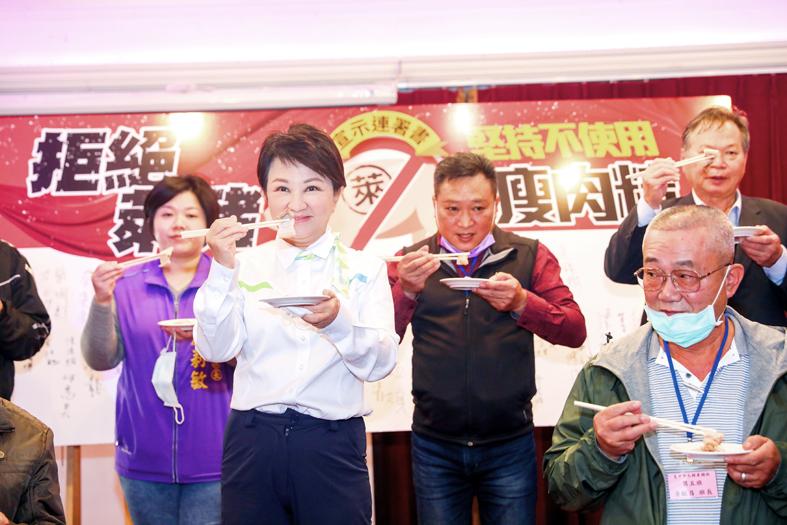
Photo: Chang Hsuan-che, Taipei Times
The event sparked a response from the AIT, the first from the de facto US embassy since President Tsai Ing-wen (蔡英文) first announced that Taiwan had approved the lessening of restrictions on US pork imports with traces of ractopamine.
AIT spokeswoman Amanda Mansour said in a statement that all US exports to Taiwan and other trade partners “are safe and meet the same high, evidence-based standards” as pork consumed in the US.
“When political figures propagate disinformation and raise unfounded anxiety among Taiwan consumers, it is a disservice to everyone. We call on all parties to approach this issue responsibly and on the basis of science,” she said.
“The United States and Taiwan are partners in safety and partners in security. We are confident that our robust trade relationship will continue to be an important and mutually beneficial part of that partnership,” she said.
Li told a news conference in Taipei that interaction between the two nations should be based on parity, reciprocity and mutual trust, instead of sowing distrust by ambushing others.
The US is an important friend of Taiwan, with both sides maintaining close cooperation in regional security and trade matters, he said, adding that the partnership has become even closer since Tsai took office.
The Executive Yuan is in dialogue with local governments and would continue to work out differences between local governments and the central government on the issue, Li said.
Separately yesterday, Lu restated her objection to the importation of US pork containing traces of ractopamine, as she joined Taichung City Council Deputy Speaker Yen Li-min (顏莉敏), Councilor Lee Jung-hung (李榮鴻) and representatives from the ROC Swine Association to make a declaration opposing the importation of US pork with traces of ractopamine.
The AIT’s commentary on the issue should be given due respect, but it was her duty to safeguard residents’ safety, Lu said.
There are evidently concerns regarding the pork, as the Ministry of Education and the Ministry of Health and Welfare have each issued bans against the use of such pork in schools and medical facilities, Lu said, adding that the bans would not have imposed if there was no concern over such products.
Additional reporting by Chang Hsuan-che
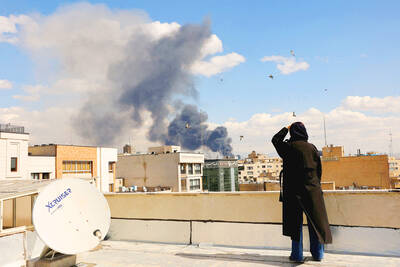
CHAOS: Iranians took to the streets playing celebratory music after reports of Khamenei’s death on Saturday, while mourners also gathered in Tehran yesterday Iranian Supreme Leader Ayatollah Ali Khamenei was killed in a major attack on Iran launched by Israel and the US, throwing the future of the Islamic republic into doubt and raising the risk of regional instability. Iranian state television and the state-run IRNA news agency announced the 86-year-old’s death early yesterday. US President Donald Trump said it gave Iranians their “greatest chance” to “take back” their country. The announcements came after a joint US and Israeli aerial bombardment that targeted Iranian military and governmental sites. Trump said the “heavy and pinpoint bombing” would continue through the week or as long
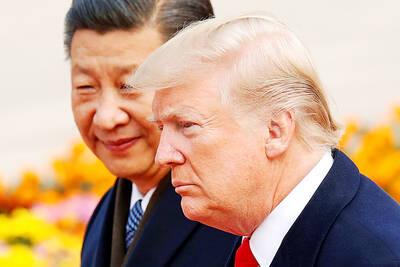
TRUST: The KMT said it respected the US’ timing and considerations, and hoped it would continue to honor its commitments to helping Taiwan bolster its defenses and deterrence US President Donald Trump is delaying a multibillion-dollar arms sale to Taiwan to ensure his visit to Beijing is successful, a New York Times report said. The weapons sales package has stalled in the US Department of State, the report said, citing US officials it did not identify. The White House has told agencies not to push forward ahead of Trump’s meeting with Chinese President Xi Jinping (習近平), it said. The two last month held a phone call to discuss trade and geopolitical flashpoints ahead of the summit. Xi raised the Taiwan issue and urged the US to handle arms sales to
BIG SPENDERS: Foreign investors bought the most Taiwan equities since 2005, signaling confidence that an AI boom would continue to benefit chipmakers Taiwan Semiconductor Manufacturing Co’s (TSMC, 台積電) market capitalization swelled to US$2 trillion for the first time following a 4.25 percent rally in its American depositary receipts (ADR) overnight, putting the world’s biggest contract chipmaker sixth on the list of the world’s biggest companies by market capitalization, just behind Amazon.com Inc. The site CompaniesMarketcap.com ranked TSMC ahead of Saudi Aramco and Meta Platforms Inc. The Taiwanese company’s ADRs on Tuesday surged to US$385.75 on the New York Stock Exchange, as strong demand for artificial intelligence (AI) applications led to chip supply constraints and boost revenue growth to record-breaking levels. Each TSMC ADR represents

State-run CPC Corp, Taiwan (CPC, 台灣中油) yesterday said that it had confirmed on Saturday night with its liquefied natural gas (LNG) and crude oil suppliers that shipments are proceeding as scheduled and that domestic supplies remain unaffected. The CPC yesterday announced the gasoline and diesel prices will rise by NT$0.2 and NT$0.4 per liter, respectively, starting Monday, citing Middle East tensions and blizzards in the eastern United States. CPC also iterated it has been reducing the proportion of crude oil imports from the Middle East and diversifying its supply sources in the past few years in response to geopolitical risks, expanding


 RSS
RSS