


A decision by Turkish President Recep Tayyip Erdogan to remove the Republic of China (ROC) flag from a thank-you tweet to countries that offered support in the wake of Friday’s massive earthquake was due to pressure from China, which was regrettable, top officials said yesterday.
While Erdogan did not name the countries and organizations that reached out to Turkey after the magnitude 7 quake on Saturday, he posted pictures of their flags, but the tweet was later taken down and replaced with a new one that did not include the ROC flag.
Turkey maintains diplomatic ties with China.
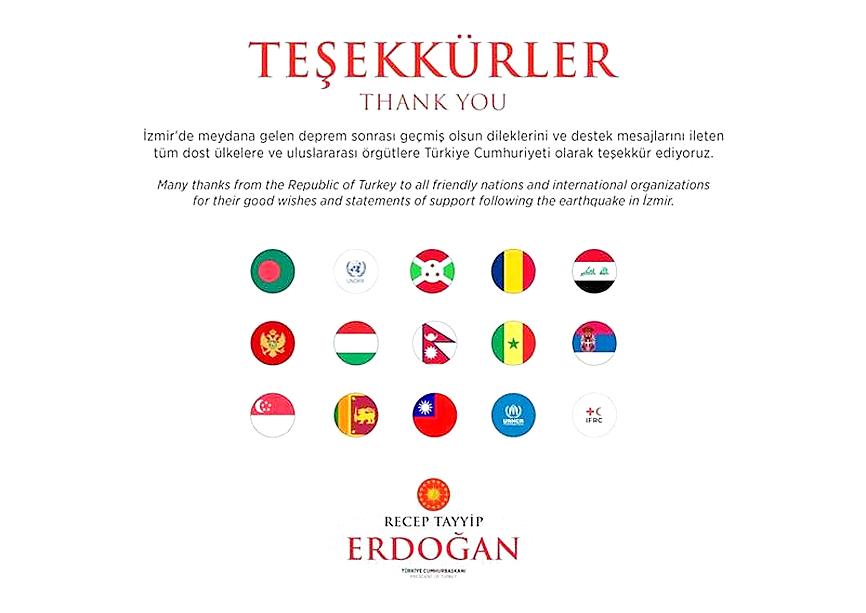
Photo: Screen grab from Twitter
“According to information obtained by our representative office in Turkey, it was due to China’s meddling and pressure,” Minister of Foreign Affairs Joseph Wu (吳釗燮) told reporters in front of the Legislative Yuan in Taipei attending a legislative hearing.
He said Taiwan, as a nation that upholds human rights, would continue to provide humanitarian assistance to other countries that need help, such as the Philippines and Vietnam after recent devastating typhoons.
“We condemn China’s regrettable intervention and repression on a matter of humanitarian assistance that has no political implications,” Wu said.
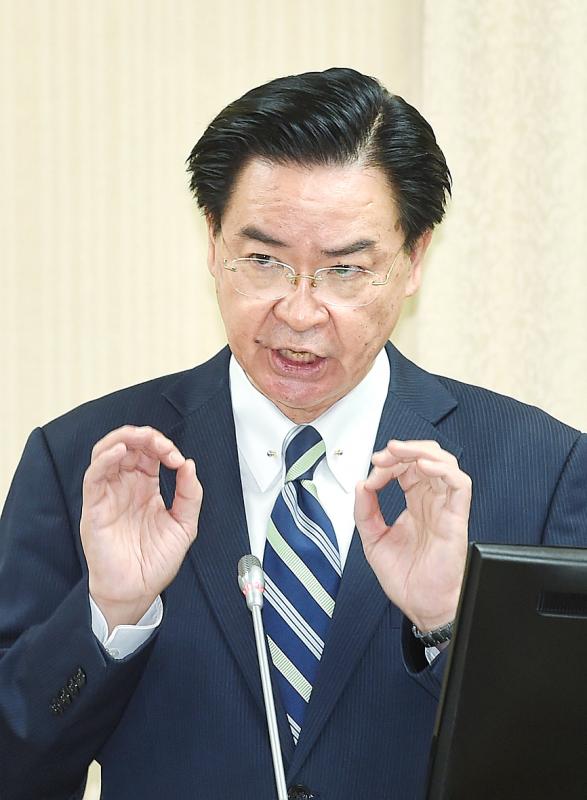
Photo: Fang Pin-chao, Taipei Times
Premier Su Tseng-chang (蘇貞昌) said the issue showed that the Chinese government was “narrow-minded,” as it was normal for a country to express appreciation to others that offer support in times of crisis.
“What China did was try to restrict Taiwan’s international space,” Su said on the sidelines of a ceremony to commend government agencies providing open data.
In the face of such repression, Taiwanese should realize that Taiwan can only hold its place in the international community by standing on its own feet, he said.
The overall death toll from Friday’s quake reached 87 yesterday, after search-and-rescue teams found more bodies amid toppled buildings in Izmir, Turkey’s third-largest city.
Close to 1,000 people were injured, mostly in Turkey, by the quake, which was centered in the Aegean Sea northeast of the Greek island of Samos.
The tremors were felt across western Turkey, as well as in the Greek capital, Athens. Hundreds of aftershocks have followed.
In other developments, the Ministry of National Defense said that Chinese People’s Liberation Army (PLA) aircraft yesterday entered Taiwan’s southwest air defense identification zone on eight separate occasions, the 32nd day such incursions have occurred since the middle of September.
The Chinese aircraft involved were one Y-8 marine patrol plane, one Y-8 tactical reconnaissance aircraft, two Su-30 jets, two J-16 fighters and two J-10 jets, the defense ministry said.
The air force scrambled planes to monitor the Chinese aircraft, issuing radio warnings and mobilizing air defense assets before the Chinese planes left the air defense identification zone, it said.
It was the ninth consecutive day of incursions and the 32nd day on which such incursions have taken place since Sept. 16, a day before the defense ministry began regularly publishing details of Chinese military movements on its Web site.
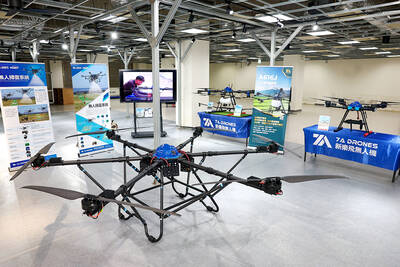
DRONE CENTRAL: Taiwan aims to become Asia’s democratic hub for drones, with most exports focused on high-quality military-grade models, an official said Taiwan’s drone industry is expected to expand significantly by 2030, producing 100,000 units per month and exporting half of them, the Ministry of Economic Affairs said yesterday. Current drone production capacity is about 15,000 units per month, but the industry can quickly scale up as demand increases, Industrial Development Administration Director-General Chiou Chyou-huey (邱求慧) told a news conference in Taipei. Taiwan’s drone output grew 2.5-fold last year to NT$12.9 billion (US$408.3 million) under a government program to develop the uncrewed vehicle sector, he said. The Executive Yuan in October last year approved plans to invest NT$44.2 billion into domestic production of uncrewed aerial
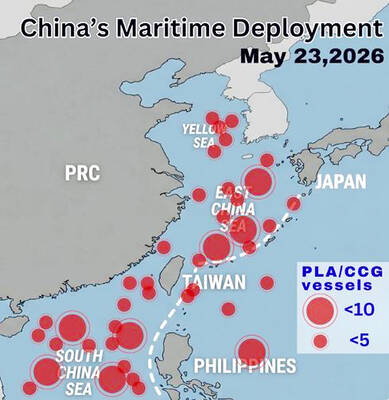
WARNING: China should stop engaging in actions that undermine regional peace and stability, as it would only build resentment among people across the Strait, the CGA said China has deployed more than 100 navy, coast guard and other vessels in waters from the Yellow Sea to the South China Sea and the western Pacific since US President Donald Trump and Chinese President Xi Jinping (習近平) met in Beijing, National Security Council Secretary-General Joseph Wu (吳釗燮) said yesterday. “In this part of the world, #China is the one & only PROBLEM wrecking the #StatusQuo & threatening regional peace & stability,” Wu wrote on X. In a separate post, he said Beijing was coercing Taiwan’s maritime domain, calling it illegal and provocative, after the Coast Guard Administration (CGA) expelled a

VERBOSE VESSELS: A CGA cutter and a China Coast Guard exchanged verbal barbs for more than a day in Taiwanese-controlled waters before the Chinese vessel left The Taiwanese and Chinese coast guards had a standoff near the strategically located Pratas Islands (Dongsha Islands, 東沙群島) in the north of the South China Sea, the Coast Guard Administration (CGA) said yesterday. The two sides engaged in intense radio exchanges over sovereignty claims during the 33-hour standoff. China Coast Guard vessel 3501 eventually left the restricted waters, 26.6 nautical miles (49.2km) west of the Pratas Islands, at 5pm yesterday, the CGA said. Lying approximately between southern Taiwan and Hong Kong, the Taiwan-controlled Pratas are seen by some security experts as vulnerable to Chinese attack due to their distance — more than
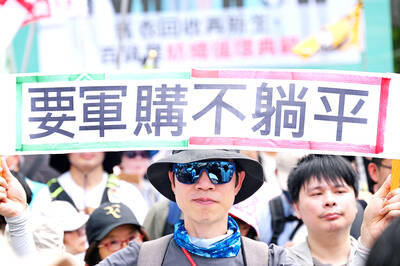
More than 8,000 people took part in a rally in Taipei yesterday to express support for more defense spending, after the opposition slashed the Cabinet’s proposed NT$1.25 trillion (US$39.6 billion) special defense budget and capped it at NT$780 billion. The demonstrators urged the Cabinet to propose another bill. Taiwan Economic Democracy Union convener Lai Chung-chiang (賴中強) said the main problem of the passed budget plan is the removal of funding for critical items, not just that the total amount is smaller. Critical budget items included purchasing or developing uncrewed vehicles, Strong Bow (強弓) missile systems, additional ammunition, artificial intelligence-powered combat systems and Taiwan-US


 RSS
RSS