


Taiwan’s economy last quarter grew 3.33 percent, beating the government forecast of 2.01 percent, as demand for devices used in 5G equipment, as well as work-from-home and remote-learning trends, proved stronger than expected, the Directorate-General of Budget, Accounting and Statistics (DGBAS) said yesterday.
It was the best performance in nine quarters, reversing a downward trend in the second quarter, thanks to robust exports and soft imports that allowed external demand to more than offset languid private consumption, the agency said.
“Strong exports accounted for the economic showing that was better than expected” and might boost full-year growth to 1.9 percent from 1.56 percent in the DGBAS’ last forecast, national income section official Wu Pei-shuan (吳佩璇) told a media briefing in Taipei.
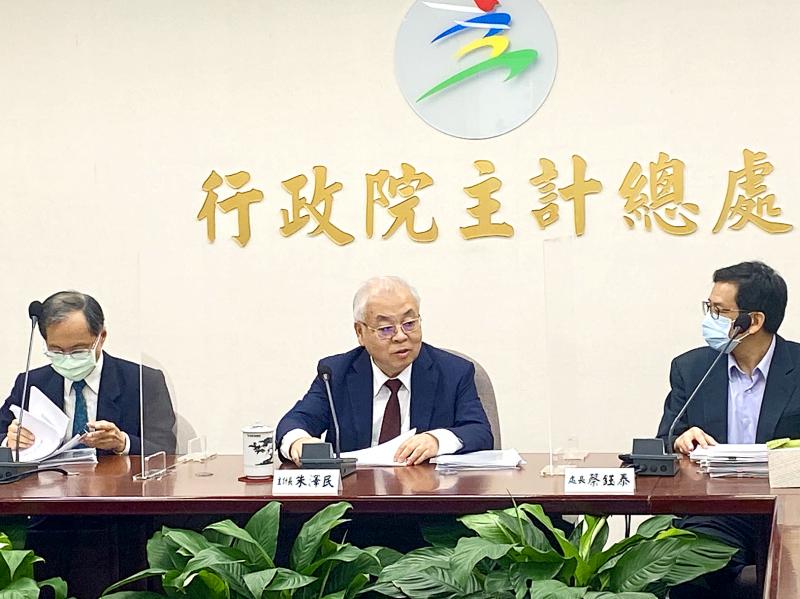
Photo: Clare Cheng, Taipei Times
The agency is to issue its formal update on Nov. 27 after a committee meeting, she said.
Exports of electronic components in the third quarter surged 20.39 percent year-on-year, while shipments of information and communications technology products soared 20.64 percent, Wu said.
The COVID-19 pandemic has caused disruptions at workplaces, schools and recreational facilities around the world, but has created unprecedented demand for tablets, notebook computers, TVs, servers, data centers, and other technology products and solutions necessary to maintain a low-contact economy.
Restrictions imposed by Washington on China’s Huawei Technologies Co (華為) prompted the Shenzhen-based technology titan to stockpile inventory ahead of the Sept. 15 deadline and increased business at its local suppliers.
Against that backdrop, net external demand contributed 3.2 percentage points to third-quarter growth, indicating little help from the domestic front, the report said.
Private investment increased a mild 2.04 percent, while government spending increased 3.2 percent, together adding 0.91 percentage points to the growth, it said.
Government agencies have commissioned public works ahead of schedule to shore up the economy, Wu said.
Consumer spending stayed in negative territory with a 1.51 percent retreat, although a boom in domestic travel significantly eased the drop in the critical GDP component, the report said.
Outbound travel shrank 97.8 percent, similar to a 98.94 percent slump in the second quarter, Wu said.
Domestic airline revenue declined 86.89 percent, while passengers on public transportation shrank 10 percent, it said.
However, retail businesses and restaurants saw a recovery of 4.57 percent and 0.85 percent respectively, partly on the back of the Triple Stimulus Voucher Program, Wu said, but added that this effect was difficult to quantify.

Tropical Storm Gaemi strengthened into a typhoon at 2pm yesterday, and could make landfall in Yilan County tomorrow, the Central Weather Administration (CWA) said yesterday. The agency was scheduled to issue a sea warning at 11:30pm yesterday, and could issue a land warning later today. Gaemi was moving north-northwest at 4kph, carrying maximum sustained winds near its center of up to 118.8kph and gusts of 154.8kph. The circumference is forecast to reach eastern Taiwan tomorrow morning, with the center making landfall in Yilan County later that night before departing from the north coast, CWA weather forecaster Kuan Shin-ping (官欣平) said yesterday. Uncertainty remains and

SEA WARNING LIKELY: The storm, named Gaemi, could become a moderate typhoon on Wednesday or Thursday, with the Taipei City Government preparing for flooding A tropical depression east of the Philippines developed into a tropical storm named Gaemi at 2pm yesterday, and was moving toward eastern Taiwan, the Central Weather Administration (CWA) said. Gaemi could begin to affect Taiwan proper on Tuesday, lasting until Friday, and could develop into a moderate typhoon on Wednesday or Thursday, it said. A sea warning for Gaemi could be issued as early as Tuesday morning, it added. Gaemi, the third tropical storm in the Pacific Ocean this typhoon season, is projected to begin moving northwest today, and be closest to Taiwan on Wednesday or Thursday, the agency said. Today, there would likely

DISRUPTIONS: The high-speed rail is to operate as normal, while several airlines either canceled flights or announced early departures or late arrivals Schools and offices in 15 cities and counties are to be closed today due to Typhoon Gaemi, local governments announced last night. The 15 are: Taipei, New Taipei City, Taoyuan, Tainan, Keelung, Hsinchu and Kaohsiung, as well as Yilan, Hualien, Hsinchu, Miaoli, Chiayi, Pingtung, Penghu and Lienchiang counties. People should brace for torrential rainfall brought by the storm, with its center forecast to make landfall on the east coast between tonight and tomorrow morning, the Central Weather Administration (CWA) said. The agency issued a sea warning for the typhoon at 11:30pm on Monday, followed by a land warning at 11:30am yesterday. As of

CASUALTY: A 70-year-old woman was killed by a falling tree in Kaohsiung as the premier warned all government agencies to remain on high alert for the next 24 hours Schools and offices nationwide are to be closed for a second day today as Typhoon Gaemi crosses over the nation, bringing torrential rain and whipping winds. Gaemi was forecast to make landfall late last night. From Tuesday night, its outer band brought substantial rainfall and strong winds to the nation. As of 6:15pm last night, the typhoon’s center was 20km southeast of Hualien County, Central Weather Administration (CWA) data showed. It was moving at 19kph and had a radius of 250km. As of 3pm yesterday, one woman had died, while 58 people were injured, the Central Emergency Operation Center said. The 70-year-old


 RSS
RSS