


Activist investors led by Shanyuan Group (三圓建設) chairman Wang Kuang-hsiang (王光祥) won seven seats on Tatung Co’s (大同) nine-member board at an extraordinary shareholders’ meeting in Taipei yesterday, ending the founding Lin (林) family’s 102-year control.
With approval from the Ministry of Economic Affairs, institutional shareholders held the special meeting to elect new board members, nearly four months after Tatung deprived 27 investors owning a combined 53 percent stake in the firm of their voting rights at a shareholders’ meeting on June 30.
Shareholders with a combined 92.34 percent stake, or 2.03 billion shares, showed up to vote or had placed their ballots via an electronic voting platform operated by Taiwan Depository and Clearing Corp (台灣集保), said Hsin Tung Investment Consultancy Co (欣同) chairman Lin Hung-hsin (林宏信), who chaired the meeting.
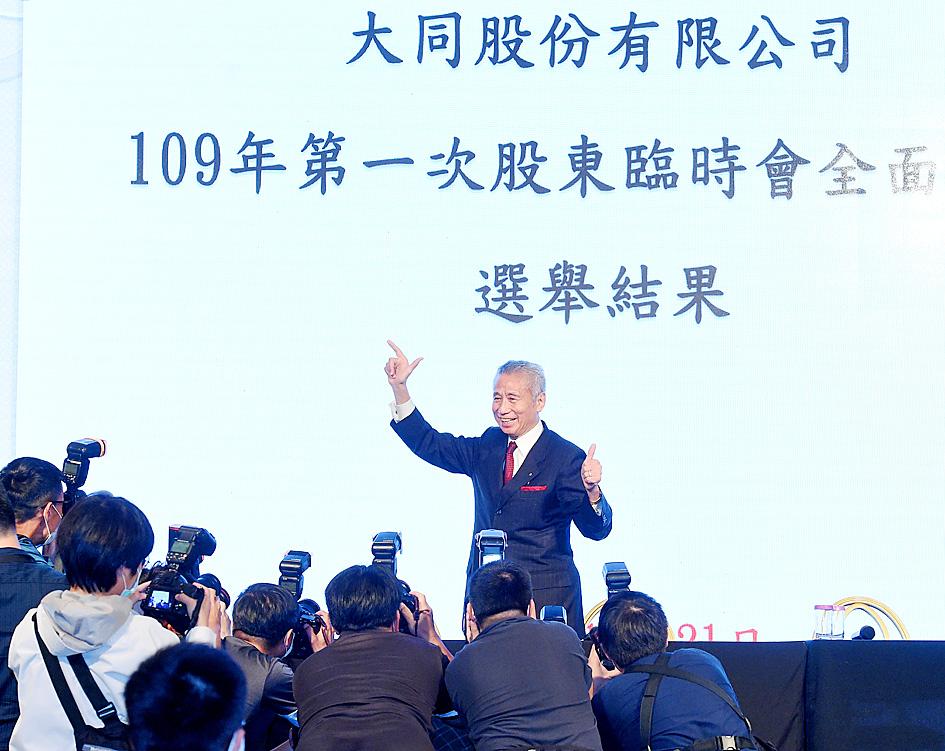
Photo: Chu Pei-hsiung, Taipei Times
Candidates appointed by institutional investors won seven seats, including two independent director seats, with leading activist investors Wang, Lin Hung-hsin and Eastern Broadcasting Co (東森電視) chairman Lin Wen-yuan (林文淵) elected as new board directors and garnering 1.43 billion, 1.42 billion and 1.42 billion votes respectively.
Tatung-appointed candidates won two seats, with Tatung chairwoman Lin Kuo Wen-yen (林郭文艷) receiving 1.3 billion votes to stay on the board and James Wang (王金來), a former chairman of Ernst & Young Taiwan, gaining 2.29 billion votes, the highest tally, to take the third independent director seat.
The firm is to hold an extraordinary board meeting on Wednesday next week at the earliest to elect a new chair, Wang Kuang-hsiang told a news conference yesterday.
“We will support Lin Wen-yuan as the new chairman and hope to make Tatung prosperous for the next century,” Wang said.
Lin Kuo, who took over as chairwoman in February 2018 when her husband, Lin Wei-shan (林蔚山), stepped down over a corporate scandal, feared institutional investors might sell the firm’s properties, while the board election was held under unresolved suspicions of Chinese involvement.
“I will continue to protect Tatung as a matter of Taiwanese national security,” Lin Kuo said.
Stephen Wu (吳志光), a lawyer at Lee and Li Attorneys-at-Law (理律法律事務所), said that her decision to stay on the board was unusual.
Many in such a scenario would concentrate on winning the independent director seats, as they can curb bad decisions proposed by a rival party, he said.
“It seems that Lin Kuo has decided to fight until the last minute ... staying on the board might enable her to do something more if the FSC [Financial Supervisory Commission] finds signs of Chinese influence in the firm again,” Wu said.
The Securities and Futures Investors Protection Center is to continue its lawsuit against Lin Kuo, even though company shareholders elected a new board, and if the agency wins, Lin Kuo would be barred from serving on the board.

Japan has deployed long-range missiles in a southwestern region near China, the Japanese defense minister said yesterday, at a time when ties with Beijing are at their lowest in recent years. The missiles were installed in Kumamoto in the southern region of Kyushu, as Japan is attempting to shore up its military capacity as China steps up naval activity in the East China Sea. “Standoff defense capabilities enable us to counter the threat of enemy forces attempting to invade our country ... while ensuring the safety of our personnel,” Japanese Minister of Defense Shinjiro Koizumi said. “This is an extremely important initiative for
Chinese Nationalist Party (KMT) Chairwoman Cheng Li-wun (鄭麗文) today accepted an invitation from Chinese President Xi Jinping (習近平) to lead a delegation to China next month, saying she hopes to promote the peaceful development of cross-strait relations and bring stability to the Taiwan Strait. “I am grateful and happy to accept this invitation,” Cheng said in a statement from the KMT chairperson’s office. Cheng said she hopes both sides can work together to promote the peaceful development of cross-strait relations, enhance exchange and cooperation, bring stability to the Taiwan Strait and improve people’s livelihoods. At today's news conference, Cheng said any efforts to

MORE POPULAR: Taiwan Pass sales increased by 59 percent during the first quarter compared with the same period last year, the Tourism Administration said The Tourism Administration yesterday said that it has streamlined the Taiwan Pass, with two versions available for purchase beginning today. The tourism agency has made the pass available to international tourists since 2024, allowing them to access the high-speed rail, Taiwan Railway Corp services, four MRT systems and four Taiwan Tourist Shuttles. Previously, five types of Taiwan Pass were available, but some tourists have said that the offerings were too complicated. The agency said only two types of Taiwan Pass would be available, starting from a three-day pass with the high-speed rail and a three-day pass with Taiwan Railway Corp. The former costs NT$2,800

The nation’s fastest supercomputer, Nano 4 (晶創26), is scheduled to be launched in the third quarter, and would be used to train large language models in finance and national defense sectors, the National Center for High-Performance Computing (NCHC) said. The supercomputer, which would operate at about 86.05 petaflops, is being tested at a new cloud computing center in the Southern Taiwan Science Park in Tainan. The exterior of the server cabinet features chip circuitry patterns overlaid with a map of Taiwan, highlighting the nation’s central position in the semiconductor industry. The center also houses Taiwania 2, Taiwania 3, Forerunner 1 and


 RSS
RSS