


Former Australian prime minister Malcolm Turnbull yesterday urged solidarity between all democratic nations in the Indo-Pacific region to ensure regional prosperity and peace, while former Swedish prime minister Carl Bildt raised concerns about China’s “wolf warrior” diplomacy at the Yushan Forum in Taipei.
Speaking via videoconference, Turnbull said that international focus on Taiwan has grown due to the nation’s effective handling of the COVID-19 pandemic, instead of ever-increasing cross-strait tensions, but that President Tsai Ing-wen’s (蔡英文) statement about “particular forces” threatening regional democracies has been supported by the re-emergence of nationalism and protectionism in the region.
Mutual respect for each nation’s sovereignty is the foundation of the rule-based international order, while an ever-increasing belligerent China has become a hotspot of international contention, he added.
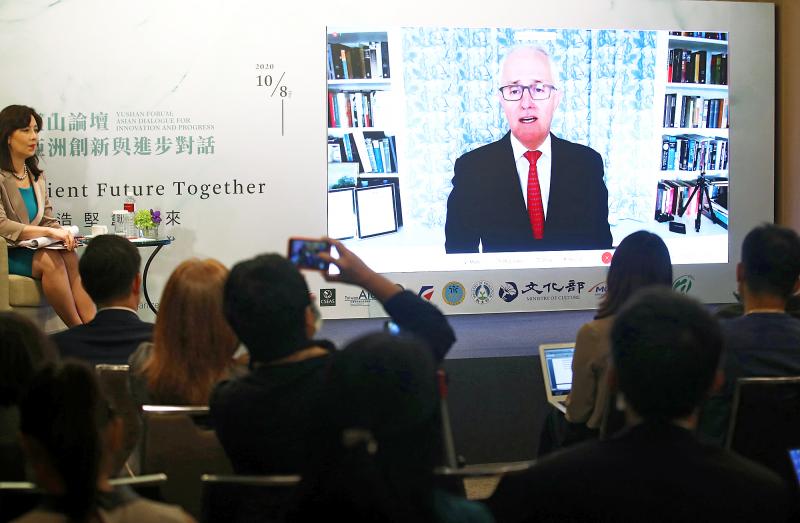
Photo: CNA
The world had hoped that with the rise of its middle class, Chinese society would — like that of Taiwan — successfully transition toward liberal democracy, Turnbull said.
However, under Chinese President Xi Jinping’s (習近平) leadership, the Chinese Communist Party has become increasingly authoritarian at home, while becoming more bellicose and aggressive internationally, he said, citing the examples of Beijing’s oppression of Hong Kong and the Uighur concentration camps in Xinjiang.
“China’s unilateral actions in the South China Sea are becoming a nightmare for ASEAN,” he added.
Turnbull cited China’s abuse of its increasing influence to threaten the economies of other nations, such as banning the import of Japanese and South Korean goods, as well as suspending imports of Australian beef.
Turnbull said that his administration’s decision to ban Huawei Technologies Co (華為) and ZTE Corp (中興) from supplying equipment for Australia’s 5G networks was not political, but rather because they posed a national security risk.
More nations are on their guard against China, whose goal is to become a regional hegemony and eventually replace the US as the world superpower, he said.
“We must guard our democratic values and defend our sovereignty against such aggression, and that is why all nations who share the same values in the region must work together to ensure peace and prosperity,” Turnbull said.
Speaking to reporters after his speech, Turnbull said that he had heard of no further developments regarding a free-trade agreement between Australia and Taiwan, adding that he, in principle, supports such a move.
Australia is an open economy and a free-trade agreement would mean more employment opportunities, Turnbull said, adding that this was why he had worked with Japan, Indonesia and other nations to form the Comprehensive and Progressive Agreement for Trans-Pacific Partnership (CPTPP).
It is regrettable that US President Donald Trump decided to pull out of the framework, but we hope that Taiwan can join the CPTPP one day, he said.
Australia’s observance of the “one China” policy would not affect its efforts to create friendly ties with Taiwan, Turnbull said.
Bildt told reporters that China’s abuse of the rule of law in Hong Kong and human rights elsewhere in the world had sparked concern from many EU nations.
While Sweden cooperates with China, Beijing’s “wolf warrior” diplomacy has affected relations to a certain degree, he said.
China is the primary victim of this mistaken diplomatic policy, he added.
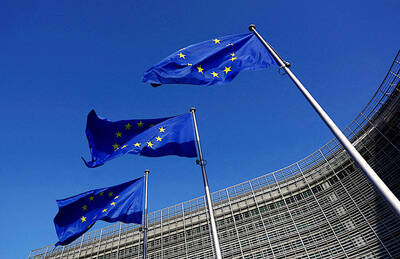
LEVERAGE: China did not ‘need to fire a shot’ to deny Taiwan airspace over Africa when it owns ‘half the continent’s debt,’ a US official said, calling it economic warfare The EU has raised concerns about overflight rights following the delay of President William Lai’s (賴清德) planned state visit to the Kingdom of Eswatini after three African nations denied overflight clearance for his charter at the last minute. Taiwanese allies Paraguay and Saint Kitts and Nevis, as well as several US lawmakers and the Inter-Parliamentary Alliance on China (IPAC) condemned China for allegedly pressuring the countries. Lai was scheduled to fly directly to Taiwan’s only African ally from yesterday to Sunday to celebrate the 40th anniversary of King Mswati III’s accession and his 58th birthday, but Seychelles, Mauritius and Madagascar suddenly revoked
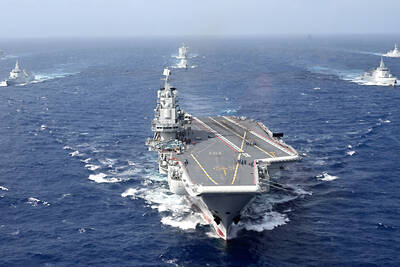
PROVOCATIVE: Chinese Deputy Ambassador to the UN Sun Lei accused Japan of sending military vessels to deliberately provoke tensions in the Taiwan Strait China denounced remarks by Japan and the EU about the South China Sea at a UN Security Council meeting on Monday, and accused Tokyo of provocative behavior in the Taiwan Strait and planning military expansion. Ayano Kunimitsu, a Japanese vice foreign minister, told the Council meeting on maritime security that Tokyo was seriously concerned about the situation in the East China and South China seas, and reiterated Japan’s opposition to any attempt to change the “status quo” by force, and obstruction of freedom of navigation and overflight. Stavros Lambrinidis, head of the EU delegation to the UN, also highlighted South China Sea
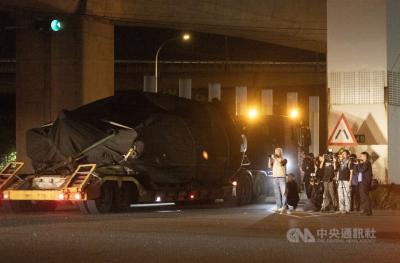
The final batch of 28 M1A2T Abrams tanks purchased from the US arrived at Taipei Port last night and were transported to the Armor Training Command in Hsinchu County’s Hukou Township (湖口), completing the military’s multi-year procurement of 108 of the tanks. Starting at 12:10am today, reporters observed more than a dozen civilian flatbed trailers departing from Taipei Port, each carrying an M1A2T tank covered with black waterproof tarps. Escorted by military vehicles, the convoy traveled via the West Coast Expressway to the Armor Training Command, with police implementing traffic control. The army operates about 1,000 tanks, including CM-11 Brave Tiger
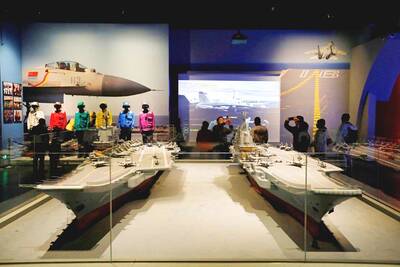
China on Wednesday teased in a video an aircraft carrier that could be its fourth, and the first using nuclear power, while making an allusion to Taiwan and vowing to further build up its islands, as it looks to boost maritime power, secure resources and bolster territorial claims. The video, issued on the eve of the 77th founding anniversary of the Chinese People’s Liberation Army Navy, featured fictional officers with names that are homophones of three commissioned aircraft carriers, the Liaoning (遼寧), Shandong (山東) and Fujian (福建). Titled Into the Deep, it showed a 19-year-old named “Hejian” (何劍) joining the group, sparking


 RSS
RSS