


An American Institute in Taiwan (AIT) director for the first time yesterday joined a Taiwanese president to commemorate the 823 Artillery Bombardment of 1958.
President Tsai Ing-wen (蔡英文) laid a wreath and bowed her head in respect at a memorial park in Kinmen County to mark the 62nd anniversary of the beginning of the bombardment, also known as the Second Taiwan Strait Crisis.
AIT Director Brent Christensen also offered his respects, standing behind Tsai.
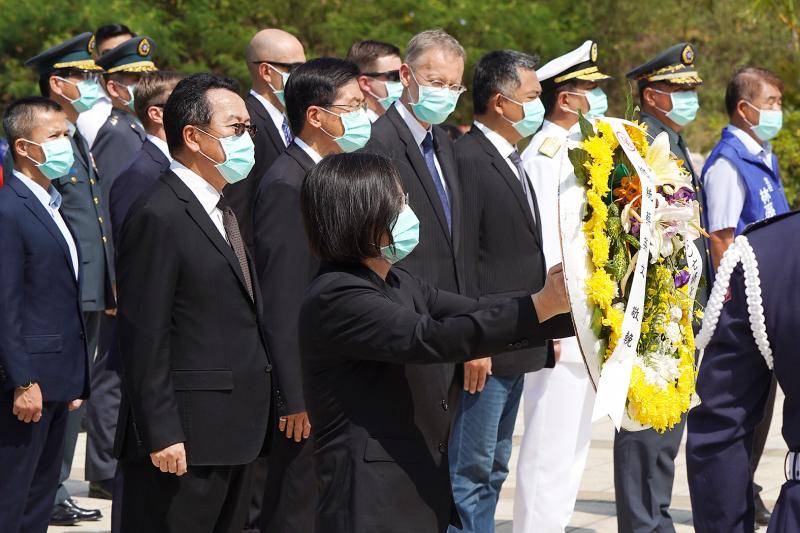
Photo: CNA
Like Tsai, Christensen did not make public comments.
The Chinese Communist Party began the bombardment of Kinmen on Aug. 23, 1958, nine years after the Republic of China (ROC) government fled to Taiwan after the Chinese Civil War.
According to Academia Sinica data, 475,000 artillery shells were fired within 44 days at the Kinmen islands, which lie 10km from Xiamen in China’s Fujian Province, but the communist troops could not capture them.
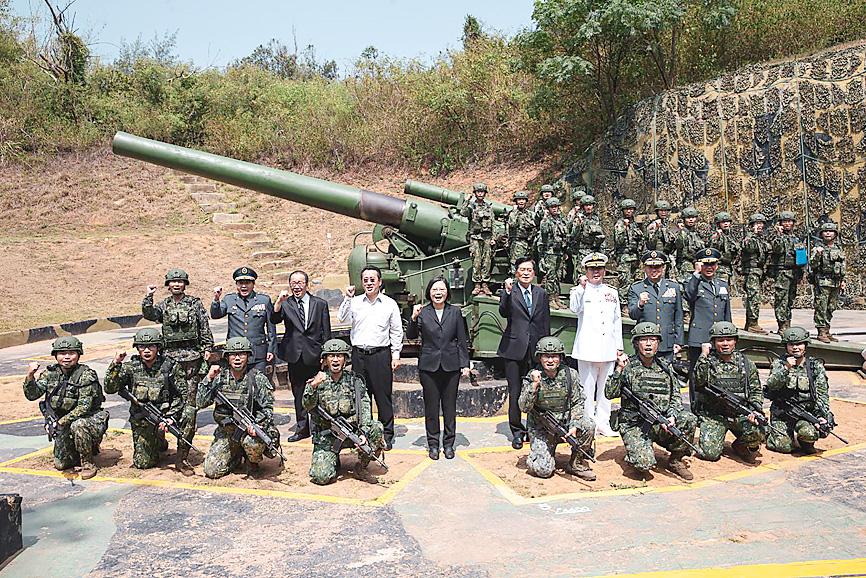
Photo: CNA
The bombardment is regarded as a significant battle that helped safeguard the ROC government in Taiwan.
Presidential Office spokesman Xavier Chang (張惇涵) yesterday thanked Christensen for his attendance at the event.
“We are thankful to our US friends for joining us on this very meaningful day, to recall those who came before us and made great sacrifices to protect the safety of those living on Taiwan, Penghu, Kinmen and Matsu,” he said. “Those sacrifices helped secure regional peace, and advance Taiwan’s democracy and freedom.”
The spirit of the commemoration ceremony serves as a reminder that the protection of national sovereignty, democracy and freedom relies on the combined efforts of all Taiwanese, he said.
“U.S.-Taiwan security cooperation goes back decades and has been a key element in our partnership,” the AIT wrote on Facebook yesterday.
“Commemorations such as these remind us that today’s U.S.-Taiwan security cooperation builds on a long and proud history that exemplifies the phrase ‘Real Friends, Real Progress,’” it wrote.
Christensen also paid tribute to Lieutenant Colonel Alfred Medendorp and Lieutenant Colonel Frank Lynn, Americans who died on Kinmen in 1954 while defending it with ROC soldiers, the AIT wrote.
Meanwhile, the Chinese People’s Liberation Army has announced that it plans to conduct more drills in the coming week in the waters just to the north and south of Taiwan.
The Ministry of National Defense yesterday released a video reiterating Taiwan’s readiness in the face of ongoing Chinese threats.
Separately on Saturday, speaking at a Taiwan-US cultural event, Representative to the US Hsiao Bi-khim (蕭美琴) said that her work in the US is focused on security, the economy and Taiwan’s global participation.
On the issue of security, Hsiao emphasized Taiwan-US cooperation on security in the Indo-Pacific region.
“To bow and bend the knee will not bring lasting peace. All Taiwanese have a responsibility toward supporting national defense,” she said, citing a statement made previously by Tsai.
On the issue of the economy, Hsiao said that she is hoping for the establishment of a Taiwan-US bilateral trade agreement.
She also thanked the US for its continued support of Taiwan’s participation in international organizations, and for taking the lead regarding other nations that similarly face suppression and isolation by China.
“When like-minded nations stand together they become stronger,” she said.
Additional reporting by Reuters and Aaron Tu

Japan has deployed long-range missiles in a southwestern region near China, the Japanese defense minister said yesterday, at a time when ties with Beijing are at their lowest in recent years. The missiles were installed in Kumamoto in the southern region of Kyushu, as Japan is attempting to shore up its military capacity as China steps up naval activity in the East China Sea. “Standoff defense capabilities enable us to counter the threat of enemy forces attempting to invade our country ... while ensuring the safety of our personnel,” Japanese Minister of Defense Shinjiro Koizumi said. “This is an extremely important initiative for

MORE POPULAR: Taiwan Pass sales increased by 59 percent during the first quarter compared with the same period last year, the Tourism Administration said The Tourism Administration yesterday said that it has streamlined the Taiwan Pass, with two versions available for purchase beginning today. The tourism agency has made the pass available to international tourists since 2024, allowing them to access the high-speed rail, Taiwan Railway Corp services, four MRT systems and four Taiwan Tourist Shuttles. Previously, five types of Taiwan Pass were available, but some tourists have said that the offerings were too complicated. The agency said only two types of Taiwan Pass would be available, starting from a three-day pass with the high-speed rail and a three-day pass with Taiwan Railway Corp. The former costs NT$2,800

POLLS CONCERNS: There are concerns within the KMT that a Cheng Li-wun-Xi Jinping meeting could trigger a voter backlash in elections in November Chinese Nationalist Party (KMT) Chairwoman Cheng Li-wun (鄭麗文) accepted an invitation from Chinese President Xi Jinping (習近平) to visit next month, her party and Chinese state media reported yesterday. Cheng, who took up her role in November last year, “gladly accepted” the invitation to lead a delegation to China, the KMT said in a statement, confirming a Xinhua news agency report. Cheng “looks forward to joint efforts by both parties to advance the peaceful development of cross-strait relations, promote cross-strait exchanges and cooperation, and work for peace in the Taiwan Strait and greater well-being for people on both sides,” the statement said. Chinese

SIGNIFICANT TO THE WORLD: The delegation’s visit aims to send a clear message that bipartisan support for Taiwan is consistent, US Senator Jeanne Shaheen said The US Senate’s bipartisan support for Taiwan remains strong and Taiwan-US ties would continue for decades to come, a US Senate delegation said in Taipei yesterday, while calling on the legislature to swiftly pass a special defense budget bill. A US delegation led by Democratic US Senator Jeanne Shaheen and Republican US Senator John Curtis — both members of the US Senate Committee on Foreign Relations — arrived in Taiwan yesterday for a two-day visit. The other senators of the delegation included Senate Taiwan Caucus cochair Thom Tillis and Senate Committee on Armed Services senior member Jacky Rosen. Shaheen told a news


 RSS
RSS