


International organizations are not the place to play politics, especially when the matter relates to healthcare, US Secretary of Health and Human Services Alex Azar said in Taipei yesterday, adding that the region and the world are safer because of Taiwan’s commitment to health promotion.
On the third day of his visit, the highest-level visit by a senior US Cabinet official in decades, Azar met with Minister of Foreign Affairs Joseph Wu (吳釗燮) at the Grand Mayfull Hotel in Zhongshan District (中山) yesterday morning, following his meetings with President Tsai Ing-wen (蔡英文) and Minister of Health and Welfare Chen Shih-chung (陳時中) on Monday.
Taiwan faces an increasingly difficult situation as China continues to pressure it into accepting its political conditions, “conditions that would turn Taiwan into the next Hong Kong,” Wu said before his closed-door meeting with Azar.
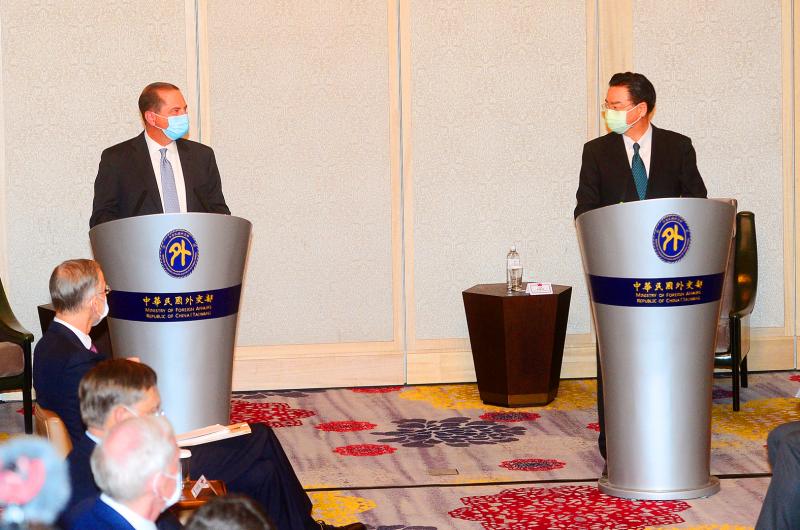
Photo: Wang Yi-sung, Taipei Times
“The people of Taiwan are all too familiar with dealing with threats, be it military, diplomatic or the threats of epidemics,” Wu said.
Thanking Azar for supporting Taiwan’s fight for international space, Wu said that the battle is not just about Taiwan’s status, but about sustaining democracy in the face of authoritarian aggression.
“Taiwan must win these battles, so democracy prevails,” he said.
The US would continue advocating for the contributions Taiwan can make to the world on important issues like health, Azar said, adding that he would discuss these issues and Taiwan’s global health leadership with Wu.
Following his talk with Wu, Azar and his delegation attended a luncheon banquet hosted by Vice President William Lai (賴清德), representing Tsai.
Wu, Chen, former vice president Chen Chien-jen (陳建仁), National Security Council Secretary-General Wellington Koo (顧立雄), Minister of Economic Affairs Wang Mei-hua (王美花), Academia Sinica President James Liao (廖俊智) and American Institute in Taiwan Director Brent Christensen also attended the luncheon, Lai wrote on Facebook.
In the afternoon, Azar traveled to National Taiwan University’s College of Public Health, where he delivered a 15-minute speech to an audience of more than 100 health experts and students, as well as the ambassadors of Palau, the Marshall Islands, Nauru and Tuvalu — Taiwan’s four Pacific allies.
Azar praised Taiwan’s aid to Pacific island nations and others around the world, and praised former president Lee Teng-hui (李登輝), who died on July 30.
“President Lee’s legacy goes beyond just political freedom,” Azar said. “The democratic legacy he built has made Taiwan a leader not only in freedom and economic growth, but also in global health.”
“Taiwan’s approach to combating the virus through openness, transparency and cooperation stands in stark contrast to the country where the virus began,” he said.
“The Chinese Communist Party had the chance to warn the world and work with the world on battling the virus. But they chose not to, and the costs of that choice mount higher every day,” Azar said. “I believe it is no exaggeration to say that, if this virus had emerged in a place like Taiwan or the United States, it might have been snuffed out easily.”
“Instead, Beijing appears to have resisted information-sharing, muzzling doctors who spoke out and hobbling the world’s ability to respond,” he said.
China’s influence outweighs its investment in the WHO, and it uses influence not to advance public health objectives, but its own narrow political interests, he said.
Taiwan in 2016 became the eighth jurisdiction to publish results from its Joint External Evaluation by engaging the Johns Hopkins Center for Health Security as its evaluators, he said.
“The Indo-Pacific region and the whole world are safer because of Taiwan’s commitment to this public health work,” he added.
Azar is scheduled to pay his respects to Lee at a memorial to the former president at the Taipei Guest House today before his delegation heads to the airport to return to the US.
Additional reporting by AFP
Taiwan Semiconductor Manufacturing Co (TSMC, 台積電), the world’s largest foundry service provider, yesterday said that global semiconductor revenue is projected to hit US$1.5 trillion in 2030, after the figure exceeds US$1 trillion this year, as artificial intelligence (AI) demand boosts consumption of token and compute power. “We are still at the beginning of the AI revolution, but we already see a significant impact across the whole semiconductor ecosystem,” TSMC deputy cochief operating officer Kevin Zhang (張曉強) said at the company’s annual technology symposium in Hsinchu City. “It is fair to say that in the past decade, smartphones and other mobile devices were
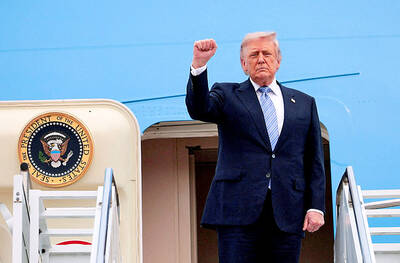
US-CHINA SUMMIT: MOFA welcomed US reassurance of no change in its Taiwan policy; Trump said he did not comment when Xi talked of opposing independence US President Donald Trump yesterday said he has not made a decision on whether to move forward with a major arms package for Taiwan after hearing concerns about it from Chinese President Xi Jinping (習近平). Trump’s comments on Taiwan came as he flew back to Washington after wrapping up critical talks in which both leaders said important progress was made in stabilizing US-China relations even as deep differences persist between the world’s two biggest powers on Iran and Taiwan. “I will make a determination,” Trump said, adding: “I’ll be making decisions. But, you know, I think the last thing we need right
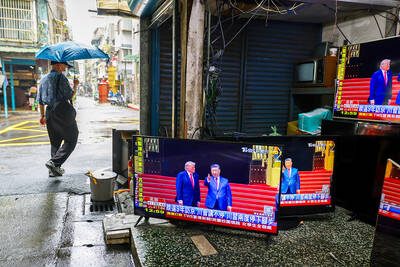
TAIWAN ISSUE: US treasury secretary Scott Bessent said on the first day of meetings that ‘it wouldn’t be a US-China summit without the Taiwan issue coming up’ There were no surprises on the first day of the summit between US President Donald Trump and Chinese President Xi Jinping (習近平), the Mainland Affairs Council (MAC) said yesterday, as the government reiterated that cross-strait stability is crucial to the Asia-Pacific region, as well as the world. As the two presidents met for a highly anticipated summit yesterday, Chinese state media reported that Xi warned Trump that missteps regarding Taiwan could push their two countries into “conflict.” Trump arrived in China with accolades for his host, calling Xi a “great leader” and “friend,” and extending an invitation to visit the White House
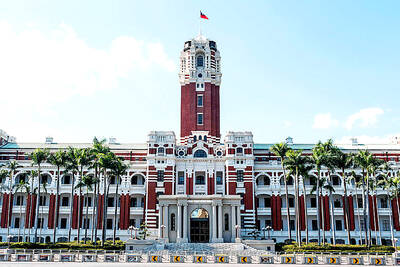
SECURITY: Taipei presses the US for arms supplies, saying the arms sales are not only a reflection of the US security commitment to Taiwan but also serve as a mutual deterrent against regional threats Taiwan is committed to preserving the cross-strait “status quo” and contributing to regional peace and stability, the Presidential Office said yesterday. “It is an undeniable fact that the Republic of China is a sovereign and independent democratic nation,” Presidential Office spokeswoman Karen Kuo (郭雅慧) reiterated, adding that Beijing has no right to claim sovereignty over Taiwan. The statements came after US President Donald Trump warned against Taiwanese independence. Trump wrapped up a state visit to Beijing on Friday, during which Chinese President Xi Jinping (習近平) had pressed him not to support Taiwan. Taiwan depends heavily on US security backing to deter China from carrying


 RSS
RSS