


Stimulus coupons valued at NT$3,000 (US$99.85) are to be handed out, but would require proof of purchases totaling NT$1,000, the Executive Yuan said yesterday.
The plan is intended to help small stores and businesses amid the COVID-19 pandemic, Executive Yuan spokesman Ting Yi-ming (丁怡銘) told a news conference after the weekly Cabinet meeting, adding that Premier Su Tseng-chang (蘇貞昌) is to unveil details at a news conference on Tuesday next week.
Most businesses affected by the pandemic are small stores and the Executive Yuan wants to help them, Ting said.
Every Republic of China citizen is to receive a NT$3,000 coupon after spending NT$1,000, he said.
The coupons can be obtained by presenting receipts from in-store purchases, electronic payments, electronic ticketing or credit cards, he said.
With other government agencies announcing their own stimulus packages, digital platforms stand to benefit, as Taiwanese are accustomed to spending online, Ting said.
The aggregate effect of the Executive Yuan’s package might exceed the amount invested, as 1.2 million disadvantaged families would be eligible to receive the coupons without providing receipts.
National Development Council Deputy Minister Cheng Cheng-mount (鄭貞茂) said there was no simple answer to how the coupons would affect GDP.
The NT$40 billion budget for the coupons was calculated by multiplying NT$2,000 by 20 million people, Deputy Minister of Economic Affairs Tseng Wen-sheng (曾文生) said.
How this affects GDP would depend on capital turnover and stimulus policies, Tseng said.
“You need to implement a policy to derive reliable data,” Cheng said.
The government would adjust the system once the coupons are released, but they would have a noticeable effect on the economy, Cheng said.
The Executive Yuan is aware of potential privacy concerns if coupon distribution is implemented in a similar way to masks, so privacy would be a priority, Ting said.

An Emirates flight from Dubai arrived at Taiwan Taoyuan International Airport yesterday afternoon, the first service of the airline since the US and Israel launched strikes against Iran on Saturday. Flight EK366 took off from the United Arab Emirates (UAE) at 3:51am yesterday and landed at 4:02pm before taxiing to the airport’s D6 gate at Terminal 2 at 4:08pm, data from the airport and FlightAware, a global flight tracking site, showed. Of the 501 passengers on the flight, 275 were Taiwanese, including 96 group tour travelers, the data showed. Tourism Administration Deputy Director-General Huang He-ting (黃荷婷) greeted Taiwanese passengers at the airport and

POSSIBILITIES EMERGE: With Taiwan’s victory and Japan’s narrow win over Australia, Taiwan now have a chance to advance if South Korea also beat the Aussies Taiwan has high hopes that the national baseball team would advance to the World Baseball Classic (WBC) quarter-finals after clinching a crucial 5-4 victory over South Korea in a nail-biting extra-inning game at the Tokyo Dome yesterday. Boosted by three home runs — two solo shots by Yu Chang (張育成) and Cheng Tsung-che (鄭宗哲) and a two-run homer by Stuart Fairchild — the triumph gave Taiwan a much-needed second victory in the five-team Pool C, where only the top two finishers would advance to the knockout stage in Miami, Florida. Entering extra innings with the game tied at four apiece, Taiwan scored

MISSION OF PEACE: The foreign minister urged Beijing to respect Taiwan’s existence as an independent nation, and work together to ensure peace and stability in the region Minister of Foreign Affairs Lin Chia-lung (林佳龍) yesterday rejected Chinese Minister of Foreign Affairs Wang Yi’s (王毅) comments about Taiwan, criticizing China as a “troublemaker” in the international community and a disruptor of cross-strait peace. Speaking at a news conference on the sidelines of the Chinese National People’s Congress, Wang said that Taiwan has always been a territory of China and that it would be impossible for it to become its own country. The “return” of Taiwan to China was the natural outcome of the Chinese people’s resistance against Japan in World War II, and that any pursuit of independence was “doomed
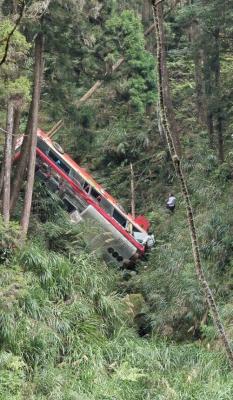
One person was killed and another seven injured today when a tourist shuttle bus plunged 30m to 40m down a ravine in Nantou County, the Tourism Administration said. The bus is suspected to have suddenly accelerated out of control near the flower center of the Sun-Link-Sea Forest Recreation Area, a popular attraction during cherry blossom season. Of the eight onboard, a 66-year-old man was killed, four were seriously injured and three sustained minor injuries, including the driver. The Nantou County Police Department said it received a report of the incident at 12:15pm and dispatched seven teams to assist. All surviving passengers have been transferred


 RSS
RSS