


The High Court’s Tainan branch yesterday overturned a death sentence on rape and murder charges against Hsieh Chih-hung (謝志宏) based on new findings from the Taiwan High Prosecutors’ Office after it restarted the investigation.
Hsieh was accused of being an accomplice to Kuo Chun-wei (郭俊偉) in the murder of a woman surnamed Chen (陳), 18, and a man surnamed Chang (張), 68, on June 24, 2000.
After first being found guilty in October 2001, Hsieh and Kuo had their verdicts and death sentences upheld in seven subsequent retrials, during which Hsieh maintained his innocence and said that his confession resulted from torture.
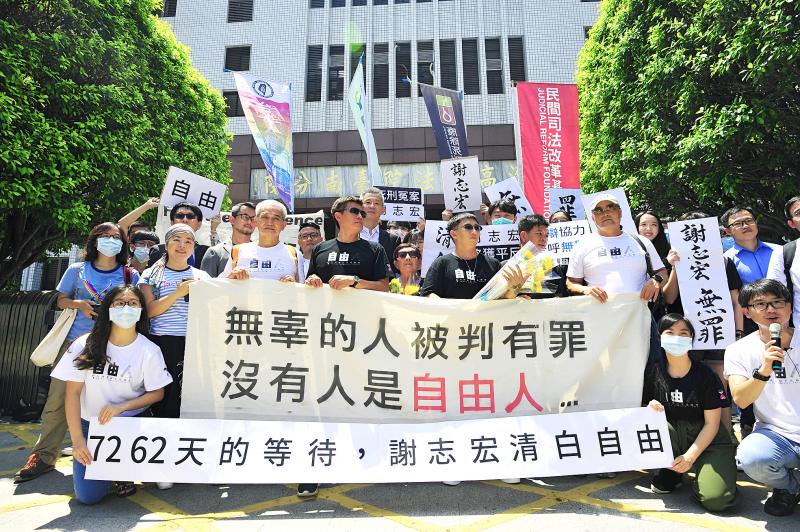
Photo: Wang Chieh, Taipei Times
In September 2018, the Taiwan High Prosecutors’ Office, citing new evidence that proved Hsieh’s innocence, filed for a retrial.
The High Court on March 14 last year accepted the petition and ordered Hsieh’s sentence to be temporarily suspended.
The court then granted a request to release Hsieh from the Tainan Detention Center, where he had been held since 2001, and began to hear the new case presented by prosecutors, before delivering the verdict yesterday.
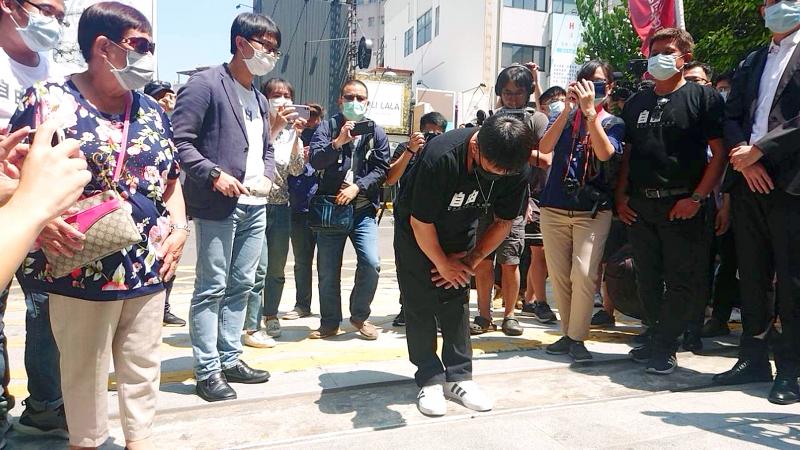
Photo: Wang Chieh, Taipei Times
Yesterday’s decision stated that because the police had not recorded either of Hsieh’s interrogation sessions and could provide little to no corroborating material, the interrogation was in breach of the Code of Criminal Procedure (刑事訴訟法).
Hsieh’s confession could therefore not be used as evidence, it said.
Kuo had accused Hsieh of being his accomplice and passed polygraph testing, but the court said that the testing should only point to Kuo’s credibility and not be considered proof of it.
Given that Kuo was diagnosed with antisocial personality disorder, the court dismissed the polygraph results.
A coroner’s examination of the victims’ bodies found wounds of various depths and stated that it was possible that there might have been more than one perpetrator, but it is reasonable that Kuo committed both murders, the court said.
The collegiate bench convened to preside over the case yesterday cited these reasons as grounds for finding Hsieh innocent.
The ruling can be appealed.
Hsieh, after exiting the courthouse yesterday, bowed in the direction of the bench, saying that he also wished to thank his lawyer, Yeh Chien-ting (葉建廷), for using his situation as a case study for his class and for bringing it to the attention of Lan Chin-lung (藍錦龍) of the Yilan County forensics office.
Hsieh also expressed thanks to the Taiwan Innocence Project and lawyer Tu Hsin-cheng (涂欣成), both having helped with his case.
“Please don’t look at death-row inmates as criminals, but as people, and let them have the chance, as I did, to look into their case again,” Hsieh said.
Prosecutors said that they would determine whether to appeal the ruling once it receives the verdict.
Additional reporting by Wang Chieh

Right-wing political scientist Laura Fernandez on Sunday won Costa Rica’s presidential election by a landslide, after promising to crack down on rising violence linked to the cocaine trade. Fernandez’s nearest rival, economist Alvaro Ramos, conceded defeat as results showed the ruling party far exceeding the threshold of 40 percent needed to avoid a runoff. With 94 percent of polling stations counted, the political heir of outgoing Costa Rican President Rodrigo Chaves had captured 48.3 percent of the vote compared with Ramos’ 33.4 percent, the Supreme Electoral Tribunal said. As soon as the first results were announced, members of Fernandez’s Sovereign People’s Party
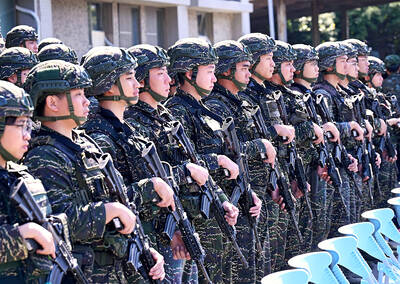
MORE RESPONSIBILITY: Draftees would be expected to fight alongside professional soldiers, likely requiring the transformation of some training brigades into combat units The armed forces are to start incorporating new conscripts into combined arms brigades this year to enhance combat readiness, the Executive Yuan’s latest policy report said. The new policy would affect Taiwanese men entering the military for their compulsory service, which was extended to one year under reforms by then-president Tsai Ing-wen (蔡英文) in 2022. The conscripts would be trained to operate machine guns, uncrewed aerial vehicles, anti-tank guided missile launchers and Stinger air defense systems, the report said, adding that the basic training would be lengthened to eight weeks. After basic training, conscripts would be sorted into infantry battalions that would take
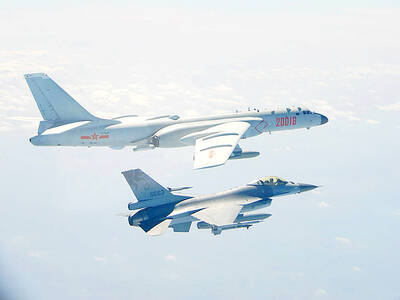
GROWING AMBITIONS: The scale and tempo of the operations show that the Strait has become the core theater for China to expand its security interests, the report said Chinese military aircraft incursions around Taiwan have surged nearly 15-fold over the past five years, according to a report released yesterday by the Democratic Progressive Party’s (DPP) Department of China Affairs. Sorties in the Taiwan Strait were previously irregular, totaling 380 in 2020, but have since evolved into routine operations, the report showed. “This demonstrates that the Taiwan Strait has become both the starting point and testing ground for Beijing’s expansionist ambitions,” it said. Driven by military expansionism, China is systematically pursuing actions aimed at altering the regional “status quo,” the department said, adding that Taiwan represents the most critical link in China’s

‘REALLY PROUD’: Nvidia would not be possible without Taiwan, Huang said, adding that TSMC would be increasing its capacity by 100 percent Nvidia Corp CEO Jensen Huang (黃仁勳) on Saturday praised and lightly cajoled his major Taiwanese suppliers to produce more to help power strong demand for artificial intelligence (AI), capping a visit to the country of his birth, where he has been mobbed by adoring fans at every step. Speaking at an impromptu press conference in the rain outside a Taipei restaurant, where he had hosted suppliers for a “trillion-dollar dinner,” named after the market capitalization of those firms attending, Huang said this would be another good year for business. “TSMC needs to work very hard this year because I need a lot


 RSS
RSS