


Taiwan has not received an invitation to the 73rd session of the World Health Assembly (WHA), which is to be held virtually from Monday next week, and all of the nation’s diplomatic allies, except the Vatican, have tendered proposals to the WHO backing Taiwan’s bid for participation, the Ministry of Foreign Affairs said yesterday.
In the past, some of the nation’s allies chose not to make formal appeals and instead made remarks at the decisionmaking body of the WHO, but this year those that could make proposals to back Taiwan’s WHA bid have all done so, ministry spokeswoman Joanne Ou (歐江安) told a news briefing in Taipei, describing the development as a “home run.”
The Vatican, which is only an observer at the WHA, would voice its support for Taiwan through other methods, the ministry said.
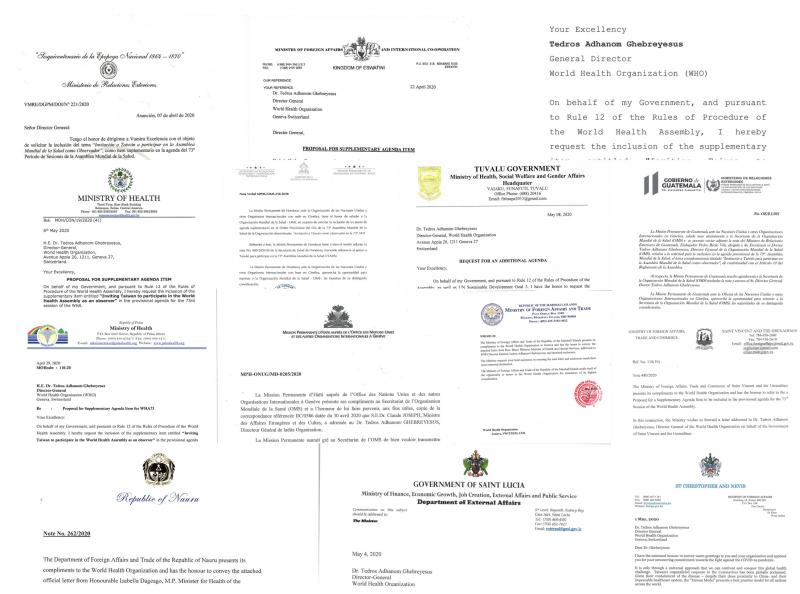
Photo: Lu Yi-hsuan, Taipei Times
In a letter addressed to WHO Director-General Tedros Adhanom Ghebreyesus and signed by Saint Vincentian Prime Minister Ralph Gonsalves, Saint Vincent and the Grenadines said that Taiwan from 2009 to 2016 had been invited to the WHA, and has had meaningful and ongoing interactions with the WHO.
“Since the election of the Democratic [Progressive] Party’s Tsai Ing-wen [蔡英文] to the presidency of Taiwan, the government of the People’s Republic of China has opposed the continuation of Taiwan’s observer-participant status at the WHA,” the letter said.
“If ever there is a time in which Taiwan deserves to be a part of the WHA as an observer, it is now, at the time of COVID-19... But locking out Taiwan from any participation at the WHA diminishes this august assembly and the peoples of the world who can benefit even more from Taiwan’s expertise, professionalism and generosity,” it added.
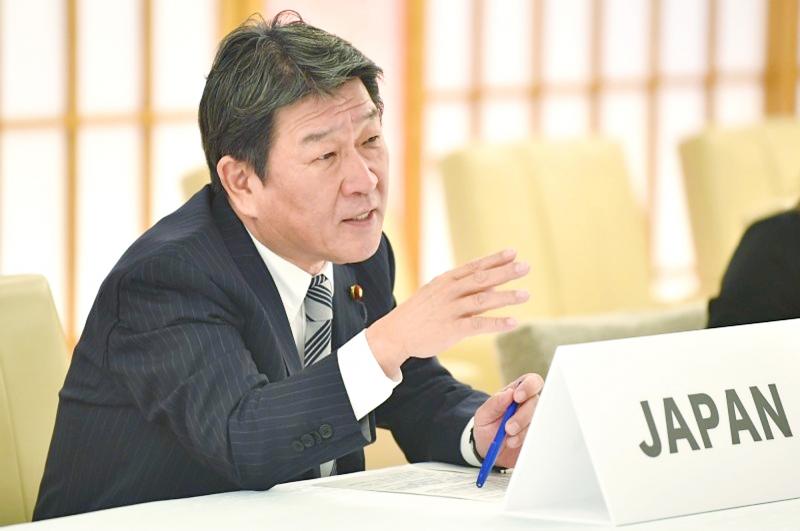
Photo: AFP
On Wednesday, 102 members of the European Parliament and four German lawmakers issued an open letter to the health ministers of the EU’s 27 member states calling for Minister of Health and Welfare Chen Shih-chung (陳時中) to be included in the virtual WHA, the ministry said.
The novel coronavirus “will dominate” the WHA, the open letter said.
“As the virus knows no borders, nationalities and ideologies, the world needs to share all available information and expertise that can be helpful to combat the [COVID-19] pandemic,” it said.
“That is why we, the undersigned members of the European and national parliaments, urge you to insist that the World Health Organization returns to the pragmatic protocol — practiced from 2009 to 2016 — of inviting Taiwan as an observer to this meeting format,” it added.
Citing the stance of the US, Canada, Australia and New Zealand for a return to the format, the open letter urged the European health ministers to insist that Taiwan be invited as an observer, as the nation has “successfully managed to curb the spread of the virus, in spite of Taiwan’s geographic proximity to the virus origin.”
Separately on Wednesday, Japanese Minister for Foreign Affairs Toshimitsu Motegi said that Taiwan was excluded from the WHA due to Beijing’s influence.
Japan would do its utmost to back Taiwan’s bid to join the WHA, Motegi said when answering questions in a session of the Japanese House of Representatives.
The US, Canada and Australia have also expressed support for Taiwan’s WHA bid by various means.
“Australia supports Taiwan’s involvement in the World Health Organization’s work and Taiwan’s participation as an observer at the World Health Assembly. There has never been a better time, nor a greater need, to work with all relevant partners to beat COVID-19 and respond to global health issues,” the Australian Office in Taipei wrote on Facebook.
While Taiwan’s bid might not succeed, many people are helping Taiwan and “the wind is blowing,” Chen said yesterday at the Central Epidemic Command Center’s daily news briefing.
Even if it is blocked from the assembly, the nation would still join certain meetings on the sidelines, as in previous years, Chen said, adding that he could not share details about any of the meetings.
Additional reporting by CNA

A signaling system malfunction disrupted high-speed rail (HSR) services beginning at 8am today, with trains temporarily reduced to three northbound and three southbound trains per hour as authorities conduct inspections. The malfunction occurred on a section of track in Miaoli County during pre-operation checks early this morning, forcing northbound and southbound trains to use a single track, the HSR operator said. The regular schedule has been replaced with three hourly trains offering only nonreserved seating in each direction, stopping at every station, it said, adding that business class cars would still have reserved seating. Departures from terminal stations are scheduled at the top

Taiwan is still in the process of assessing the possibility of recruiting workers from Eswatini, the Ministry of Foreign Affairs said yesterday, adding that its goal is to help Eswatini upgrade its vocational training centers. If there are plans to recruit workers from Eswatini, safeguarding national security, protecting public health and ensuring the employment rights of Taiwanese would be prerequisites, Department of West Asian and African Affairs Director-General Yen Chia-liang (顏嘉良) told a news conference. Key considerations would also include filling labor shortages in specific industries, and fostering bilateral professional and technical exchanges, he said. Yen was asked about the progress of labor

A US uncrewed surface vessel (USV) encountered multiple Chinese warships during an autonomous transit of the Taiwan Strait, US defense company Seasats said in a statement on Wednesday. Seasats announced that a Lightfish USV had completed the first autonomous transit of the Taiwan Strait. Over five days, the USV traversed the entire length of the Strait while constantly monitoring surface vessel traffic, the company said. The Lightfish encountered multiple Chinese warships, one of which was a Chinese People’s Liberation Army Navy (PLAN) Type 056 corvette, it said. The Chinese vessels were operating “well within Taiwan’s exclusive economic zone without transmitting their identity via the

VERBOSE VESSELS: A CGA cutter and a China Coast Guard exchanged verbal barbs for more than a day in Taiwanese-controlled waters before the Chinese vessel left The Taiwanese and Chinese coast guards had a standoff near the strategically located Pratas Islands (Dongsha Islands, 東沙群島) in the north of the South China Sea, the Coast Guard Administration (CGA) said yesterday. The two sides engaged in intense radio exchanges over sovereignty claims during the 33-hour standoff. China Coast Guard vessel 3501 eventually left the restricted waters, 26.6 nautical miles (49.2km) west of the Pratas Islands, at 5pm yesterday, the CGA said. Lying approximately between southern Taiwan and Hong Kong, the Taiwan-controlled Pratas are seen by some security experts as vulnerable to Chinese attack due to their distance — more than


 RSS
RSS