


The Central Epidemic Command Center (CECC) last night reported four new cases of COVID-19, bringing the nation’s total to 436, after announcing at its 2pm news briefing that there had been no new cases and it was mulling loosening disease prevention regulations.
The four cases are members of the crew of the supply ship Panshih (磐石), one of three vessels that had taken part in a “Friendship Flotilla” to the Western Pacific and which became the center of a scandal after 31 crew tested positive for COVID-19 following the flotilla’s return to Taiwan, forcing 713 other navy personnel from the flotilla to be put into a 14-day centralized quarantine.
That quarantine period ended at 12am yesterday, and tests on the 713 had been completed by noon, Minister of Health and Welfare Chen Shih-chung (陳時中), who heads the CECC, told its afternoon briefing.
Photo: Chiang Ying-ying, AP
Those whose tested negative would be released from quarantine, although they would still have to undergo a seven-day self-health management period, except for the 346 who had been on the Panshih, who would have to pass a second test today before they could be released, he said.
The rest of the sailors, officers and cadets would be released from quarantine at 5:30am today, Chen told the evening briefing.
The CECC and the Ministry of National Defense had increased communications in the wake of the Panshih scandal and established an ad hoc task force to modify the military’s standard disease prevention procedures, he added.
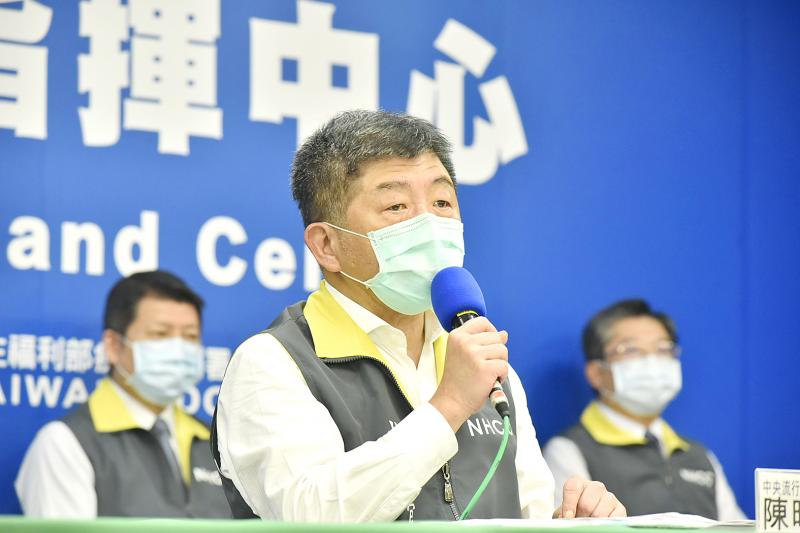
Photo: CNA
As it is difficult for shipboard medical officers to diagnose COVID-19, navy vessels deployed on longer journeys would be equipped with simple polymerase chain reaction (PCR) test kits, he said, adding that the center would also arrange for the kits to be available on outlying islands and in remote areas.
“I want to represent the ministry in apologizing again to the public for the infection incident on the Friendship Flotilla,” Deputy Minister of National Defense Chang Che-ping (張哲平) told the afternoon briefing.
The flotilla had fulfilled its goal of combat readiness training and a goodwill mission, and the military had learned more about disease prevention from the incident, so he hoped the public would support military personnel to help boost their morale as they guard the nation and protect its people, Chang added.
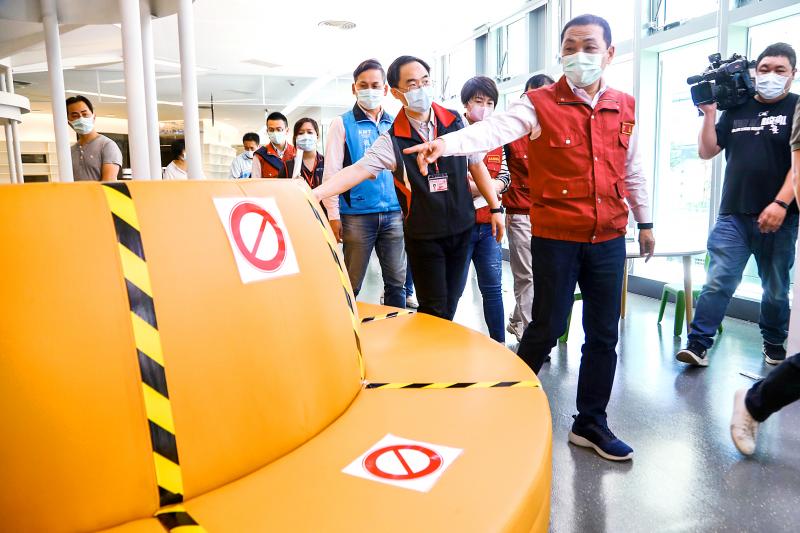
Photo: CNA
In the afternoon, Chen told reporters that while the center was mulling easing some restrictions, Taiwan could not afford to let its guard down.
“We are not asking a lot from everyone, but each individual must thoroughly perform personal protection measures, including wearing a mask, practice social distancing and frequently washing hands, as well as cooperating with temperature measuring and name registration at some locations,” he added.
Chen gave an example of how two US cities responded to the 1918 influenza pandemic — Philadelphia, Pennsylvania, suffered a high death rate due to slow actions during the early stages of the outbreak, while St Louis, Missouri, reacted quickly and had a significantly lower death rate.
However, when the pandemic seemed to be declining, St Louis rolled back its social distancing measures and the number of flu deaths went up again, he said, adding that Taiwan must remain vigilant to prevent a second wave of COVID-19 infections.
Deputy Minister of the Interior Chen Tsung-yen (陳宗彥) told the first briefing that the CECC had received the CPBL’s proposal to allow a maximum of 500 people, including players, staff, umpires and fans into baseball stadiums, with an audience about 250 people initially after reopening, and officials would review it.
Meanwhile, New Taipei City Mayor Hou You-yi (侯友宜) said that beginning today, the city would open publicly owned sports centers and other venues that had been closed since March 20 in “two stages and four steps.”
The two stages refer to two two-week periods in which different types of venues would open, while the four steps refer to weekly meetings and evaluations to determine further openings, he said.
Sports centers, cultural centers, libraries and some community activity centers would open, he said.
The venues would require mandatory sign-in upon entry, and a controlled flow of entry — meaning people would enter one at a time and have their temperatures checked, he added.
The first stage would be from today to May 17, and would apply to outdoor venues, indoor venues with good circulation and the ability to control entries.
The city would require that venues be kept clean and that they only host activities that would allow for social distancing, Hou said.
The second stage would begin on May 18 and would be contingent on the absence of cases of community transmission.
The rest of public venues would reopen in this stage, with disease prevention prioritized, he said.
Additional reporting by Chen Hsin-yu and staff writer

Taiwan has arranged for about 8 million barrels of crude oil, or about one-third of its monthly needs, to be shipped from the Red Sea this month to bypass the Strait of Hormuz and ease domestic supply pressures, CPC Corp, Taiwan (CPC, 台灣中油) said yesterday. The state-run oil company has worked with Middle Eastern suppliers to secure routes other than the Strait of Hormuz, through which about 20 percent of the world’s oil and liquefied natural gas typically passes, CPC chairman Fang Jeng-zen (方振仁) said at a meeting of the legislature’s Economics Committee in Taipei. Suppliers in Saudi Arabia have indicated they
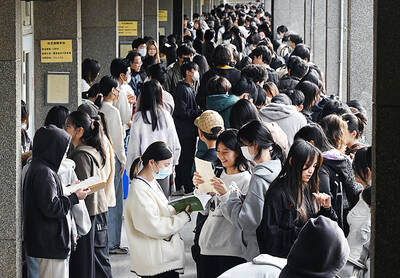
A global survey showed that 60 percent of Taiwanese had attained higher education, second only to Canada, the Ministry of the Interior said. Taiwan easily surpassed the global average of 43 percent and ranked ahead of major economies, including Japan, South Korea and the US, data from the Organisation for Economic Co-operation and Development (OECD) for 2024 showed. Taiwan has a high literacy rate, data released by the ministry showed. As of the end of last year, Taiwan had 20.617 million people aged 15 or older, accounting for 88.5 percent of the total population, with a literacy rate of 99.4 percent, the data
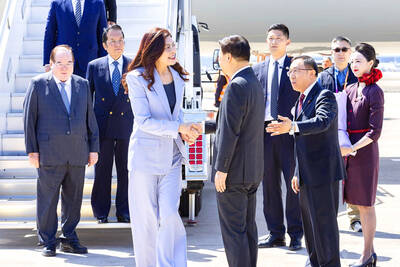
CCP ‘PAWN’? Beijing could use the KMT chairwoman’s visit to signal to the world that many people in Taiwan support the ‘one China’ principle, an academic said Chinese Nationalist Party (KMT) Chairwoman Cheng Li-wun (鄭麗文) yesterday arrived in China for a “peace” mission and potential meeting with Chinese President Xi Jinping (習近平), while a Taiwanese minister detailed the number of Chinese warships currently deployed around the nation. Cheng is visiting at a time of increased Chinese military pressure on Taiwan, as the opposition-dominated Legislative Yuan stalls a government plan for US$40 billion in extra defense spending. Speaking to reporters before going to the airport, Cheng said she was going on a “historic journey for peace,” but added that some people felt uneasy about her trip. “If you truly love Taiwan,

NEW LOW: The council in 2024 based predictions on a pessimistic estimate for the nation’s total fertility rate of 0.84, but last year that rate was 0.69, 17 percent lower An expected National Development Council (NDC) report expects the nation’s population to drop below 12 million by 2065, with the old-age dependency ratio to top 100 percent sooner than 2070, sources said yesterday. The council is slated to release its latest population projections in August, using an ultra-low fertility model, the sources said. The previous report projected that Taiwan’s population would fall to 14.37 million by 2070, but based on a new estimate of the total fertility rate (TFR) — the average number of children born to a woman over her lifetime — the population is expected to reach 12 million by


 RSS
RSS