


Lam Wing-kei (林榮基), a former manager of Hong Kong’s Causeway Bay Books, was attacked yesterday morning by two unidentified men who threw red paint at him at a coffee shop in Taipei.
The incident took place at about 9am close to Zhongshan MRT Station near Lam’s new bookstore, which is scheduled to open on Saturday.
Lam, who immediately notified the police, said the suspects were wearing baseball caps and appeared to be in their 30s.
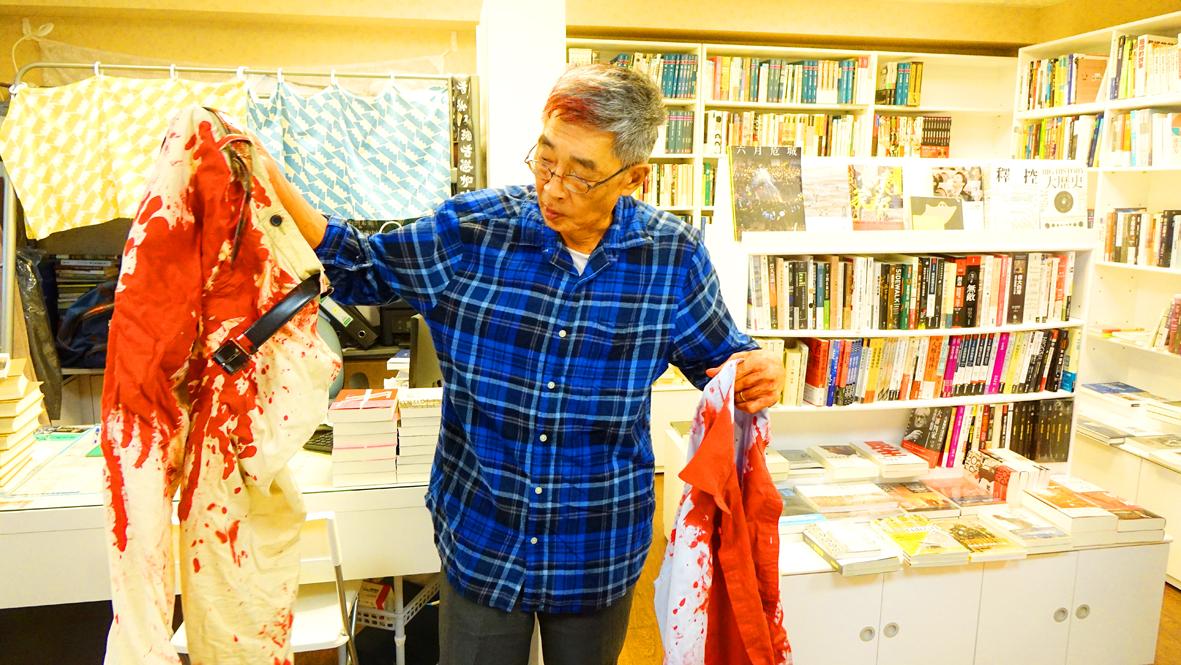
Photo: George Tsorng, Taipei Times
They fled the scene on foot after splashing him with red paint, he said.
“It’s hard to imagine this sort of thing happening in Taiwan,” he said after the incident, adding that he believed the attack was orchestrated by authorities in China.
“Obviously, it was a threat, warning me not to open my bookstore,” Lam said.
Zhongshan Police Precinct said it was reviewing footage from surveillance cameras in the area to identify and find the attackers.
The incident occurred one day after Lam received a legal warning from a bookstore in New Taipei City, telling him that he was infringing on its trademark by giving his store a similar name in Chinese.
However, Lam expressed doubt about the company registered in New Taipei City’s Jhonghe District (中和), saying that it was probably a shell entity serving as a front for Chinese authorities, without elaborating.
The Mainland Affairs Council yesterday said that law enforcement would investigate the matter to determine whether the Chinese Communist Party or its affiliates were behind the legal challenge.
Lam was one of five shareholders and staff at Causeway Bay Books in Hong Kong, which sold books critical of Chinese leaders.
He disappeared into Chinese custody at the end of 2015, and was released on bail and allowed to return to Hong Kong in June 2016 to retrieve a hard drive listing the bookstore’s customers.
Instead, he jumped bail and went public, detailing how he was detained and blindfolded by police after crossing the border into Shenzhen, China, and spent months being interrogated.
He fled to Taiwan in April last year, and subsequently raised nearly NT$6 million (US$199,322) via a fundraising Web site from September to November last year to fund his new bookstore in Taipei.

‘NO SECURITY RISK’: The Railway Bureau reassured the public that the technicians’ activities were limited to technical guidance and did not involve sensitive systems The Railway Bureau yesterday said it had invited eight Chinese technicians to assist with an airport MRT construction project. The bureau issued the confirmation after an Internet user said Chinese nationals had entered the construction zone of Taiwan Taoyuan International Airport’s Terminal 3 project. They asked why “individuals from an enemy state” were allowed access to such a major national infrastructure project, which raised serious concerns over Taiwan’s industrial safety, sensitive systems and information security. The bureau’s Northern Region Engineering Branch Office said subcontractor Taiwan Handle Industrial Co (台灣手把工業) of the Taoyuan airport MRT’s “Contract No. CU05 Project A14 Station Civil, MEP &

A signaling system malfunction disrupted high-speed rail (HSR) services beginning at 8am today, with trains temporarily reduced to three northbound and three southbound trains per hour as authorities conduct inspections. The malfunction occurred on a section of track in Miaoli County during pre-operation checks early this morning, forcing northbound and southbound trains to use a single track, the HSR operator said. The regular schedule has been replaced with three hourly trains offering only nonreserved seating in each direction, stopping at every station, it said, adding that business class cars would still have reserved seating. Departures from terminal stations are scheduled at the top

Taiwan is still in the process of assessing the possibility of recruiting workers from Eswatini, the Ministry of Foreign Affairs said yesterday, adding that its goal is to help Eswatini upgrade its vocational training centers. If there are plans to recruit workers from Eswatini, safeguarding national security, protecting public health and ensuring the employment rights of Taiwanese would be prerequisites, Department of West Asian and African Affairs Director-General Yen Chia-liang (顏嘉良) told a news conference. Key considerations would also include filling labor shortages in specific industries, and fostering bilateral professional and technical exchanges, he said. Yen was asked about the progress of labor

A US uncrewed surface vessel (USV) encountered multiple Chinese warships during an autonomous transit of the Taiwan Strait, US defense company Seasats said in a statement on Wednesday. Seasats announced that a Lightfish USV had completed the first autonomous transit of the Taiwan Strait. Over five days, the USV traversed the entire length of the Strait while constantly monitoring surface vessel traffic, the company said. The Lightfish encountered multiple Chinese warships, one of which was a Chinese People’s Liberation Army Navy (PLAN) Type 056 corvette, it said. The Chinese vessels were operating “well within Taiwan’s exclusive economic zone without transmitting their identity via the


 RSS
RSS