


The Central Epidemic Command Center yesterday announced 23 new confirmed cases of COVID-19, raising the total number to 100 in Taiwan.
Minister of Health and Welfare Chen Shih-chung (陳時中), who heads the center, said that two of the cases were locally transmitted, while 21 were likely imported.
One of the locally transmitted cases was a man in his 20s who is the son of a member of a tour group that visited Egypt from March 3 to Thursday last week, Chen said, adding that three members of the tour group have tested positive.
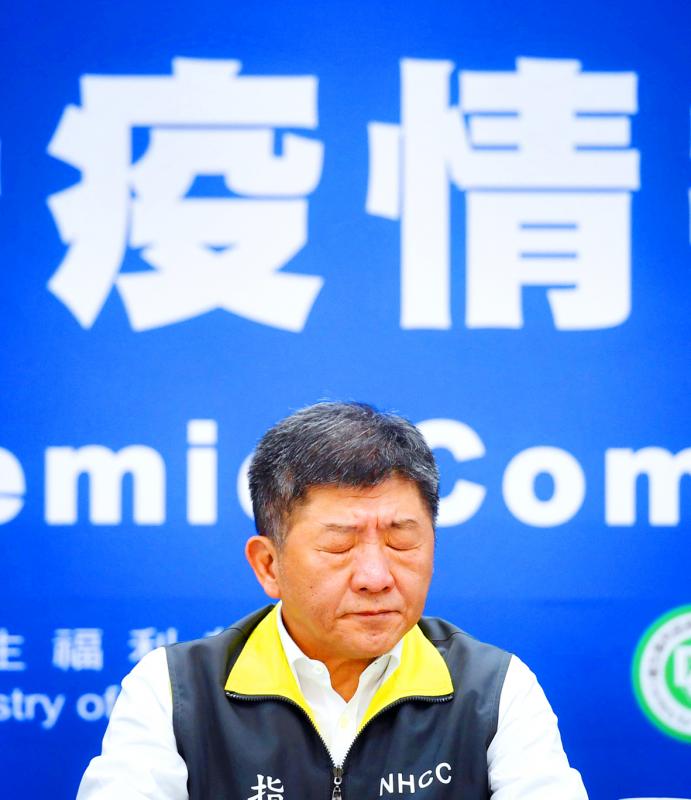
Photo: CNA
Another cluster of cases is a tour group of 15 people who visited Turkey from March 4 to Friday last week, with nine members having tested positive as of Tuesday and another four members testing positive yesterday, Chen said.
The 21 cases that were likely imported include three people who had traveled in Spain and the US; two people who traveled in the UK and France; a person who traveled in Indonesia, Qatar, the Philippines, Switzerland and Germany; a person who traveled in France, Spain and the UK; and a person who traveled in the UK, Italy and France.
Eleven of the people had symptoms that were detected at airport quarantine stations upon their return to Taiwan, Chen said.
The center is most concerned about three people who stayed in Taiwan for a longer period of time, meaning that they might have caused community spread, he said.
Centers for Disease Control (CDC) Deputy Director-General Chuang Jen-hsiang (莊人祥) said that one of the three cases is a Frenchman in his 20s who arrived in Taipei on Thursday last week and sought treatment for a fever on Monday.
Another case is a Taiwanese woman in her 20s who visited Bali, Indonesia, with her husband from March 6 to Thursday last week, experienced a sore throat and mild coughing on Tuesday last week and sought treatment on Monday, he said.
Chen said that the most concerning case of all is a woman in her 20s living in southern Taiwan who has not traveled abroad recently and leads a relatively simple life, but began experiencing symptoms on Thursday last week and tested positive yesterday.
The case requires a thorough investigation into the source of the infection and the people with whom the woman came into close contact, Chen added.
The woman sought treatment at a clinic for a fever, a sore throat and coughing on Thursday last week and on Monday, and sought treatment for the fever the next day at an emergency room, where the doctor arranged for her to be tested, center advisory specialist panel convener Chang Shan-chwen (張上淳) said.
“A peak in the number of confirmed cases is expected to occur in the upcoming days, so we announced enhanced border control measures this morning,” Chen said. “Airport quarantine officers might be under extreme pressure over the next few days, but we hope to hold out and overcome this peak period.”
The next two weeks are the most critical for containing the spread of COVID-19, so the center urges everyone to keep a safe social distance and maintain good personal hygiene, while those who are placed under quarantine or in home isolation need to cooperate, Chen said.
Deputy Minister of the Interior Chen Tsung-yen (陳宗彥) said that many of the policies that the center has recently announced — including advising people to avoid unnecessary overseas travel and extending foreign workers’ visas — are meant to reduce the flow of people so that the risk of transmission is lowered.
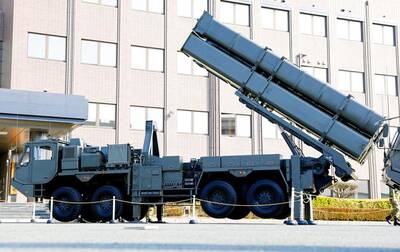
Japan has deployed long-range missiles in a southwestern region near China, the Japanese defense minister said yesterday, at a time when ties with Beijing are at their lowest in recent years. The missiles were installed in Kumamoto in the southern region of Kyushu, as Japan is attempting to shore up its military capacity as China steps up naval activity in the East China Sea. “Standoff defense capabilities enable us to counter the threat of enemy forces attempting to invade our country ... while ensuring the safety of our personnel,” Japanese Minister of Defense Shinjiro Koizumi said. “This is an extremely important initiative for
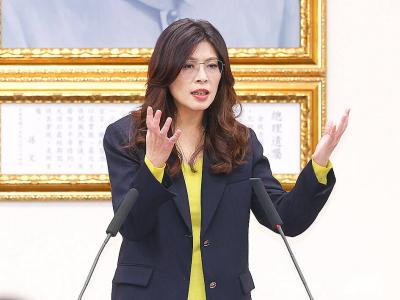
Chinese Nationalist Party (KMT) Chairwoman Cheng Li-wun (鄭麗文) today accepted an invitation from Chinese President Xi Jinping (習近平) to lead a delegation to China next month, saying she hopes to promote the peaceful development of cross-strait relations and bring stability to the Taiwan Strait. “I am grateful and happy to accept this invitation,” Cheng said in a statement from the KMT chairperson’s office. Cheng said she hopes both sides can work together to promote the peaceful development of cross-strait relations, enhance exchange and cooperation, bring stability to the Taiwan Strait and improve people’s livelihoods. At today's news conference, Cheng said any efforts to

The nation’s fastest supercomputer, Nano 4 (晶創26), is scheduled to be launched in the third quarter, and would be used to train large language models in finance and national defense sectors, the National Center for High-Performance Computing (NCHC) said. The supercomputer, which would operate at about 86.05 petaflops, is being tested at a new cloud computing center in the Southern Taiwan Science Park in Tainan. The exterior of the server cabinet features chip circuitry patterns overlaid with a map of Taiwan, highlighting the nation’s central position in the semiconductor industry. The center also houses Taiwania 2, Taiwania 3, Forerunner 1 and
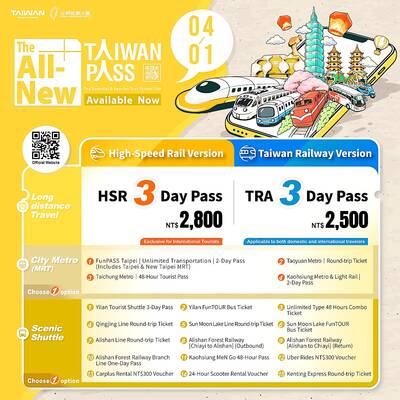
MORE POPULAR: Taiwan Pass sales increased by 59 percent during the first quarter compared with the same period last year, the Tourism Administration said The Tourism Administration yesterday said that it has streamlined the Taiwan Pass, with two versions available for purchase beginning today. The tourism agency has made the pass available to international tourists since 2024, allowing them to access the high-speed rail, Taiwan Railway Corp services, four MRT systems and four Taiwan Tourist Shuttles. Previously, five types of Taiwan Pass were available, but some tourists have said that the offerings were too complicated. The agency said only two types of Taiwan Pass would be available, starting from a three-day pass with the high-speed rail and a three-day pass with Taiwan Railway Corp. The former costs NT$2,800


 RSS
RSS