


The EU on Monday announced a multimillion-dollar investment in a German company that is working on a potential vaccine for COVID-19, amid reports that the US government was interested in acquiring the firm.
The funding is part of a coordinated EU response to the pandemic, making use of public and private funding to support research, the European Commission said.
“I am proud that we have leading companies like CureVac in the EU,” said European Commission President Ursula von der Leyen, Germany’s former minister of defense. “Their home is here, but their vaccines will benefit everyone, in Europe and beyond.”

Photo: Reuters
The EU’s executive body did not mention possible US interest in CureVac, but said it would provide up to 80 million euros (US$88 million) in support so that it can “scale up development and production of a vaccine against the coronavirus in Europe.”
CureVac on Monday denied reports that the US government was acting to acquire it.
“CureVac has not received from the US government or related entities an offer before, during and since the task force meeting in the White House on March 2,” the company said on Twitter.
The company’s then-chairman had met with US President Donald Trump at the White House as part of a discussion with numerous pharmaceutical executives.
Amid multiple reports that Trump was offering the firm a large amount of money to secure its work for the US, the White House said it was unaware of such “underlying information.”
German Chancellor Angela Merkel deflected a question about CureVac, referring to the company’s statement.
However, before CureVac’s tweet, Merkel’s chief of staff, Helge Braun, told the Bild daily that German officials had “very intensive contact” with CureVac over the past two weeks “when there were thoughts of enticing it to the United States.”
Braun said the firm would get the support it needs to develop a vaccine as quickly as possible for use in Germany and around the world.
In related news, US drugmaker Pfizer Inc has signed a deal with Germany’s BioNTech SE to codevelop a potential vaccine for COVID-19 using BioNTech’s mRNA-based drug development platform, the companies said yesterday.
The drugmakers are to start the collaboration immediately and have signed a letter of intent for the vaccine’s distribution outside China, they said in a joint statement.
The companies said they would finalize financial terms, and details regarding development, manufacturing and potential commercialization of the vaccine over the next few weeks.
Additional reporting by Reuters

SECURITY: As China is ‘reshaping’ Hong Kong’s population, Taiwan must raise the eligibility threshold for applications from Hong Kongers, Chiu Chui-cheng said When Hong Kong and Macau citizens apply for residency in Taiwan, it would be under a new category that includes a “national security observation period,” Mainland Affairs Council (MAC) Minister Chiu Chui-cheng (邱垂正) said yesterday. President William Lai (賴清德) on March 13 announced 17 strategies to counter China’s aggression toward Taiwan, including incorporating national security considerations into the review process for residency applications from Hong Kong and Macau citizens. The situation in Hong Kong is constantly changing, Chiu said to media yesterday on the sidelines of the Taipei Technology Run hosted by the Taipei Neihu Technology Park Development Association. With

CARROT AND STICK: While unrelenting in its military threats, China attracted nearly 40,000 Taiwanese to over 400 business events last year Nearly 40,000 Taiwanese last year joined industry events in China, such as conferences and trade fairs, supported by the Chinese government, a study showed yesterday, as Beijing ramps up a charm offensive toward Taipei alongside military pressure. China has long taken a carrot-and-stick approach to Taiwan, threatening it with the prospect of military action while reaching out to those it believes are amenable to Beijing’s point of view. Taiwanese security officials are wary of what they see as Beijing’s influence campaigns to sway public opinion after Taipei and Beijing gradually resumed travel links halted by the COVID-19 pandemic, but the scale of
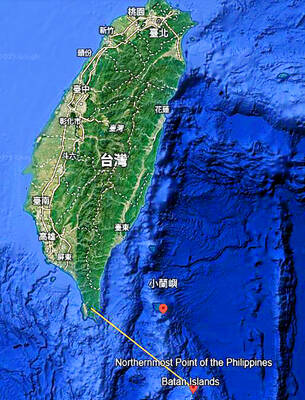
A US Marine Corps regiment equipped with Naval Strike Missiles (NSM) is set to participate in the upcoming Balikatan 25 exercise in the Luzon Strait, marking the system’s first-ever deployment in the Philippines. US and Philippine officials have separately confirmed that the Navy Marine Expeditionary Ship Interdiction System (NMESIS) — the mobile launch platform for the Naval Strike Missile — would take part in the joint exercise. The missiles are being deployed to “a strategic first island chain chokepoint” in the waters between Taiwan proper and the Philippines, US-based Naval News reported. “The Luzon Strait and Bashi Channel represent a critical access
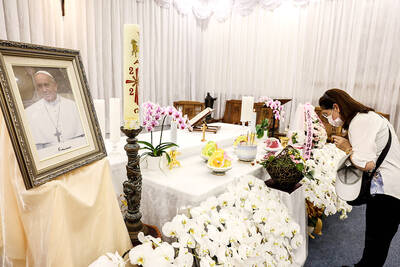
Pope Francis is be laid to rest on Saturday after lying in state for three days in St Peter’s Basilica, where the faithful are expected to flock to pay their respects to history’s first Latin American pontiff. The cardinals met yesterday in the Vatican’s synod hall to chart the next steps before a conclave begins to choose Francis’ successor, as condolences poured in from around the world. According to current norms, the conclave must begin between May 5 and 10. The cardinals set the funeral for Saturday at 10am in St Peter’s Square, to be celebrated by the dean of the College


 RSS
RSS