


A 78-year-old man died in a Perth hospital yesterday, marking Australia’s first COVID-19 fatality, after returning from the Diamond Princess cruise ship off the coast of Japan last month, while a 35-year-old Thai man who also had dengue fever died in Thailand on Saturday.
The Australian man was initially sent to the Howard Springs facility in northern Australia after becoming ill on the flight back from Japan and was then moved to the Sir Charles Gairdner Hospital in Perth, where he died yesterday morning.
His 79-year-old wife, who also tested positive for the virus, remains isolated in the hospital in a stable condition and there is no risk to the community, said Andrew Robertson, Western Australia’s chief health officer.
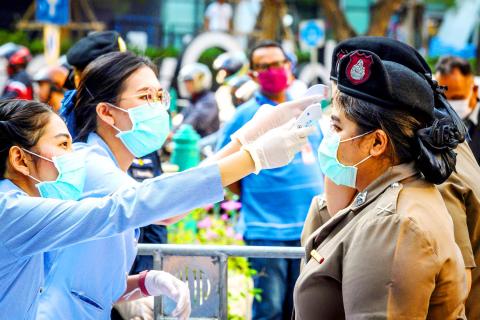
Photo: AFP
Elsewhere in the country, two new cases emerged in the past few days in Sydney and the Gold Coast after a man and a woman returned from trips to Iran.
Australia over the weekend banned incoming travel from Iran for non-nationals, and Australian Minister of Health Greg Hunt said he has asked the deputy chief medical officer, Paul Kelly, to consider the appropriate level of travel advice for Italy.
Restrictions on travel from China were extended last week.
“Right from the outset, we’ve made it clear that we will take strong action, but that Australia is not immune,” Hunt said in Melbourne yesterday.
There are now 27 confirmed cases in Australia, he said.
The death came just days after the Australian government activated an emergency plan to deal with the outbreak, when Australian Prime Minister Scott Morrison said the risk of a global pandemic is “very much upon us.”
Thailand has recorded 42 cases since January, with 30 of those recovering and 11 still being treated in hospitals, the Thai Department of Disease Control said.
Thai health officials said the dead man had worked in the retail sector, where he had come into contact with many tourists during the early stages of the outbreak.
“This was a case of local transmission, and he was at risk, because he had exposure to Chinese tourists,” department Director-General Suwanchai Wattanayingcharoen told a news conference.
The patient was first admitted to a private hospital for dengue fever on Jan. 27. He was later diagnosed with COVID-19 and on Feb. 5 transferred to the government’s main treatment center, Suwanchai said.
He died from multiple-organ failure late on Saturday.
New measures to deal with the spread of the disease — earlier introduced by Thailand’s National Committee on Communicable Diseases — came into effect yesterday.
Health officials can now order those suspected of being infected to be quarantined and to undergo treatment. Officials can also order the closure of venues and public areas to contain the virus.
China yesterday reported 35 more deaths from COVID-19, taking the toll in the country to 2,870.
The number was lower than the 47 fatalities reported by Chinese authorities on Saturday.
The Chinese National Health Commission also reported 573 new infections, bringing the total number of cases in mainland China to 79,824.
Armenia yesterday confirmed its first case of COVID-19, an Armenian citizen who recently returned from Iran and who was in a stable condition in hospital.
The British government said there were 12 new confirmed cases yesterday, increasing the total to 35.

The National Chungshan Institute of Science and Technology yesterday showcased its locally developed variants of the Vision 60 robotic patrol dog, which it plans to deploy on the nation’s outlying territories in the South China Sea. The variants were produced under the Joint Lab project — created by the institute and domestic companies — and assembled with domestically produced motors, lenses and artificial intelligence (AI) systems alongside licensed tech from the US, Missile and Rocket Systems Research Division deputy director Jen Kuo-kang (任國光) told the media event at a military base in Taipei’s Dazhi (大直) area. Taiwan has built up its strengths

RIGHT DIRECTION: Taiwan’s efforts to prevent forced labor include a proposal to ‘fully prohibit’ employers from withholding workers’ documents, an official said Taiwan is to establish a mechanism to restrict imports of goods linked to forced labor, the Executive Yuan said yesterday, after the US proposed imposing additional tariffs on Taiwanese goods over labor concerns. “The Ministry of Labor and the Ministry of Economic Affairs are to establish an interministerial review procedure,” Executive Yuan spokesperson Michelle Lee (李慧芝) said at a news briefing in Taipei. “The government is to use the Foreign Trade Act [貿易法] as the legal basis to restrict imports of goods produced with forced labor” and bring its supply chain governance more in line with international standards on human rights, resilience

NOT IMMEDIATE: Taiwan has a chance to appeal the proposed 10 percent tariff before it starts, while other countries face a 12.5 percent tariff from the trade office Taiwan is among 60 economies determined by the US to have failed to impose or enforce a ban on the importation of goods produced with forced labor, according to a notice released on Tuesday by the Office of the US Trade Representative (USTR), which proposed imposing an additional 10 percent or more tariff on them. The USTR in a statement said that following an investigation, it had determined under Section 301 of the Trade Act of 1974 that the failure of the 60 economies to impose and effectively enforce a prohibition on the importation of goods produced with forced labor is

TIT-FOR-TAT: The US allegedly revoked the visa of a Chinese national working at Xinhua News Agency in the US in response to Beijing’s expulsion of Vivian Wang The Presidential Office yesterday condemned China for expelling a New York Times correspondent from Beijing following the newspaper’s interview with President William Lai (賴清德), saying the move highlighted Beijing’s suppression of press freedom and its threat to international news media. Taiwan has noted a series of recent incidents in which Beijing used similar tactics to “threaten and pressure international media outlets and journalists,” Presidential Office spokeswoman Karen Kuo (郭雅慧) said in a statement. “This concerns not only press freedom and freedom of expression, but also the safety of journalists, and Taiwan and relevant partners are paying close attention to the situation,” she


 RSS
RSS