


As many as half of China’s breeding pigs have either died from African swine fever or been slaughtered because of the spreading disease, twice as many as officially acknowledged, according to the estimates of four people who supply large farms.
While other estimates are more conservative, the plunge in the number of sows is poised to leave a large hole in the supply of the country’s favorite meat, pushing up food prices and devastating livelihoods in a rural economy that includes 40 million pig farmers.
“Something like 50 percent of sows are dead,” said Edgar Wayne Johnson, a veterinarian who has spent 14 years in China and founded Enable Agricultural Technology Consulting, a Beijing-based farm services firm with clients nationwide.
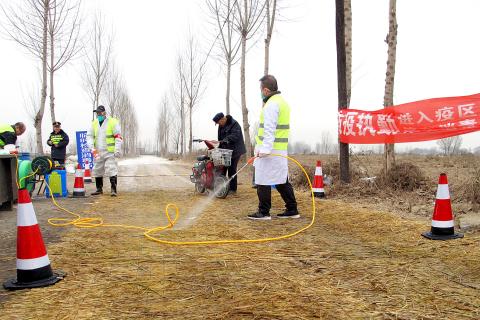
Photo: Reuters
Three other executives at producers of vaccines, feed additives and genetics also estimate losses of 40 to 50 percent, based on falling sales for their companies’ products and direct knowledge of the extent of the deadly disease on farms across the country.
Losses are not only from infected pigs dying or being culled, but also farmers sending pigs to market early when the disease is discovered nearby, farmers and industry insiders have said, which analysts say has kept a lid on pork prices in recent months.
However, prices began rising substantially this month and the Chinese Ministry of Agriculture and Rural Affairs has said they could surge by 70 percent in coming months as a result of the outbreak.
China, which produces half the world’s pork, last month said its sow herd declined by a record 23.9 percent in May from a year earlier, a slightly deeper drop than for the overall pig herd.
Sows, or adult females bred to produce piglets for slaughter, account for about one in 10 pigs in China. A decline in the sow herd usually equates to a similar drop in pork output, industry experts say.
The ministry on Monday last week said the disease has been “effectively controlled,” Xinhua news agency reported.
Dutch agricultural lender Rabobank said in April that pork production losses from China’s African swine fever outbreak could reach 35 percent.
It is revising that number higher to account for widespread slaughtering in recent months, senior analysts Pan Chenjun (潘晨軍) said.
Since China’s first reported case in August last year, it has spread to every province and beyond China’s borders, despite measures taken by Beijing to curb its advance.
The government has reported 137 outbreaks so far, but many more are going unreported, most recently in southern provinces such as Guangdong, Guangxi and Hunan, according to four farmers and an official recently interviewed by Reuters.
“Almost all the pigs here have died,” said a farmer in Guangxi’s Bobai County.
“We were not allowed to report the pig disease,” the farmer said, declining to reveal her name because of the sensitivity of the issue, adding that authorities have detained farmers for “spreading rumors” about the disease.
Authorities in Yulin, which oversees Bobai County, confirmed an outbreak of the disease in one pig on May 27.
Reuters also spoke to farmers in the cities of Zhongshan, Foshan and Maoming in Guangdong Province, all of whom had lost hundreds or thousands of pigs to the disease in the last three months.
No outbreaks have been officially reported in those cities.
China had 375 million pigs at the end of March, 10 percent fewer than at the same time a year ago, and there were 38 million sows, an 11 percent drop, China’s National Bureau of Statistics (NBS) said.
Numerous suppliers to the industry have said they believe the actual decline is much worse.
Dick Hordijk, chief executive at Royal Agrifirm, last month told Dutch radio station BNR that his firm’s profits in China would be wiped out by the disease, which was spreading like “an oil slick.”
“One hundred percent of our business was focused on pigs, half of it is now gone,” he said. “That’s a disaster for the farmers and the animals.”
Johnson said the virus is so widespread that he has detected it on the surface of a highway in the province, where it can be spread by passing trucks.
He said he used the same test that is widely used to detect the virus in pigs.

Tropical Storm Gaemi strengthened into a typhoon at 2pm yesterday, and could make landfall in Yilan County tomorrow, the Central Weather Administration (CWA) said yesterday. The agency was scheduled to issue a sea warning at 11:30pm yesterday, and could issue a land warning later today. Gaemi was moving north-northwest at 4kph, carrying maximum sustained winds near its center of up to 118.8kph and gusts of 154.8kph. The circumference is forecast to reach eastern Taiwan tomorrow morning, with the center making landfall in Yilan County later that night before departing from the north coast, CWA weather forecaster Kuan Shin-ping (官欣平) said yesterday. Uncertainty remains and

SEA WARNING LIKELY: The storm, named Gaemi, could become a moderate typhoon on Wednesday or Thursday, with the Taipei City Government preparing for flooding A tropical depression east of the Philippines developed into a tropical storm named Gaemi at 2pm yesterday, and was moving toward eastern Taiwan, the Central Weather Administration (CWA) said. Gaemi could begin to affect Taiwan proper on Tuesday, lasting until Friday, and could develop into a moderate typhoon on Wednesday or Thursday, it said. A sea warning for Gaemi could be issued as early as Tuesday morning, it added. Gaemi, the third tropical storm in the Pacific Ocean this typhoon season, is projected to begin moving northwest today, and be closest to Taiwan on Wednesday or Thursday, the agency said. Today, there would likely

DISRUPTIONS: The high-speed rail is to operate as normal, while several airlines either canceled flights or announced early departures or late arrivals Schools and offices in 15 cities and counties are to be closed today due to Typhoon Gaemi, local governments announced last night. The 15 are: Taipei, New Taipei City, Taoyuan, Tainan, Keelung, Hsinchu and Kaohsiung, as well as Yilan, Hualien, Hsinchu, Miaoli, Chiayi, Pingtung, Penghu and Lienchiang counties. People should brace for torrential rainfall brought by the storm, with its center forecast to make landfall on the east coast between tonight and tomorrow morning, the Central Weather Administration (CWA) said. The agency issued a sea warning for the typhoon at 11:30pm on Monday, followed by a land warning at 11:30am yesterday. As of

CASUALTY: A 70-year-old woman was killed by a falling tree in Kaohsiung as the premier warned all government agencies to remain on high alert for the next 24 hours Schools and offices nationwide are to be closed for a second day today as Typhoon Gaemi crosses over the nation, bringing torrential rain and whipping winds. Gaemi was forecast to make landfall late last night. From Tuesday night, its outer band brought substantial rainfall and strong winds to the nation. As of 6:15pm last night, the typhoon’s center was 20km southeast of Hualien County, Central Weather Administration (CWA) data showed. It was moving at 19kph and had a radius of 250km. As of 3pm yesterday, one woman had died, while 58 people were injured, the Central Emergency Operation Center said. The 70-year-old


 RSS
RSS