


A teacher at National Chiayi Senior High School on Friday caused controversy by asking students to answer a question about a “President Tsai-englishit’s” “silly” behavior in an English-language course exam.
The fill-in-the-blank question, which appears on the test paper for the school’s 11th-grade students, reads: “President Tsai-englishit made some silly ____ in her speech.” Students were given four choices — amateurs, disasters, parades, or comments — to complete the sentence.
The teacher, surnamed Chang (張), denied that the question had anything to do with President Tsai Ing-wen (蔡英文).
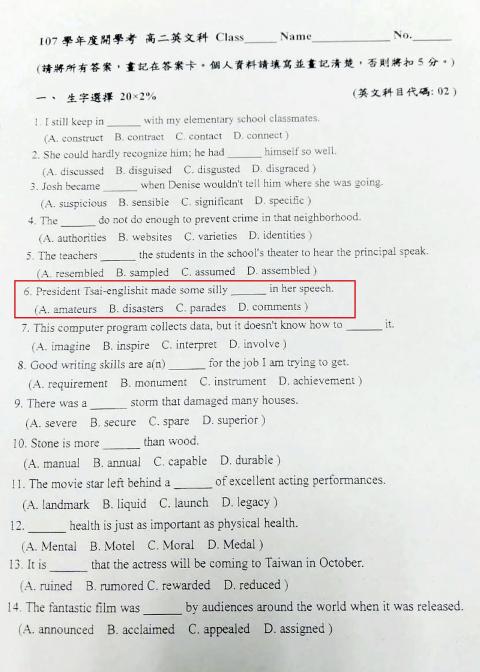
Photo: Wang Shan-yen, Taipei Times
“Tsai-englishit” is definitely not a translation of any real politician’s name and is unrelated to any particular political party, he said.
He designed the question to test students’ understanding of the word “comments,” he said, adding that the word is easily associated with politicians.
Chang said he has not joined any political parties and has little interest in politics, but he is aware of the public perception of politicians as often making silly comments.
For example, a central government official once said a coal-fired power plant would use “clean coal,” he said, referring to then-premier William Lai’s (賴清德) remark in March last year.
The test question was meant to be a “friendly reminder” that politicians’ comments are not always true, he said.
He used dramatic words in the question to make fun of politicians in general, as it was not a formal midterm exam, he said, adding that he thought that the over-the-top word choice would prevent people from connecting it to people in real life.
School principal Liu Yung-tang (劉永堂) said that Chang did not devise the question to promote any political stance, but to spark students’ interest in English.
Since many found it inappropriate, the school would convene a meeting to discuss the matter and ask teachers to avoid making the same mistake, he said, adding that the school would be more careful in the future.
Chiayi City Councilor Tsai Yung-chuan (蔡永泉), of the Taiwan Solidarity Union, who had taught English for more than 20 years, said he found it hard to believe the question was not intended to insult Tsai.
“Tsai-englishit” is similar to Tsai Ing-wen and contains the word “shit” in it, he said.
There are plenty of ways to spark students’ interest other than making fun of someone’s name, he said.
Lawyer Chen Tse-chia (陳澤嘉) said the test question is not illegal, because insulting the president is not banned by law.
The incident highlights the freedom of speech that people enjoy in Taiwan, something that would not be tolerated in a communist country, he said.
Taiwan is a diverse and free democracy and the president would surely just laugh it off, he added.
After learning of the incident, Tsai yesterday wrote on Facebook that the word “comment” is commonly used in news reports.
She gave two example sentences for the word: “President Tsai Ing-wen rejects Beijing leader’s unfriendly comments,” and “As there is no censorship in Taiwan, Brother Caramel can freely comment on public affairs.”
The president is aware of the discussion sparked by the school exam and did not mind it, Presidential Office spokesman Sidney Lin (林鶴明) said.
The school principal and teachers can rest assured that there is nothing to worry about, he added.
Additional reporting by Su Yung-yao

Tropical Storm Gaemi strengthened into a typhoon at 2pm yesterday, and could make landfall in Yilan County tomorrow, the Central Weather Administration (CWA) said yesterday. The agency was scheduled to issue a sea warning at 11:30pm yesterday, and could issue a land warning later today. Gaemi was moving north-northwest at 4kph, carrying maximum sustained winds near its center of up to 118.8kph and gusts of 154.8kph. The circumference is forecast to reach eastern Taiwan tomorrow morning, with the center making landfall in Yilan County later that night before departing from the north coast, CWA weather forecaster Kuan Shin-ping (官欣平) said yesterday. Uncertainty remains and

SEA WARNING LIKELY: The storm, named Gaemi, could become a moderate typhoon on Wednesday or Thursday, with the Taipei City Government preparing for flooding A tropical depression east of the Philippines developed into a tropical storm named Gaemi at 2pm yesterday, and was moving toward eastern Taiwan, the Central Weather Administration (CWA) said. Gaemi could begin to affect Taiwan proper on Tuesday, lasting until Friday, and could develop into a moderate typhoon on Wednesday or Thursday, it said. A sea warning for Gaemi could be issued as early as Tuesday morning, it added. Gaemi, the third tropical storm in the Pacific Ocean this typhoon season, is projected to begin moving northwest today, and be closest to Taiwan on Wednesday or Thursday, the agency said. Today, there would likely

DISRUPTIONS: The high-speed rail is to operate as normal, while several airlines either canceled flights or announced early departures or late arrivals Schools and offices in 15 cities and counties are to be closed today due to Typhoon Gaemi, local governments announced last night. The 15 are: Taipei, New Taipei City, Taoyuan, Tainan, Keelung, Hsinchu and Kaohsiung, as well as Yilan, Hualien, Hsinchu, Miaoli, Chiayi, Pingtung, Penghu and Lienchiang counties. People should brace for torrential rainfall brought by the storm, with its center forecast to make landfall on the east coast between tonight and tomorrow morning, the Central Weather Administration (CWA) said. The agency issued a sea warning for the typhoon at 11:30pm on Monday, followed by a land warning at 11:30am yesterday. As of

CASUALTY: A 70-year-old woman was killed by a falling tree in Kaohsiung as the premier warned all government agencies to remain on high alert for the next 24 hours Schools and offices nationwide are to be closed for a second day today as Typhoon Gaemi crosses over the nation, bringing torrential rain and whipping winds. Gaemi was forecast to make landfall late last night. From Tuesday night, its outer band brought substantial rainfall and strong winds to the nation. As of 6:15pm last night, the typhoon’s center was 20km southeast of Hualien County, Central Weather Administration (CWA) data showed. It was moving at 19kph and had a radius of 250km. As of 3pm yesterday, one woman had died, while 58 people were injured, the Central Emergency Operation Center said. The 70-year-old


 RSS
RSS