


Democratic Progressive Party (DPP) lawmakers yesterday condemned Chinese censorship after entertainer Chen Chia-hsing (陳嘉行) said his recommendation for a new book was removed due to pressure from a Chinese publisher.
Chen yesterday posted on Facebook an image of a letter he received from the editor-in-chief of the unidentified book’s Taiwanese publisher.
In the letter, the editor-in-chief, whose name was blacked out in the online image, began by thanking Chen for agreeing to write a recommendation for the new book.
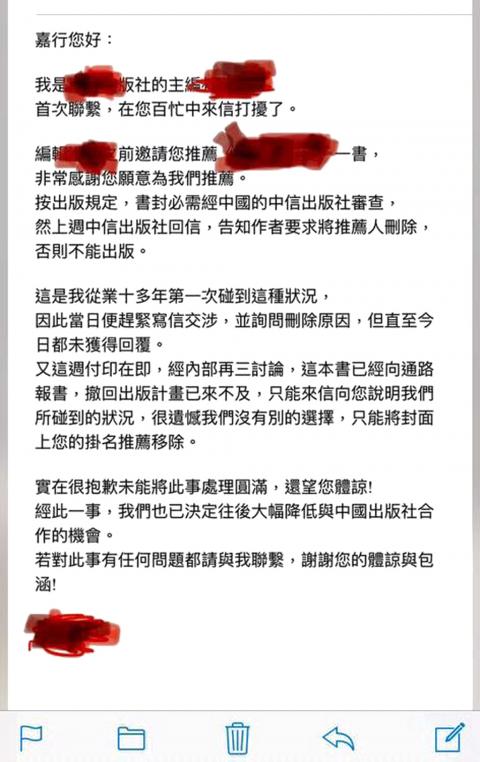
Photo: Screengrab from Facebook
According to publishing regulations, the book cover must be reviewed by China’s CITIC Press Group, the letter said.
Last week, the Chinese publishing company informed the book’s author that Chen’s recommendation must be removed if the book is to be published, it said.
The editor-in-chief said that having worked in the industry for more than 10 years, it was the first time they ever encountered something like this.
The editor-in-chief asked the Chinese publisher for a reason, but has yet to receive a response, the letter said.
Since it is too late to withdraw plans to publish the book, the company had no choice but to remove Chen’s recommendation from the cover, it said, expressing the company’s regret.
In a brief statement posted alongside the image, Chen apologized for causing the Taiwanese publisher trouble and said he is aware of Chinese censorship, especially toward Taiwanese.
“Politics is politics, publishing is publishing,” he wrote.
Chen might have run afoul of Chinese censors because he had previously publicly expressed his support for President Tsai Ing-wen (蔡英文).
In his statement, Chen also called on the Chinese Nationalist Party (KMT) to “take a look at Tibet” as it proposes signing a peace treaty with China.
The incident highlights the difference in freedom of speech in Taiwan and China, DPP Legislator Liu Shyh-fang (劉世芳) said.
In Taiwan, excluding cases that contravene defamation laws or other laws, any views that are critical of politicians, such as Tsai or Kaohsiung Mayor Han Kuo-yu (韓國瑜), are protected by freedom of speech, she said.
In contrast, Chinese censorship is not limited to publishing, but also extends to television shows, she said, citing as an example reports that a male entertainer’s ears were blurred out because he was wearing earrings.
DPP Legislator Chuang Ruei-hsiung (莊瑞雄) called the slogans that politicians use to describe Taiwan-China relations, such as “the two sides of the Taiwan Strait are one family,” ironic in light of the incident.
The incident shows that China maintains strict control on published content, DPP Legislator Rosalia Wu (吳思瑤) said.
China has repeatedly attempted to weaken or eliminate Taiwan’s “most precious” values, including freedom of thought, democratic speech and human rights, she said.
Although what happened in Chen’s case is new, similar situations could continue to occur, she added.


RESILIENCE: Taiwan plays a key role in semiconductors, energy, information infrastructure and advanced manufacturing, AIT Director Raymond Greene said Taiwan’s continued investment in deterrence and resilience remains vital, especially in uncrewed systems and other emerging technologies, American Institute in Taiwan (AIT) Director Raymond Greene said yesterday. Greene made the remarks at the annual National Strategic Summit on Supply Chain Resilience held by the Research Institute for Democracy, Society and Emerging Technology (DSET), a government-backed think tank. As Taiwan last year became the US’ fourth-largest trading partner and supply chain security is becoming more important, cooperation in emerging technologies continues to deepen between the two countries, he said. The US is committed to accelerating innovation, building key infrastructure, strengthening cooperation

The National Chungshan Institute of Science and Technology yesterday showcased its locally developed variants of the Vision 60 robotic patrol dog, which it plans to deploy on the nation’s outlying territories in the South China Sea. The variants were produced under the Joint Lab project — created by the institute and domestic companies — and assembled with domestically produced motors, lenses and artificial intelligence (AI) systems alongside licensed tech from the US, Missile and Rocket Systems Research Division deputy director Jen Kuo-kang (任國光) told the media event at a military base in Taipei’s Dazhi (大直) area. Taiwan has built up its strengths

RIGHT DIRECTION: Taiwan’s efforts to prevent forced labor include a proposal to ‘fully prohibit’ employers from withholding workers’ documents, an official said Taiwan is to establish a mechanism to restrict imports of goods linked to forced labor, the Executive Yuan said yesterday, after the US proposed imposing additional tariffs on Taiwanese goods over labor concerns. “The Ministry of Labor and the Ministry of Economic Affairs are to establish an interministerial review procedure,” Executive Yuan spokesperson Michelle Lee (李慧芝) said at a news briefing in Taipei. “The government is to use the Foreign Trade Act [貿易法] as the legal basis to restrict imports of goods produced with forced labor” and bring its supply chain governance more in line with international standards on human rights, resilience
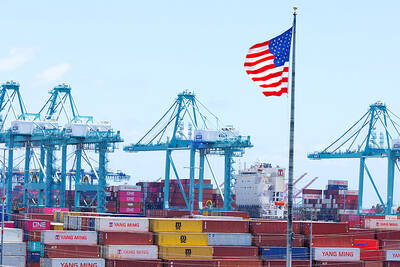
NOT IMMEDIATE: Taiwan has a chance to appeal the proposed 10 percent tariff before it starts, while other countries face a 12.5 percent tariff from the trade office Taiwan is among 60 economies determined by the US to have failed to impose or enforce a ban on the importation of goods produced with forced labor, according to a notice released on Tuesday by the Office of the US Trade Representative (USTR), which proposed imposing an additional 10 percent or more tariff on them. The USTR in a statement said that following an investigation, it had determined under Section 301 of the Trade Act of 1974 that the failure of the 60 economies to impose and effectively enforce a prohibition on the importation of goods produced with forced labor is


 RSS
RSS