


The Control Yuan yesterday voted seven to four to impeach National Taiwan University (NTU) president Kuan Chung-ming (管中閔) for allegedly breaching the Civil Servant Work Act (公務員服務法) by writing opinion pieces for the Chinese-language Next Magazine (壹週刊) while serving as minister without portfolio.
Control Yuan members Chen Shih-meng (陳師孟), Tien Chiu-chin (田秋堇), Fang Wan-fu (方萬富), Lin Sheng-fong (林盛豐), Walis Perin, Peter Chang (張武修) and Yang Fang-wan (楊芳婉) voted for the impeachment, while members Wang Mei-yu (王美玉), Liu Te-hsun (劉德勳), Chang Jen-hsiang (章仁香) and Chiang Ming-tsang (江明蒼) voted against it.
An investigation into Kuan’s allegedly illegal work was launched by Control Yuan members Wang Yu-ling (王幼玲) and Tsai Chung-yi (蔡崇義) in April last year.
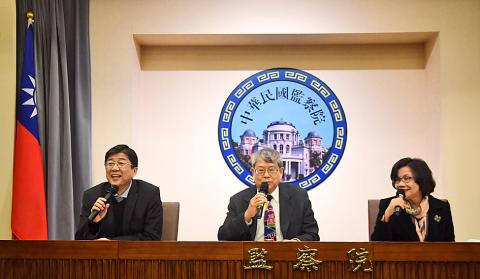
Photo: CNA
The case is to be forwarded to the Public Functionary Disciplinary Sanction Commission.
According to a statement that Next Magazine submitted to the Control Yuan, while Kuan was a professor at NTU, he made a verbal agreement with the magazine that he would write opinion pieces in return for NT$50,000 (US$1,622) per month or NT$650,000 per year, Wang Yu-ling said yesterday at a news conference in Taipei, adding that the payments totaled NT$650,000 per year, because Kuan received an additional NT$25,000 every six months.
However, Kuan’s relationship with Next Magazine continued from 2010 to 2016, which was after his invitation to join the Cabinet as minister without portfolio, she said.
Kuan continued to regularly submit opinion pieces to the magazine anonymously while serving in the Cabinet from February 2012 to February 2015, during which time he was paid NT$1.9 million, she said.
By doing so, he breached Article 14 of the act, which prohibits civil servants from taking on outside work, she said.
Civil servants are allowed to submit articles to publications, but they can only do so occasionally, Tsai said.
Kuan said in a document submitted to the Control Yuan that he only wrote for Next Magazine at the magazine’s invitation and that he had never held any position at the magazine.
The Ministry of Civil Service in 2010 ruled that providing the media with information related to a position was only legal for a civil servant when the work was unpaid, Wang Yu-ling said.
Asked to comment yesterday, Kuan said that he would explain his position after reading the Control Yuan’s decision, adding that he had not yet been officially notified.
He said he would consult with his lawyers and confirm if they had submitted his statement to the Control Yuan.
Meanwhile, Minister of Education Pan Wen-chung (潘文忠) said the ministry respects the Control Yuan’s decision.
“The case is in a preliminary stage and the ministry will not act on it until the decision passes a second review at the Public Functionary Disciplinary Sanction Commission,” he said.
Additional reporting by Ann Maxon, staff reporter

‘NO SECURITY RISK’: The Railway Bureau reassured the public that the technicians’ activities were limited to technical guidance and did not involve sensitive systems The Railway Bureau yesterday said it had invited eight Chinese technicians to assist with an airport MRT construction project. The bureau issued the confirmation after an Internet user said Chinese nationals had entered the construction zone of Taiwan Taoyuan International Airport’s Terminal 3 project. They asked why “individuals from an enemy state” were allowed access to such a major national infrastructure project, which raised serious concerns over Taiwan’s industrial safety, sensitive systems and information security. The bureau’s Northern Region Engineering Branch Office said subcontractor Taiwan Handle Industrial Co (台灣手把工業) of the Taoyuan airport MRT’s “Contract No. CU05 Project A14 Station Civil, MEP &

A US uncrewed surface vessel (USV) encountered multiple Chinese warships during an autonomous transit of the Taiwan Strait, US defense company Seasats said in a statement on Wednesday. Seasats announced that a Lightfish USV had completed the first autonomous transit of the Taiwan Strait. Over five days, the USV traversed the entire length of the Strait while constantly monitoring surface vessel traffic, the company said. The Lightfish encountered multiple Chinese warships, one of which was a Chinese People’s Liberation Army Navy (PLAN) Type 056 corvette, it said. The Chinese vessels were operating “well within Taiwan’s exclusive economic zone without transmitting their identity via the
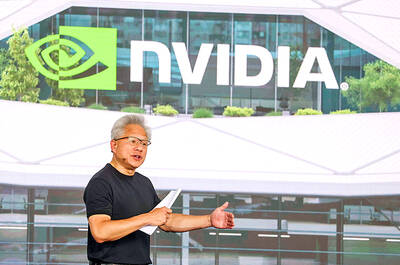
‘BOOMING’: ’ The number of partners we have here is incredible. You can see from their stock prices. They’re doing so well, they’re so happy,’ Jensen Huang said Nvidia Corp’s spending in Taiwan has ballooned to about US$150 billion a year, 10 times the US$10 billion to US$15 billion the company spent five years ago, Nvidia chief executive officer Jensen Huang (黃仁勳) said yesterday, suggesting Taiwan’s strategic importance in the global artificial intelligence (AI) supply chain. “Taiwan is the epicenter of the AI revolution. This is where the chips come, packaging comes. This is where the systems are made. This is where AI supercomputers were created,” Huang said at a meeting for the company’s employees in Beitou-Shilin Technology Park (北投士林科技園區) in Taipei, the planned site of Nvidia’s Taipei headquarters. “Taiwan
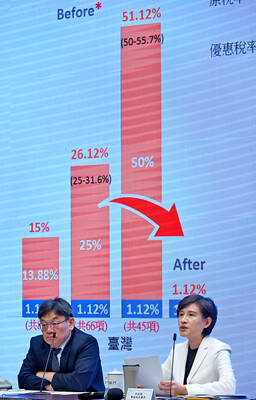
GREATER REACH? Auto parts and wood products would face tariffs of up to 15%, matching those targeting the EU, Japan and South Korea, Vice Premier said The US has announced that preferential tariff treatment for Taiwan’s non-semiconductor Section 232 goods would take effect retroactively from May 1, the Executive Yuan said yesterday. The US government yesterday posted a notice on the Federal Register’s public inspection Web site previewing tariff concessions for Taiwan under a memorandum of understanding (MOU) on Taiwan-US investment after two months of negotiations. The MOU signed on Jan. 15 stipulated three major preferential tariff arrangements: a 15 percent “reciprocal” tariff rate for Taiwan without stacking most-favored nation (MFN) rates; preferential Section 232 treatment for semiconductors and related products; and preferential Section 232 treatment for non-semiconductor


 RSS
RSS