


Chinese President Xi Jinping (習近平) yesterday issued an impassioned defense of free markets’ ability to combat economic uncertainty as he sought allies in Europe.
In a speech to lawmakers in Spain, where he is on a state visit before attending the G20 leaders’ summit in Argentina, Xi said that the world is facing “instability, uncertainty and hot topics without precedents in our history.”
“I think we are at a crossroads,” Xi said. “In economic terms, we need to decide if we are going to follow the economic globalization and free market or if we are going to choose unilateralism and protectionism.”
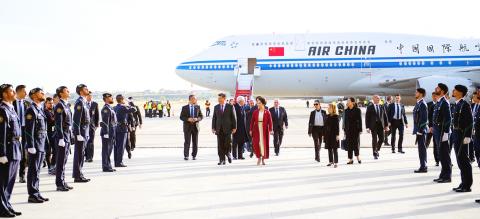
Photo: AP
Xi then called on the international community to unite and find consensus to “defend peace and prosperity in the world.”
Xi and US President Donald Trump are expected to meet for talks over dinner on Saturday in Buenos Aires.
However, Xi’s two-day visit to Spain is presenting the Chinese leader with the opportunity to charm a country that has traditionally avoided confrontation with Beijing.
Spain, which is in the middle of an uneven economic recovery from recession that is showing signs of wearing off, is also keen on getting Chinese contracts for its companies and reciprocal investment.
However, top officials said that Spain would not officially endorse Xi’s Belt and Road Initiative.
The Spanish government said it is instead interested in exploring with China joint projects in third countries, especially in Africa and Latin America.
A top official also said that Xi and Spanish Prime Minister Pedro Sanchez were to upgrade their countries’ “strategic framework relationship” to reflect Beijing’s greater influence in world affairs since the last state visit in 2005.
That move aims to respond to the uncertainty raised by trade tensions between Beijing and Washington, and a stricter EU approach to Chinese investment since the bloc’s parliament approved a new screening scheme to shield strategic sectors in its member states.
Britain’s departure from the EU also makes Spain attractive to Beijing, as the country is seen as “friendlier” than other European countries, said Mario Esteban, an expert with Spain’s Royal Elcano Institute, an official think tank.
Spain and Portugal, for example, were among the countries whose ambassadors did not back a letter by 15 Western diplomats about China’s rights record in Xinjiang.
Xi, who arrived on Tuesday afternoon in Madrid, yesterday reviewed Spain’s guard of honor with King Felipe VI, as Chinese first lady Peng Liyuan (彭麗媛) and Queen Letizia of Spain observed from a platform at the entrance of the Royal Palace in the Spanish capital.
The honors continued in Madrid’s City Hall, where Xi received golden keys to the city, and then at the Spanish Senate, where Xi said that China wants to provide wider access to foreign products, importing US$10 trillion in goods over the next five years.
“We will make efforts to streamline access to our market, improve the investment climate, increase intellectual property protection and voluntarily increase the opening to the exterior,” he said.
Xi was to meet Sanchez later yesterday, when they were to preside over the signing of about 20 government and business agreements, including a deal to export on-the-bone legs of Iberian ham to China.
Xi is to fly to Argentina today for tomorrow’s G20 leaders’ summit, after which he is to visit Panama and Portugal.

AIR SUPPORT: The Ministry of National Defense thanked the US for the delivery, adding that it was an indicator of the White House’s commitment to the Taiwan Relations Act Deputy Minister of National Defense Po Horng-huei (柏鴻輝) and Representative to the US Alexander Yui on Friday attended a delivery ceremony for the first of Taiwan’s long-awaited 66 F-16C/D Block 70 jets at a Lockheed Martin Corp factory in Greenville, South Carolina. “We are so proud to be the global home of the F-16 and to support Taiwan’s air defense capabilities,” US Representative William Timmons wrote on X, alongside a photograph of Taiwanese and US officials at the event. The F-16C/D Block 70 jets Taiwan ordered have the same capabilities as aircraft that had been upgraded to F-16Vs. The batch of Lockheed Martin

GRIDLOCK: The National Fire Agency’s Special Search and Rescue team is on standby to travel to the countries to help out with the rescue effort A powerful earthquake rocked Myanmar and neighboring Thailand yesterday, killing at least three people in Bangkok and burying dozens when a high-rise building under construction collapsed. Footage shared on social media from Myanmar’s second-largest city showed widespread destruction, raising fears that many were trapped under the rubble or killed. The magnitude 7.7 earthquake, with an epicenter near Mandalay in Myanmar, struck at midday and was followed by a strong magnitude 6.4 aftershock. The extent of death, injury and destruction — especially in Myanmar, which is embroiled in a civil war and where information is tightly controlled at the best of times —
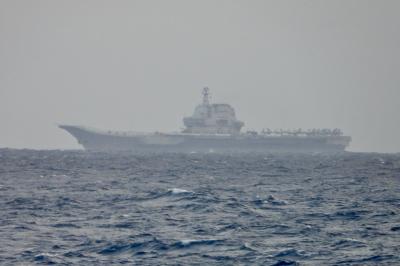
China's military today said it began joint army, navy and rocket force exercises around Taiwan to "serve as a stern warning and powerful deterrent against Taiwanese independence," calling President William Lai (賴清德) a "parasite." The exercises come after Lai called Beijing a "foreign hostile force" last month. More than 10 Chinese military ships approached close to Taiwan's 24 nautical mile (44.4km) contiguous zone this morning and Taiwan sent its own warships to respond, two senior Taiwanese officials said. Taiwan has not yet detected any live fire by the Chinese military so far, one of the officials said. The drills took place after US Secretary

THUGGISH BEHAVIOR: Encouraging people to report independence supporters is another intimidation tactic that threatens cross-strait peace, the state department said China setting up an online system for reporting “Taiwanese independence” advocates is an “irresponsible and reprehensible” act, a US government spokesperson said on Friday. “China’s call for private individuals to report on alleged ‘persecution or suppression’ by supposed ‘Taiwan independence henchmen and accomplices’ is irresponsible and reprehensible,” an unnamed US Department of State spokesperson told the Central News Agency in an e-mail. The move is part of Beijing’s “intimidation campaign” against Taiwan and its supporters, and is “threatening free speech around the world, destabilizing the Indo-Pacific region, and deliberately eroding the cross-strait status quo,” the spokesperson said. The Chinese Communist Party’s “threats


 RSS
RSS