


The Tourism Bureau is assessing the feasibility of capping the number of people allowed to visit Orchid Island (Lanyu, 蘭嶼), Green Island (綠島) and Siaoliouciou Island (小琉球), Director-General Chou Yung-hui (周永暉) said.
“Between ecological conservation and tourism, society has gradually adopted the concept of a tourism cap,” Chou said, adding that the bureau hopes to find a balance between tourism development and the quality of tourism.
As people become more environmentally conscious, an increasing number of popular travel destinations have seen local residents call for limits on the number of tourists in their areas.
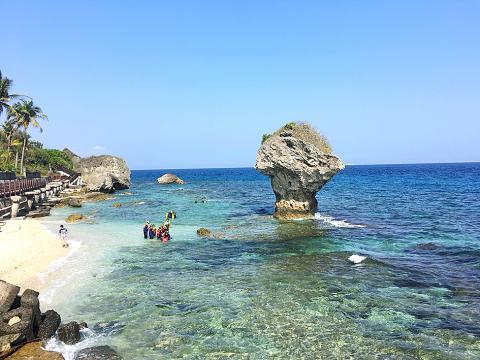
Photo: Hsiao Yu-hsin, Taipei Times
On Orchid Island, where tourism — and consequently the amount of trash — surges during the summer, residents first proposed capping the number of visitors two to three years ago.
Siaoliouciou Island, which had more than 1 million visitors last year and has seen its intertidal zone damaged, is scheduled to host a panel for local residents this month to discuss a tourism cap.
Turtle Island (Gueishan Island, 龜山島), Yehliu Geopark (野柳地質公園) in New Taipei City, and Kinmen County’s Dadan Island (大膽島) and Lieyu Township (烈嶼) have already adopted such caps, Chou said.
The bureau is now considering other areas and will discuss caps on islands with the public at the Modern Tourism Forum, he said.
During its peak tourism season last year, Siaoliouciou Island broke its daily water usage record of 6,000 tonnes, while surges in electricity usage led to a power outage on parts of the island, said Chen Wen-yu (陳文玉), the director of a tourism association on the island.
There should be a cap on the number of tourists and visitor activities should also be spread out instead of concentrating in the intertidal zone, Chen said.
Introducing a cap for Siaoliouciou could lead to protests because not many people visit the island on weekdays and tourism is largely concentrated on weekends or holidays, Liouciou Fishermen’s Association chief executive Tsai Pao-hsing (蔡寶興) said.
Now that Siaoliouciou Island has become a prime tourist attraction, the government should reassess its plans for land use and reduce the amount of farmland on the island, he added.
Lanyu Township Representative Council Chairman Chang chin-shang (張錦商) said he backs the idea of a cap, but also believes there should be supplementary measures and communication between the tourism industry and local representatives.
Many visitors to Orchid Island generate large of amounts of trash and disturb the environment, and the island cannot sustain such practices, he said.
Some day-trippers use the public restrooms, leave their trash and depart without spending any money on the island, he said, adding that if a cap is introduced, he hopes it would promote two-night stays on the island.
Lyudao Township Representative Council Chairman Ho Fu-hsiang (何富祥) said the number of visitors to Green Island has dramatically increased in the past three to five years.
If a cap is introduced in the summer, the peak tourism season, and no one visits in the winter, the policy would be criticized by island residents, he said.
The bureau should disclose its basis for evaluating the feasibility of a cap and protect legal hotels and guest houses instead of allowing the continued construction of illegal guest houses, he said.
The bureau has also tried to curb overcrowding by encouraging people to visit popular areas at different times throughout the day, Chou said.
For example, last month it allowed nighttime visits to Yehliu Geopark’s “Queen’s Head” (女王頭) for the first time, he said.
Additional reporting by Yeh Yung-chien

Tropical Storm Gaemi strengthened into a typhoon at 2pm yesterday, and could make landfall in Yilan County tomorrow, the Central Weather Administration (CWA) said yesterday. The agency was scheduled to issue a sea warning at 11:30pm yesterday, and could issue a land warning later today. Gaemi was moving north-northwest at 4kph, carrying maximum sustained winds near its center of up to 118.8kph and gusts of 154.8kph. The circumference is forecast to reach eastern Taiwan tomorrow morning, with the center making landfall in Yilan County later that night before departing from the north coast, CWA weather forecaster Kuan Shin-ping (官欣平) said yesterday. Uncertainty remains and

SEA WARNING LIKELY: The storm, named Gaemi, could become a moderate typhoon on Wednesday or Thursday, with the Taipei City Government preparing for flooding A tropical depression east of the Philippines developed into a tropical storm named Gaemi at 2pm yesterday, and was moving toward eastern Taiwan, the Central Weather Administration (CWA) said. Gaemi could begin to affect Taiwan proper on Tuesday, lasting until Friday, and could develop into a moderate typhoon on Wednesday or Thursday, it said. A sea warning for Gaemi could be issued as early as Tuesday morning, it added. Gaemi, the third tropical storm in the Pacific Ocean this typhoon season, is projected to begin moving northwest today, and be closest to Taiwan on Wednesday or Thursday, the agency said. Today, there would likely

DISRUPTIONS: The high-speed rail is to operate as normal, while several airlines either canceled flights or announced early departures or late arrivals Schools and offices in 15 cities and counties are to be closed today due to Typhoon Gaemi, local governments announced last night. The 15 are: Taipei, New Taipei City, Taoyuan, Tainan, Keelung, Hsinchu and Kaohsiung, as well as Yilan, Hualien, Hsinchu, Miaoli, Chiayi, Pingtung, Penghu and Lienchiang counties. People should brace for torrential rainfall brought by the storm, with its center forecast to make landfall on the east coast between tonight and tomorrow morning, the Central Weather Administration (CWA) said. The agency issued a sea warning for the typhoon at 11:30pm on Monday, followed by a land warning at 11:30am yesterday. As of

CASUALTY: A 70-year-old woman was killed by a falling tree in Kaohsiung as the premier warned all government agencies to remain on high alert for the next 24 hours Schools and offices nationwide are to be closed for a second day today as Typhoon Gaemi crosses over the nation, bringing torrential rain and whipping winds. Gaemi was forecast to make landfall late last night. From Tuesday night, its outer band brought substantial rainfall and strong winds to the nation. As of 6:15pm last night, the typhoon’s center was 20km southeast of Hualien County, Central Weather Administration (CWA) data showed. It was moving at 19kph and had a radius of 250km. As of 3pm yesterday, one woman had died, while 58 people were injured, the Central Emergency Operation Center said. The 70-year-old


 RSS
RSS