


The next installment of the annual Han Kuang military exercise is to reflect the military’s doctrinal shift from annihilation of the enemy to prevention of victory for the aggressor, a military official said yesterday.
The 34th Han Kuang exercise is to consist of a computer-assisted military simulation from Monday to Friday next week, as well as live-fire drills from July 4 to July 8, the general staff’s Chief of Joint Operations Major General Yeh Kuo-hui (葉國煇) told a news conference in Taipei.
The computer-assisted drill is designed to examine the soundness of the military’s Ku An operation plan and its success is not contingent on achieving victory, he said, adding that this would be a departure from past practice.
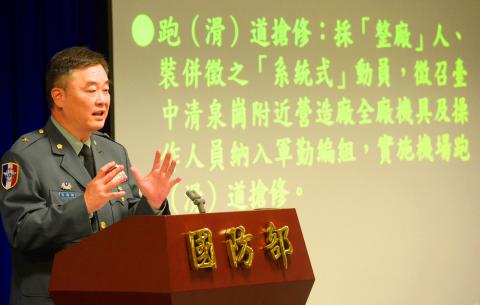
Photo: Chang Chia-ming, Taipei Times
The live-fire portion is to emphasize realism, mobilization of civilian assets, augmentation of the military’s reserve capabilities, combat under degraded command and control capabilities, and integration of the annual Wan An air raid drill, Yeh said.
For some portions of live-fire exercise, civilian assets — including Chunghwa Telecom Co (CHT, 中華電信), industries near the Ching Chuan Kang Air Base in Taichung and civilian drone operators — would be incorporated, he said.
Civilian organizations are to assist in tasks such as maintaining communication channels with cell sites, repairing damaged runways, battlefield imaging and information management, he said.
The growing gap in military resources between Taiwan and China has made the military’s traditional doctrine of emphasizing the destruction of enemy forces “not suited for the times and unachievable,” a Ministry of National Defense official said on condition of anonymity.
The live-fire drills are to involve mock air, sea and land battles during the day and night, with military units assuming attacking and defending roles, the official said.
The mock battles are intended to portray the asymmetric warfare conditions that the military believes to most realistically simulate a war with China, so it is reorienting its strategy toward preventing China’s People’s Liberation Army from conquering Taiwan, he said.
The doctrine — which had previously been elaborated by military officers — is now the guiding principle for building the armed forces, he said.
The focus on asymmetric warfare is to result in an increased emphasis on mobility, and distributing capabilities geographically and systematically to mitigate vulnerability from targeted strikes, he said.
In arms procurement, it signals a preference for weapons that prioritize efficiency, survivability, precision-strike capabilities and quality over quantity, he said.
The doctrine might favor the procurement of fast and stealthy systems that are compatible with swarm tactics, including rapid mine deployment-capable minelayers, submarines, guided missile attack boats, mobile air-defense systems, mobile anti-armor platforms, precision guided munition-firing tube artillery and self-propelled multiple launch rocket systems, he said.
The exercise’s arrangement shows that the military intends to distribute its systems and build up reserves by commandeering civilian drone resources, he said.

Tropical Storm Gaemi strengthened into a typhoon at 2pm yesterday, and could make landfall in Yilan County tomorrow, the Central Weather Administration (CWA) said yesterday. The agency was scheduled to issue a sea warning at 11:30pm yesterday, and could issue a land warning later today. Gaemi was moving north-northwest at 4kph, carrying maximum sustained winds near its center of up to 118.8kph and gusts of 154.8kph. The circumference is forecast to reach eastern Taiwan tomorrow morning, with the center making landfall in Yilan County later that night before departing from the north coast, CWA weather forecaster Kuan Shin-ping (官欣平) said yesterday. Uncertainty remains and

SEA WARNING LIKELY: The storm, named Gaemi, could become a moderate typhoon on Wednesday or Thursday, with the Taipei City Government preparing for flooding A tropical depression east of the Philippines developed into a tropical storm named Gaemi at 2pm yesterday, and was moving toward eastern Taiwan, the Central Weather Administration (CWA) said. Gaemi could begin to affect Taiwan proper on Tuesday, lasting until Friday, and could develop into a moderate typhoon on Wednesday or Thursday, it said. A sea warning for Gaemi could be issued as early as Tuesday morning, it added. Gaemi, the third tropical storm in the Pacific Ocean this typhoon season, is projected to begin moving northwest today, and be closest to Taiwan on Wednesday or Thursday, the agency said. Today, there would likely

DISRUPTIONS: The high-speed rail is to operate as normal, while several airlines either canceled flights or announced early departures or late arrivals Schools and offices in 15 cities and counties are to be closed today due to Typhoon Gaemi, local governments announced last night. The 15 are: Taipei, New Taipei City, Taoyuan, Tainan, Keelung, Hsinchu and Kaohsiung, as well as Yilan, Hualien, Hsinchu, Miaoli, Chiayi, Pingtung, Penghu and Lienchiang counties. People should brace for torrential rainfall brought by the storm, with its center forecast to make landfall on the east coast between tonight and tomorrow morning, the Central Weather Administration (CWA) said. The agency issued a sea warning for the typhoon at 11:30pm on Monday, followed by a land warning at 11:30am yesterday. As of

CASUALTY: A 70-year-old woman was killed by a falling tree in Kaohsiung as the premier warned all government agencies to remain on high alert for the next 24 hours Schools and offices nationwide are to be closed for a second day today as Typhoon Gaemi crosses over the nation, bringing torrential rain and whipping winds. Gaemi was forecast to make landfall late last night. From Tuesday night, its outer band brought substantial rainfall and strong winds to the nation. As of 6:15pm last night, the typhoon’s center was 20km southeast of Hualien County, Central Weather Administration (CWA) data showed. It was moving at 19kph and had a radius of 250km. As of 3pm yesterday, one woman had died, while 58 people were injured, the Central Emergency Operation Center said. The 70-year-old


 RSS
RSS