


About 100 parents last night attended Taipei European School’s (TES) Swire European Secondary Campus for a tense meeting to learn why two of the school’s popular administrators, Stuart Glascott and Peter Sloan, were fired on Tuesday by school chief executive David Gatley, exposing deep fissures in the way the school is run.
In a letter addressed to parents on Tuesday, Gatley wrote that Glascott and Sloan were no longer heads of the British secondary and primary sections respectively, and that over the years the school has “suffered from an unhealthy atmosphere.”
“As a consequence of manipulation there has been many unverified rumors circulating around the school. There have also been many intentional miscommunications that lead me to these conclusions,” Gatley said in the letter.
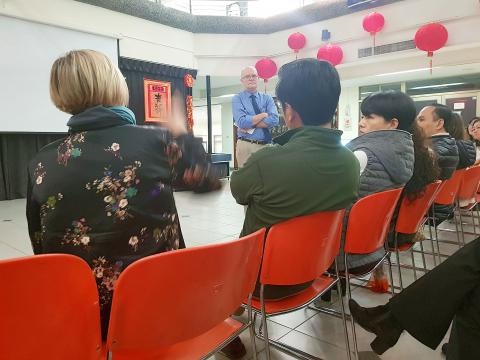
Photo: Noah Buchan, Taipei Times
However, last night Gatley refused to detail the precise reasons why the two administrators were let go, angering parents who expressed outrage that they were not told of the firing before it happened.
As parents lobbed questions at Gatley, it became apparent that he was not going to answer.
When questioned about the legality of the firings, Gatley had difficulty answering questions about labor laws and the school’s constitution.
“What a spectacular failure by TES’ ‘interim’ CEO [chief executive officer] to provide any answers today,” wrote Stephane Riverain on the school’s Facebook forum. “It’s infuriating to see that not a single member of the board of directors even had the decency to show up for the meeting ... when all the parents had to make special arrangements to be there at short notice.”
The crux of the matter revolves around the status of the school. The German and French sections only received accreditation from their home country’s education agencies if parents are at the center of the school’s decisionmaking regarding hiring and budget.
In the past, elected parent representatives would make recommendations to the board, which approved or not.
The dismissal of the two administrators was reportedly the tip of the iceberg in a series of decisions that excluded elected parents from decisions affecting the school.
The decision follows administrative changes to the school that the board of directors tried to opaquely implement in July last year. The changes were later rejected by the Taipei Bureau of Education and put on hold after some parents sent a letter to the bureau to denounce the board’s decision to unilaterally change the TES’ constitution without approval from parents.
The parents had accidentally learned about the changes and repeatedly requested clarification from board chairman C.V. Chen (陳長文), a former Straits Exchange Foundation secretary-general.
The letter was signed by 133 parents.
According to the school’s constitution, any changes to the constitution has to include the parent’s approval through a general assembly meeting, which the board of directors did not hold.
The letter did not have the effect that the authors had hoped and no resolution was reached.
Last month, in response to the board’s intransigence a petition that was signed by 606 parents and sent to the bureau demanding that the board of directors comply with the school’s constitution and Taiwanese law.
Although Gatley refused to tell parents why Sloan and Glascott were fired, most parents believe it is related to a dispute between parents and the board of directors.
“The lack of transparency does not help this whole situation. We teach children that they have to be honest and transparent, but the school does not display this characteristic,” said Anna Durmus, a parent who attended the meetings.
“I believe that parent’s opinions [are being] ignored by the present administration and while we have no issues with our section heads ... the whole situation creates distress and I’m not sure [the CEO] is in the position to run for a permanent CEO position for this school,” Durmus said.
Gatley told parents that he would meet with the board of directors tomorrow and ask them to talk directly to the parents about the firings and the future direction of the school.

Japan has deployed long-range missiles in a southwestern region near China, the Japanese defense minister said yesterday, at a time when ties with Beijing are at their lowest in recent years. The missiles were installed in Kumamoto in the southern region of Kyushu, as Japan is attempting to shore up its military capacity as China steps up naval activity in the East China Sea. “Standoff defense capabilities enable us to counter the threat of enemy forces attempting to invade our country ... while ensuring the safety of our personnel,” Japanese Minister of Defense Shinjiro Koizumi said. “This is an extremely important initiative for
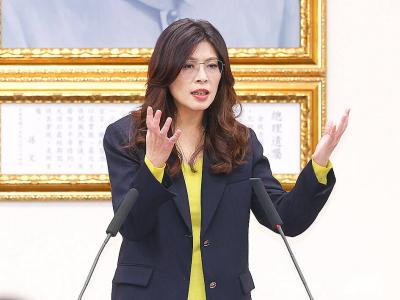
Chinese Nationalist Party (KMT) Chairwoman Cheng Li-wun (鄭麗文) today accepted an invitation from Chinese President Xi Jinping (習近平) to lead a delegation to China next month, saying she hopes to promote the peaceful development of cross-strait relations and bring stability to the Taiwan Strait. “I am grateful and happy to accept this invitation,” Cheng said in a statement from the KMT chairperson’s office. Cheng said she hopes both sides can work together to promote the peaceful development of cross-strait relations, enhance exchange and cooperation, bring stability to the Taiwan Strait and improve people’s livelihoods. At today's news conference, Cheng said any efforts to

MORE POPULAR: Taiwan Pass sales increased by 59 percent during the first quarter compared with the same period last year, the Tourism Administration said The Tourism Administration yesterday said that it has streamlined the Taiwan Pass, with two versions available for purchase beginning today. The tourism agency has made the pass available to international tourists since 2024, allowing them to access the high-speed rail, Taiwan Railway Corp services, four MRT systems and four Taiwan Tourist Shuttles. Previously, five types of Taiwan Pass were available, but some tourists have said that the offerings were too complicated. The agency said only two types of Taiwan Pass would be available, starting from a three-day pass with the high-speed rail and a three-day pass with Taiwan Railway Corp. The former costs NT$2,800

The nation’s fastest supercomputer, Nano 4 (晶創26), is scheduled to be launched in the third quarter, and would be used to train large language models in finance and national defense sectors, the National Center for High-Performance Computing (NCHC) said. The supercomputer, which would operate at about 86.05 petaflops, is being tested at a new cloud computing center in the Southern Taiwan Science Park in Tainan. The exterior of the server cabinet features chip circuitry patterns overlaid with a map of Taiwan, highlighting the nation’s central position in the semiconductor industry. The center also houses Taiwania 2, Taiwania 3, Forerunner 1 and


 RSS
RSS